📖 Read more: Centenarian Blood Reveals 5 Longevity Proteins
🧬 A Puzzle That Needed Solving
In molecular biology, there had been an unexplained phenomenon for decades: certain genetic mutations that should have completely deactivated a gene caused little or no symptoms in patients. How was it possible for a cell to function normally when its critical genes were damaged?
The answer came from a team of researchers led by Jonathan Weissman, a member of the Whitehead Institute for Biomedical Research and professor of biology at MIT. The team, with postdoctoral researcher Mohamed El-Brolosy as first author, identified that cells are not merely passive recipients of mutations — they possess a sophisticated compensation system, far more regulated than anyone had believed.
Researchers already knew — from studies in 2019 — that cells can activate similar genes as “backups” when a gene stops functioning. This is called “transcriptional adaptation.” However, no one had understood the mechanism linking mRNA degradation in the cytoplasm to gene activation in the nucleus — two entirely separate compartments of the cell.
🔬 The Key Protein: ILF3
The research team began with a gene known to activate compensatory responses. Using the method of systematic gene silencing, one by one, they searched for which molecular factors were involved in the process.
The critical discovery: a protein called ILF3 (Interleukin Enhancer-Binding Factor 3). When the gene encoding ILF3 was deactivated, cells failed to activate backup genes after degradation of defective mRNA. ILF3 proved to be the “messenger” between the cytoplasm and the nucleus.
🔑 How the Mechanism Works
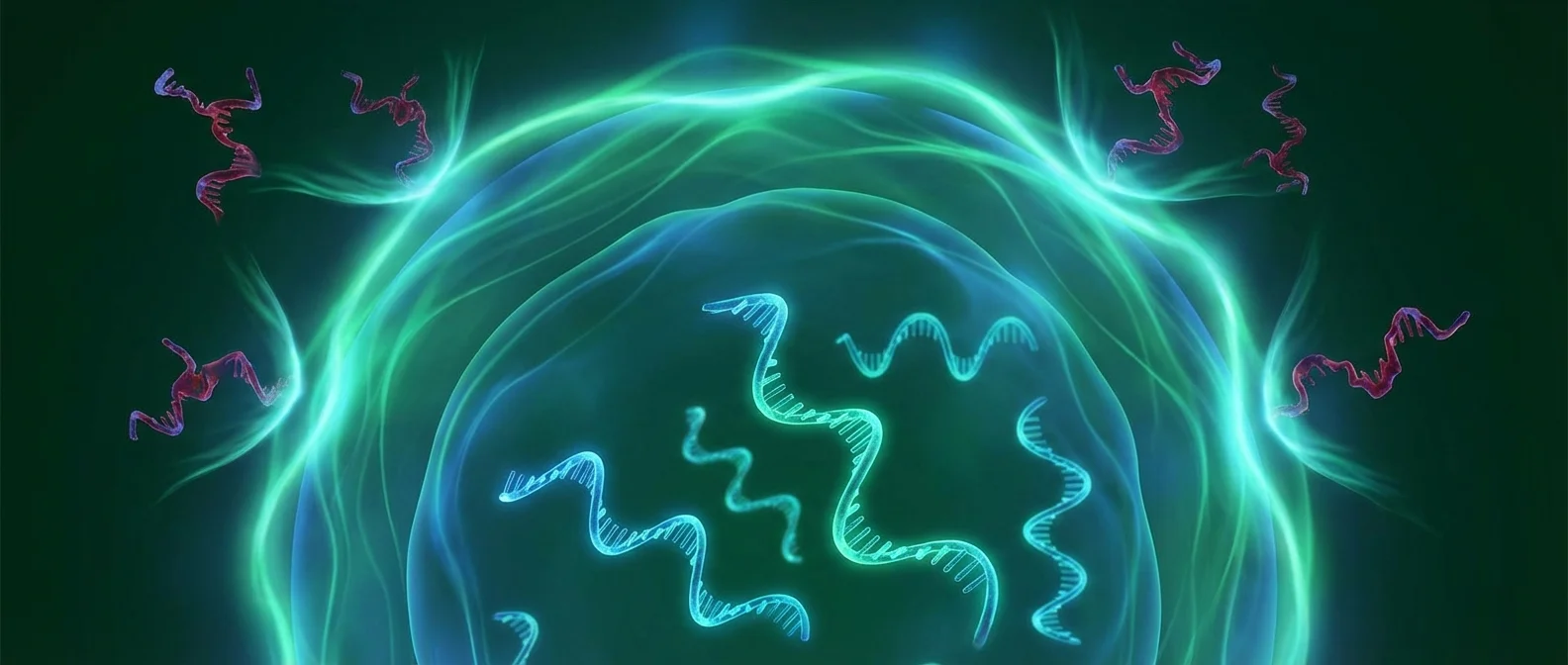
When defective mRNA is degraded in the cytoplasm, it doesn't disappear completely. It leaves behind small RNA fragments bearing a specific sequence — like a “mailing address.” The ILF3 protein recognizes these fragments, binds them, and transports them to the nucleus, where it locates backup genes with a similar sequence. In this way, it activates genes capable of taking over the lost functions.
📖 Read more: Hidden Geometry Bends Electrons Like Gravity
📬 RNA Fragments as Molecular Addresses
The most remarkable aspect of the discovery concerns how cells “know” which backup genes to activate. The small RNA fragments remaining after degradation of defective mRNA contain sequences that function as encoded “addresses.” These sequences direct ILF3 exclusively to genes that share a similar structure with the damaged gene.
To prove this, the researchers introduced mutations into the “address” sequence of the fragments. The result was revealing: the cell's compensatory response decreased dramatically. This confirmed that the system relies on precise sequence matching — it's not a random stress reaction, but a regulated biological system.
"This was extremely exciting for us. It showed us that this isn't a general stress response. It's a regulated system."
📊 The Data in Numbers
📖 Read more: New Perovskite Solar Cell Produced Without Toxic Solvents
🧪 A Second Field: Cellular Defense Against Foreign mRNA
The Whitehead Institute discovery concerns an endogenous protection system — how cells protect themselves from their own mutations. However, researchers now also know that cells have defense mechanisms against external mRNA as well.
An equally important study from the Institute for Basic Science in South Korea, led by Dr. Kim V. Narry, revealed the role of the TRIM25 protein, which detects and destroys foreign mRNA entering cells — such as mRNA from vaccines. The discovery that the N1-methylpseudouridine (m1Ψ) modification, for which the 2023 Nobel Prize in Physiology was awarded, helps mRNA vaccines evade this defense, explains why the COVID-19 vaccines were so effective.
These discoveries sketch an impressively multilayered system: cells are protected both from internal damage (compensating for mutations) and from external threats (destroying foreign mRNA). Understanding both aspects is critical for the future of RNA-based therapies.
💊 Therapeutic Prospects
The therapeutic potential of this discovery is enormous. If scientists can control this compensation mechanism, they could theoretically selectively enhance backup genes in patients with genetic diseases, without needing gene therapy or CRISPR editing. Instead of “fixing” the damaged gene, a healthy copy already present in the genome would be activated.
Beyond monogenic diseases, the research has implications for designing next-generation mRNA vaccines. Understanding both the internal compensation mechanism and cellular defense against foreign mRNA could lead to therapies that exploit both systems simultaneously.
The research team notes that this work characterizes a previously mysterious level of gene regulation. The compensation system was not something cells “learned” — it is built into their evolutionary architecture, likely millions of years before humans even discovered DNA.
🌍 The Broader Impact
The discovery that cells use fragments of degraded mRNA as signals to activate backup genes represents a new chapter in molecular biology. It changes the way we understand mutations: they are not always catastrophic, because cells have evolved self-repair mechanisms more sophisticated than we ever imagined.
At the same time, understanding how cells recognize and respond to foreign mRNA — through proteins like TRIM25 — opens pathways for more effective vaccines, gene therapies, and RNA-based drugs. We are living in an era where RNA biology is revealing, one by one, the deepest secrets of cellular life.
📎 Sources
- 🔗 Phys.org — mRNA fragments reveal a hidden process that protects cells from harmful mutations
- 🔗 Science — Mechanisms linking cytoplasmic decay of translation-defective mRNA to transcriptional adaptation (El-Brolosy et al., 2026)
- 🔗 ScienceDaily — Cellular regulator of mRNA vaccine revealed
- 🔗 Live Science — What are mRNA vaccines, and how do they work?