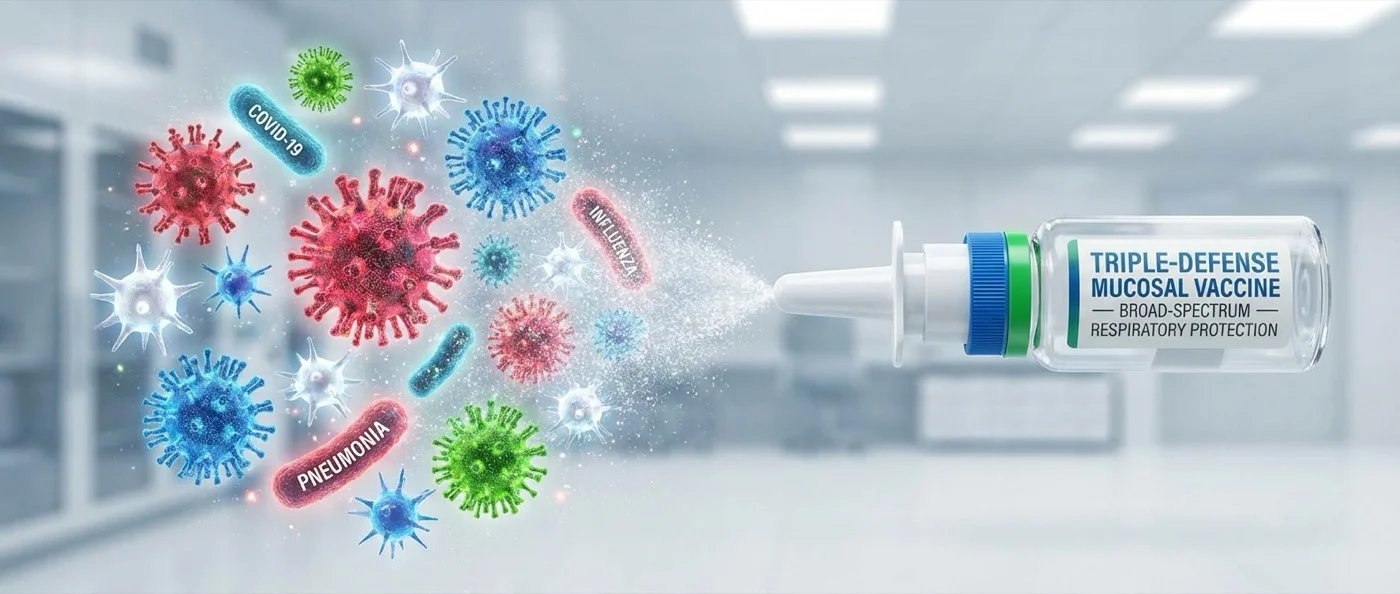
Scientists at Stanford Medicine have developed a nasal spray vaccine that, in mouse trials, simultaneously protected against SARS-CoV-2, other coronaviruses, antibiotic-resistant bacteria, and even house dust mite allergens. The technology keeps the innate immune system on high alert for over three months — far longer than previously thought possible — while also accelerating the adaptive immune response from two weeks down to three days.
🦠 The Problem With Current Respiratory Vaccines
Every autumn brings the same challenge: flu shots, COVID boosters, RSV vaccines — each targeting a single pathogen, each fading within months. The global health community has long sought a “universal” respiratory vaccine: one that protects broadly across multiple threats without requiring annual reformulation.
That goal has been elusive because the immune system's two main branches — innate immunity (the fast, non-specific first line of defense) and adaptive immunity (the slower, targeted memory response) — normally don't cooperate efficiently enough or long enough to cover multiple threats simultaneously. Stanford immunologist Bali Pulendran and his team set out to change that.
💉 The GLA-3M-052-LS+OVA Formulation
The vaccine combines two next-generation adjuvants — GLA and 3M-052-LS — that stimulate Toll-like receptors (TLRs), the molecular sensors of the innate immune system. Paired with the antigen OVA, which directs T cells into the lungs, the combination achieves something remarkable: it keeps innate immunity active for 3+ months while enabling adaptive responses within 3 days — creating a sustained, broad-spectrum immune readiness.
🔬 How It Works — The Science Behind the Spray
The human immune system operates in two "speeds": innate immunity responds immediately but normally lasts only days before quieting down. Adaptive immunity — which builds antibodies and memory T cells — takes one to two weeks to fully activate. This gap is precisely when viruses have room to multiply.
Lead researcher Haibo Zhang and colleagues discovered that the GLA+3M-052-LS adjuvant combination keeps monocytes and macrophages — key innate immune cells — in a heightened state for more than three months. At the same time, the OVA antigen trains the adaptive system to respond within three days instead of two weeks: a 4.5x acceleration in immune memory deployment.
What makes the vaccine particularly notable is its breadth of protection. Tests showed efficacy not just against SARS-CoV-2 but also against Staphylococcus aureus (a dangerous hospital pathogen) and Acinetobacter baumannii (a notorious antibiotic-resistant bacterium). In separate experiments, the nasal spray also reduced allergic inflammation triggered by house dust mite allergens — extending the technology's relevance well beyond infectious disease.
🐭 Animal Trial Results — Striking Efficacy
After receiving three doses of the nasal vaccine, all immunized mice survived lethal exposure to SARS-CoV-2. Unvaccinated control mice died. Lung viral load measurements showed a 700-fold reduction in vaccinated animals — an extraordinary margin of protection by any standard.
Crucially, protection was not limited to the exact SARS-CoV-2 strain used in training. The vaccine conferred cross-protection against other coronaviruses — suggesting that the immune readiness it generates is broad and non-strain-specific. This is precisely the quality a “universal” vaccine needs to work against future variants or entirely new respiratory pathogens.
In bacterial challenge experiments, vaccinated mice showed markedly reduced bacterial dissemination and systemic infection. The allergen trials demonstrated reduced airway inflammation. The convergence of results across such different types of threats points to a fundamental reprogramming of innate immune responsiveness — not just a targeted antibody boost.
"Imagine getting a nasal spray in the fall that protects you from all respiratory viruses, bacteria — even allergens."
— Bali Pulendran, Professor of Microbiology & Immunology, Stanford Medicine🧪 The TLR Technology — Why It Matters
Toll-like receptors (TLRs) are proteins that recognize molecular patterns shared by many pathogens — viruses, bacteria, fungi. When activated, they signal innate immune cells to attack immediately. The problem: this activation normally “switches off” within days to prevent chronic inflammation.
Stanford's innovation lies in finding the right adjuvant combination that keeps TLRs in a sustained but controlled state of readiness for months without causing pathological inflammation. This balance — “active enough but regulated” — was the key breakthrough. Earlier attempts to harness TLR stimulation for vaccines often caused toxicity from over-activation. The GLA+3M-052-LS combination appears to solve this.
Delivery via the nasal route also provides strategic advantages. The nose and upper airways are the primary entry point for most respiratory pathogens. A mucosal vaccine creates immunity exactly where viruses first invade — in the epithelial lining — rather than only in the bloodstream as injected vaccines do.
⏳ The Road to Clinical Use
Results were published in Science on February 23, 2026. The team — involving collaborators from Emory University, UNC Chapel Hill, Utah State University, and the University of Arizona — is now seeking approval to begin a Phase I safety trial in humans. NIH grant AI167966 is already funding the research.
Pulendran estimates 5–7 years before the technology could become an approved vaccine — a relatively fast timeline given that the mechanism of action is well understood. The team is also exploring whether the same formulation could be adapted for injection, potentially extending applications to pathogens that don't enter through the respiratory tract.
🌐 Why This Matters for Global Health
The COVID-19 pandemic exposed how vulnerable the world is to novel respiratory pathogens when no pre-existing vaccine exists. A broad-spectrum nasal vaccine that doesn't depend on knowing the specific strain in advance could serve as the world's first true pandemic preparedness tool — a pre-loaded immune shield ready for the next respiratory threat, whatever form it takes.