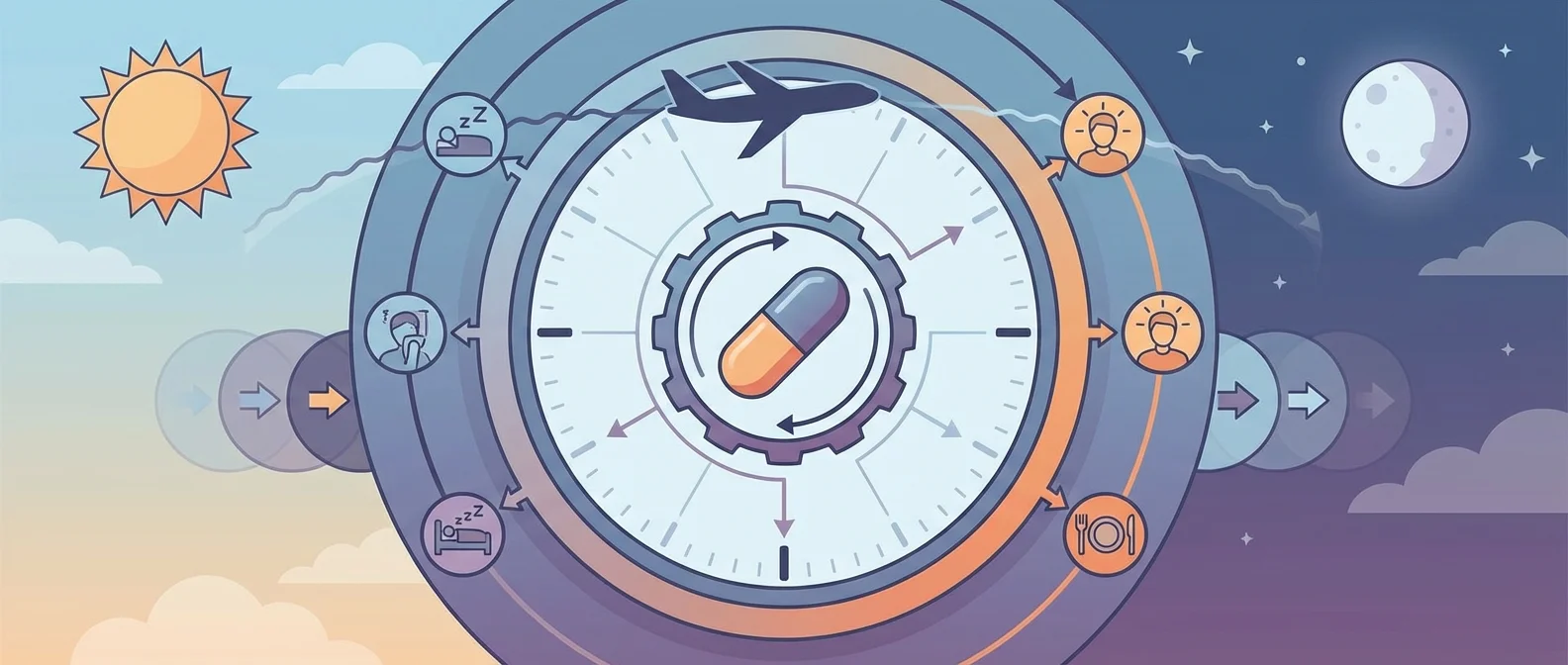
Anyone who has traveled eastward knows the nightmare of jet lag — days of insomnia, brain fog, and disorientation. Researchers from Kanazawa University in Japan discovered a compound that reduces recovery time by nearly half, resetting the internal clock with unprecedented reliability. The study was published in PNAS.
📖 Read more: 95-Million-Year-Old Spinosaurus: New Sahara Desert Discovery
⏰ The Problem with the Biological Clock
Our body runs on internal clocks — circadian rhythms — that regulate sleep, digestion, hormones, and mood. The master clock is located in the suprachiasmatic nucleus (SCN) of the brain, but every organ has its own. When we travel eastward, all clocks need to advance forward — something problematic for human biology.
Current approaches — melatonin, light exposure — depend on very precise timing and often produce inconsistent results. If you take melatonin at the wrong time, you might actually make things worse.
🔬 Mic-628: How It Works
The team of Professor Emeritus Hajime Tei (Kanazawa University), in collaboration with Yoshifumi Takahata (Osaka University), Rika Numano (Toyohashi University), and Koichiro Uriu (Institute of Science Tokyo), discovered the compound Mic-628.
Mic-628 binds to the CRY1 (cryptochrome 1) protein, which normally suppresses clock genes. This interaction forms a molecular complex (CLOCK-BMAL1-CRY1-Mic-628) that activates the Per1 gene — a key gene that regulates daily biological rhythms in mammals.
The Key: Consistent Advancement
Mic-628 advances the clock forward in a steady, predictable manner regardless of when it is administered. This is fundamentally different from melatonin, which must be taken at a very specific time. Furthermore, it simultaneously synchronizes the master clock in the brain and the clocks in other organs, such as the lungs.
📖 Read more: Bacterial Sugar: A New Weapon Against Superbugs
✈️ The Results
In mice subjected to a jet lag simulation (advancing the light-dark cycle by 6 hours), a single oral dose of Mic-628 reduced recovery time from 7 days to 4. Mathematical analysis showed that the consistent advancement is due to a built-in feedback loop of the PER1 protein that stabilizes the shift.
📖 Read more: Diamonds Have Ice-Like Water Layers at Room Temperature
💡 Beyond Travelers
Jet lag doesn't only affect travelers. Millions of shift workers experience chronic circadian disruption, with increased risk of heart disease, diabetes, and depression. A drug that reliably resets the biological clock would be a “smart drug” for everyone struggling with circadian rhythm disorders.
The researchers are planning further safety trials in animals and humans. Given that Mic-628 advances the clock through a clear biological pathway, it could become the first truly effective drug against jet lag.