📖 Read more: Elephant Whiskers: Embodied Intelligence of Touch
🌿 What Is Thigmomorphogenesis
The word thigmomorphogenesis comes from the Greek roots “thigma” (touch), “morphe” (form), and “genesis” (origin). It describes a phenomenon known for decades but poorly understood until recently: plants that receive mechanical stimuli — touch, bending, vibration, even raindrops — radically alter their morphology and biochemistry. They grow shorter, develop thicker stems, strengthen their cell walls, and flower later.
Charles Darwin was among the first to observe that plants respond to touch. However, the molecular basis of this reaction remained a mystery for more than 30 years — until two critical studies shed light on the mechanism behind this spectacular adaptation.
🔬 The Discovery at Lund University
In May 2022, researchers at Lund University in Sweden published in the scientific journal Science Advances a study that solves a three-decade-old genetic mystery. The team, led by biologists Olivier Van Aken and Essam Darwish, used the plant Arabidopsis thaliana — a small weed that serves as the “lab mouse” of plant biology — as their experimental model.
"We exposed the plant to gentle brushing, after which thousands of genes were activated and stress hormones were released," Van Aken explained. “We then used genetic screening to find the genes responsible for this process.”
The team identified six genes that play a crucial role in the touch response, divided into two distinct signaling pathways. Three genes belonged to the already known jasmonic acid pathway — a plant hormone that mediates touch signaling. The remaining three revealed an entirely new pathway, controlled by the CAMTA3 protein, which functions in a complementary manner.
🧬 Why It Matters
The discovery of two parallel touch signaling pathways — jasmonic acid (JA) and CAMTA3 — means that plants have a dual safety system. If one pathway fails, the second can take over the defense. This explains why mechanical stimulation so dramatically enhances resilience: it doesn't just activate a single response, but an entire network of defense mechanisms. This knowledge opens the door to creating climate-change-resistant crops without chemical pesticides.
"Our results solve a scientific mystery that had resisted molecular biologists worldwide for 30 years," Darwish stated. "We identified an entirely new signaling pathway that controls the plant's response to physical contact and touch."
🤝 Plants That Touch Each Other: A Communication Network
If the Lund discovery revealed the mechanism, a more recent 2025 study from the University of Missouri revealed something even more remarkable: plants that touch each other form biological signaling networks, collectively increasing their stress resistance.
Plant biologist Ron Mittler and his team placed Arabidopsis plants in two groups: one where leaves touched each other and one with plants in isolation. They then exposed them to intense light — a common environmental stressor. The results were striking: the touching plants showed significantly lower ion leakage (a sign of cellular damage) and lower accumulation of anthocyanin — a pigment that indicates stress.
"We demonstrated that if plants touch each other, they are more resilient to light stress," Mittler explained. "If you stimulate or press one plant, it sends a signal to all the other plants it touches, and they all become more tolerant."
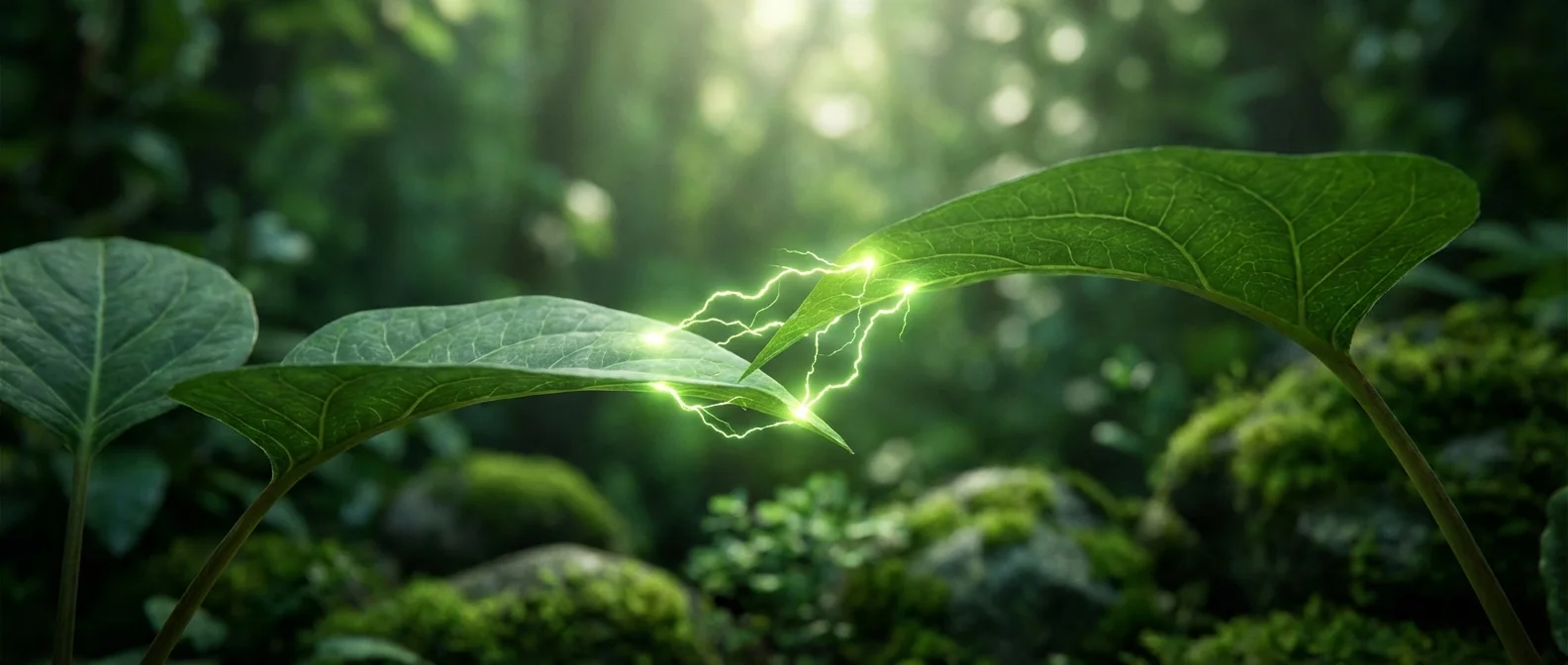
To understand the mechanism, the researchers used genetically modified plants in a chain of three: transmitter — relay — receiver. By replacing the relay with mutant plants unable to transmit chemical signals, the receiver lost its protection. This revealed that hydrogen peroxide (H₂O₂) secretion is critical for transmitting the resilience signal.
🌾 Mugifumi: When Ancient Agriculture Is Confirmed
In this case, science came to confirm a centuries-old practice. In Japan, farmers have been using a technique called mugifumi (麦踏み) — literally “wheat stepping” — for centuries. During the growth phase, they walk over young wheat or barley plants, pressing them close to the ground. Rather than destroying them, this mechanical stress forces them to grow shorter, more resilient, and ultimately more productive.
Van Aken is actively studying this very Japanese technique. "We believe there is a lot of hidden knowledge about how mechanical stimuli can lead to higher yields and improved stress resistance in crops," he explained. “Knowledge that in the long term could change modern agriculture at its core.”
"Given the extreme weather conditions and pathogen infections caused by climate change, it is of utmost importance to find new, ecologically responsible ways to improve crop productivity and resilience."
🧪 The Biochemistry Behind Touch
Every time a leaf receives mechanical pressure, it initiates a cascade of molecular events. First, mechanosensitive ion channels in the cell membrane detect the deformation and allow the influx of calcium ions (Ca²⁺). This calcium signal acts as an “alarm,” activating signaling chains.
In the jasmonic acid pathway, this hormone regulates genes associated with defense proteins and the production of secondary metabolites. In the newly discovered CAMTA3 pathway (Calmodulin-binding Transcription Activator 3), the protein acts as a transcription activator that directly regulates defense genes. The two pathways work complementarily: jasmonic acid responds more quickly to injuries, while the CAMTA3 route appears more specialized in responding to mild, repetitive mechanical stimulation.
Meanwhile, Mittler's study revealed that communication between touching plants relies on the secretion of hydrogen peroxide — a reactive oxygen species (ROS) that functions as a chemical messenger. When a plant receives stress, it secretes H₂O₂ through the contact points, “alerting” neighboring plants to prepare.
🌍 Evolutionary Advantage: Individuality or Cooperation?
The discovery that plants benefit from physical contact with each other overturns a classic assumption: that plants always compete for light, space, and nutrients. Mittler sees this as an evolutionary trade-off. “If you grow under harsh conditions, it's better to grow in a group,” he explained. "If you grow under ideal conditions, without predators and without stress, then it's better to grow alone."
This means that plants essentially make a "collective decision": in harsh environments, physical contact functions as a survival mechanism. In rich, safe environments, competition prevails.
🚜 Practical Applications in Agriculture
The researchers believe that the findings can be translated into practical agricultural applications. Controlled mechanical stimulation — through robotic systems, targeted wind use, or even specialized water sprays — could activate the plants' defense pathways without chemical pesticides. Planting density could be optimized so that plants touch each other, enhancing their collective resilience.
Genetic engineering offers yet another avenue: enhancing the expression of CAMTA3 genes or increasing sensitivity to jasmonic acid could create crop varieties with built-in mechanical resilience — without pesticides, without chemicals, solely through the power of touch.
Piyush Jain, a plant biologist at Cornell University, commented: "The authors propose a careful and inventive experimental design for a better understanding of the poorly explored plant-to-plant communication pathways."
💡 Why It Changes Everything
Thigmomorphogenesis is not merely a laboratory finding. It represents a paradigm shift in how we understand plant life. Plants are not passive organisms simply waiting for sun and water. They sense, react, communicate, and cooperate — with tools so sophisticated that it took us decades to understand them.
As climate change intensifies pressures on agriculture, harnessing these natural mechanisms is no longer a luxury — it's a necessity. A simple touch can make the difference between a plant that survives and one that thrives.
📖 Sources
- Darwish, E. et al. (2022). Touch signaling and thigmomorphogenesis are regulated by complementary CAMTA3- and JA-dependent pathways. Science Advances
- New Atlas — Plants that touch each other are more resilient to stress (2026)
- ScienceDaily — What happens when plants have stress reactions to touch (2022)
- Phys.org — What happens when plants have stress reactions to touch (2022)
- ScienceAlert — Biologists May Have Solved a 30-Year-Old Mystery (2022)