📖 Read more: Brain Circuit Boosts Exercise Endurance
🧠 Why the Brain Ages
Every person is born with millions of neural stem cells — cells responsible for creating new neurons. These new neurons play a vital role in learning and memory. Over the years, however, stem cells gradually lose their ability to renew themselves, contributing to cognitive decline.
A key mechanism behind this aging is the shortening of telomeres. Telomeres are the protective caps at the ends of chromosomes that shorten every time a cell divides. When they become too short, cells stop functioning properly. This phenomenon is widely recognized as a marker of aging.
🔬 The Discovery of DMTF1
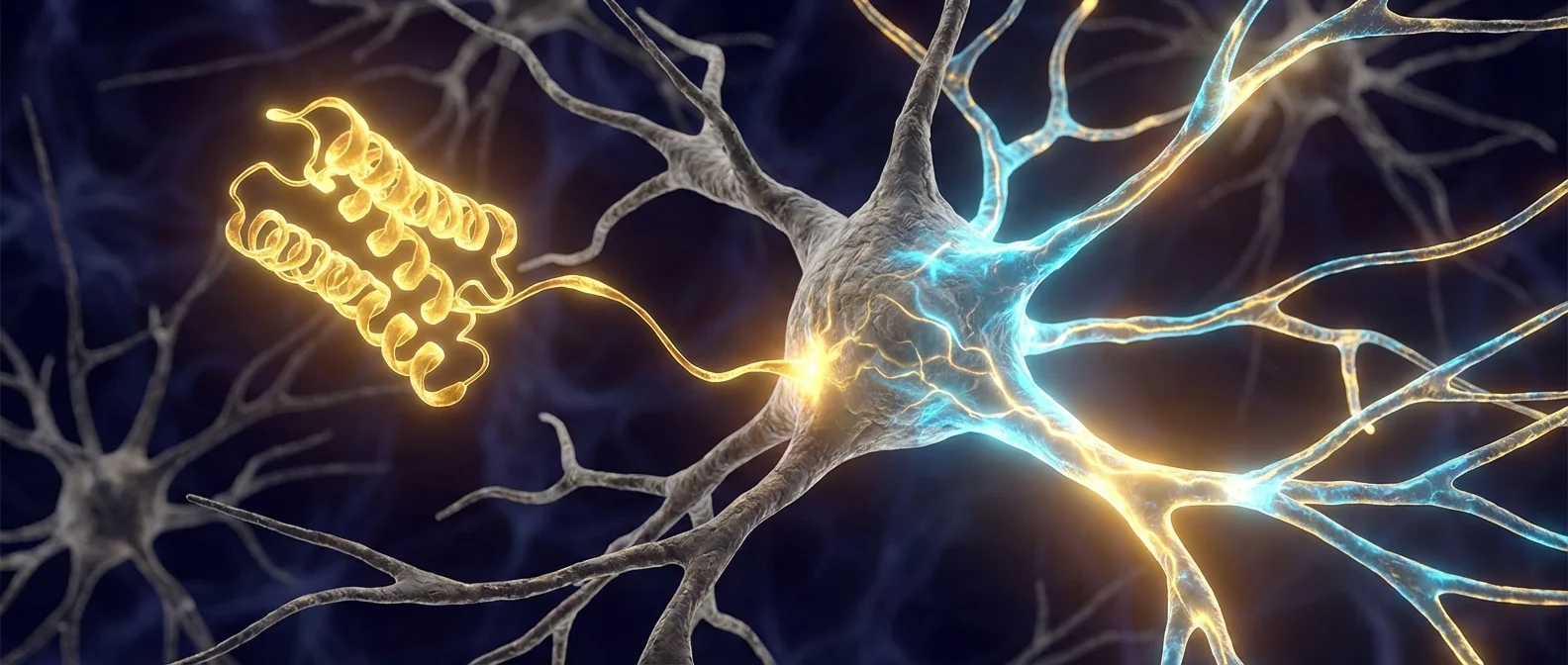
In February 2026, researchers from the Yong Loo Lin School of Medicine at the National University of Singapore published a landmark study in Science Advances. The team, led by Assistant Professor Ong Sek Tong Derrick and Dr. Liang Yajing, identified a transcription factor called DMTF1 (cyclin D-binding myb-like transcription factor 1) as a key regulator of neural stem cell activity in aging brains.
Transcription factors are proteins that control how genes are “turned on” and “turned off” in specific cells. DMTF1, as the research revealed, acts as a “regeneration switch” for neural stem cells.
🧬 How DMTF1 Works
To understand how DMTF1 works, researchers examined neural stem cells derived from humans and from laboratory models of premature aging. They used genome-wide binding and transcriptome analyses to map how DMTF1 affects gene activity.
🔑 Key Finding
DMTF1 levels are significantly reduced in aging neural stem cells. When researchers restored DMTF1 expression, the cells regained their ability to regenerate. This means brain aging is not a one-way street.
Further analysis revealed the exact mechanism. DMTF1 regulates two helper genes, Arid2 and Ss18, that “loosen” the tightly packed DNA, allowing growth genes to be activated. Without these helper genes, neural stem cells cannot renew themselves effectively.
"The diminished regeneration of neural stem cells has long been linked to neurological aging. Insufficient regeneration hinders the formation of new cells needed for learning and memory. Understanding the mechanisms provides a stronger foundation for studying age-related cognitive decline."
— Assistant Professor Ong Sek Tong Derrick, NUS Medicine⚙️ The Mechanism: Loosening the DNA
The DNA in our cells is not always accessible. It is tightly “wrapped” around proteins called histones. For a gene to be activated, the DNA must first be “unwound.” DMTF1 activates the Arid2 and Ss18 genes, which belong to the SWI/SNF complex — a group of proteins specialized in unwinding DNA. This allows growth genes to be expressed, restarting the stem cell proliferation cycle.
🧩 DMTF1 Decline
With age, DMTF1 levels drop significantly in stem cells
🔒 Locked DNA
Without DMTF1, growth genes remain “locked” in tightly packed DNA
🔓 Restoration
When DMTF1 is increased, DNA “unwinds” and cells regenerate
🧠 New Neurons
New cells support memory, learning, and cognitive function
📊 What This Means for the Future
The findings suggest that strategies designed to increase DMTF1 levels or enhance its activity could reverse or delay age-related decline in neural stem cell function.
Although current results are primarily based on in vitro experiments (in a laboratory setting), the team plans to investigate whether boosting DMTF1 can increase the number of neural stem cells and improve learning and memory under conditions of telomere shortening and natural aging — without increasing the risk of brain tumors.
In the long term, the team hopes to identify small molecules capable of safely stimulating DMTF1 activity, rejuvenating aging neural stem cells.
"Our findings suggest that DMTF1 can contribute to neural stem cell proliferation during neurological aging. Although our study is in its early stages, it provides a framework for understanding how age-related molecular changes affect stem cell behavior, and may ultimately lead to the development of successful therapies."
— Dr. Liang Yajing, NUS Medicine🌟 Broader Significance
The discovery of DMTF1 is part of a broader wave of research aimed at reversing brain aging through proteins. Other proteins, such as klotho being studied at the University of California (UCSF), have also shown impressive results in improving synaptic plasticity and memory in animal models.
However, DMTF1 offers something different: it doesn't merely improve the function of existing neurons — it restarts the production of new ones. This makes it a particularly promising target for therapies against Alzheimer's disease, dementia, and other neurodegenerative conditions where neuron loss is a central problem.
The research is at an early stage, but the message is clear: brain aging is not inevitable. With the right protein, it can be reversed.
Source: ScienceDaily — Scientists discover protein that rejuvenates aging brain cells (February 2026)