📖 Read more: Bionic Insect Eye Sees, Smells, and Guides Robots
🐆 The Return of an Apex Predator
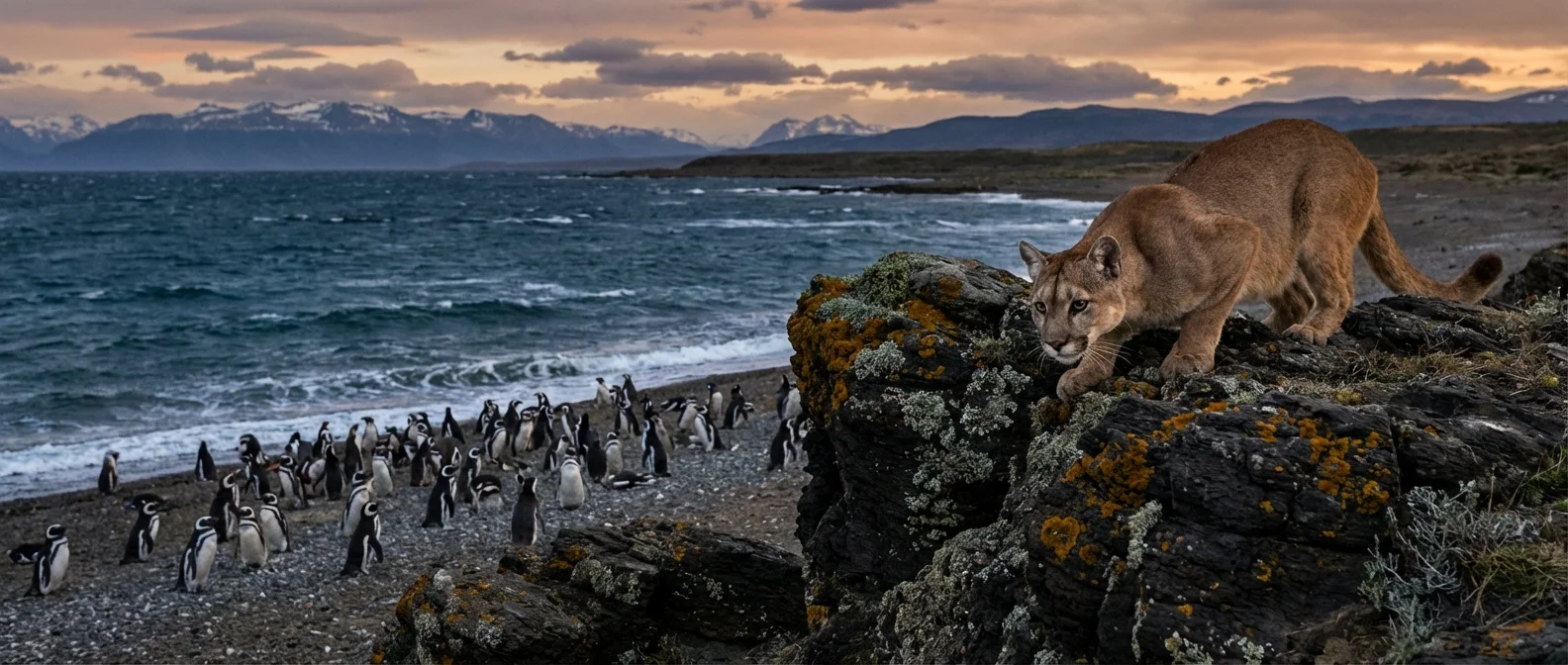
For much of the 20th century, pumas (Puma concolor) had disappeared from the coasts of southern Patagonia. Sheep ranchers hunted them relentlessly to protect their flocks, pushing their population to the brink of local extinction. When ranching was abandoned in southern Argentina in 1990, things began to change gradually.
With the establishment of Monte León National Park in 2004, pumas began returning to their historic territories. The recovery was considered a major success for biodiversity conservation — an iconic predator was reclaiming its place in the ecosystem. What no one had anticipated was what would happen when this predator encountered a species that had never faced a land predator.
🐧 Penguins Without Defenses
During the pumas' absence, Magellanic penguins (Spheniscus magellanicus) — which traditionally nested on safe coastal islands — moved to the mainland shoreline. Without land predators, the mainland offered abundant breeding space. The Monte León colony grew into one of Argentina's largest, with approximately 40,000 breeding pairs established along a 2-kilometer coastal strip.
But these penguins had evolved no defensive strategy against large felines. Unlike guanacos or rheas — the traditional prey of pumas in Patagonia — penguins are slow on land, unable to fly, and completely exposed during breeding season. For an opportunistic predator, they make an ideal target.
📖 Read more: Bourbon Waste Powers Next-Gen Supercapacitors with 25x Energy
💀 Surplus Killing: They Kill More Than They Eat
Between 2007 and 2010, researchers from the Centro de Investigaciones de Puerto Deseado at the Universidad Nacional de la Patagonia Austral, in collaboration with National Park rangers, systematically documented penguin carcasses showing signs of predation. The analysis, in partnership with the Wildlife Conservation Research Unit (WildCRU) at the University of Oxford, revealed that over 7,000 adult penguins were killed within four years.
The most alarming finding was that most carcasses were found partially or entirely uneaten. This is a phenomenon known in ecology as “surplus killing” — when a predator kills more prey than it needs for food. The ease of capture triggers an instinctive hunt without corresponding consumption, similar to what is observed in domestic cats hunting birds in gardens.
🔬 What Is Surplus Killing?
In ecology, “surplus killing” refers to the behavior of predators that kill significantly more prey than they consume. It often occurs when prey are extremely easy to catch or are found in high density. It has been documented in wolves, foxes, weasels, and now in pumas — although it is rare in large felines.
🔍 How Pumas Are Changing Behavior
A second study, published in December 2025 in Proceedings of the Royal Society B, revealed even more striking findings. Researchers installed 32 trail cameras in the park and fitted GPS collars on 14 adult pumas between 2019 and 2023. Of these, 9 hunted penguins while 5 did not.
Pumas that fed on penguins exhibited drastically different behavior: they stayed close to the colony during the breeding season (September–April) but nearly doubled their range when penguins migrated to sea in winter. Even more strikingly, pumas — animals that are typically solitary — began showing tolerance toward each other. Researchers recorded 254 encounters between penguin-feeding pumas, compared to just 4 between non-penguin-feeding pumas. The majority of encounters occurred within a 1-kilometer radius of the colony.
Puma density in the park was estimated at 13 per 100 square kilometers — 2.3 times higher than any previous record anywhere in Argentina. The abundance of food is transforming not only the diet but also the social structure of these felines.
"Restoring wildlife in today's altered landscapes doesn't simply return ecosystems to their past state. It can create entirely new interactions that reshape behavior and populations in unpredictable ways."
📖 Read more: Caffeine and Dementia: How Coffee Protects the Brain
📊 What Population Models Show
Despite the striking death toll, population models developed by the team show that puma predation alone is not enough to wipe out the colony. Extinction was predicted only in hypothetical scenarios combining very low juvenile survival (20% not reaching adulthood) with extremely low reproductive success (maximum one chick per pair). However, high predation combined with these factors dramatically worsened outcomes.
The decisive factors for the colony's viability proved to be reproductive success and juvenile penguin survival — issues significantly affected by climate change, food availability at sea, and water temperatures.
⚖️ The Conservation Dilemma
The situation at Monte León presents a rare dilemma: two native species, both worthy of conservation, are in conflict within an ecosystem profoundly altered by human activity. Killing pumas to save penguins would contradict the predator's recovery goals. Inaction could endanger smaller or newly established penguin colonies that have not yet become firmly established.
Juan Ignacio Zanón Martínez, a population ecologist at Argentina's CONICET, emphasizes that understanding the behavior of large carnivores in human-altered ecosystems "is essential for designing management strategies based on how ecosystems function today, not on how we assume they should function based on the past."
Similar challenges are emerging worldwide: feral pigs destroy turtle eggs in Georgia, USA, while coyotes colonize coastal islands in eastern North America. As land predators expand into coastal environments, more seabird colonies risk facing analogous conflicts.
🔮 The Need for Continuous Monitoring
Researchers emphasize that continuous monitoring is essential for detecting demographic changes early and taking action before ecological consequences become irreversible. The authorities of Monte León National Park continue to closely monitor both puma and penguin populations.
The research team plans to study next how the relationship between pumas and penguins affects the pumas' other prey, such as the guanaco (Lama guanicoe) — a relative of the llama. Understanding these cascading changes will be key to the long-term management of an ecosystem in transition.
Sources:
• Lera, M. et al. (2026). "Shifting predator–prey dynamics at the land–sea interface: The case of Magellanic penguins and pumas." Journal for Nature Conservation. DOI: 10.1016/j.jnc.2025.127208
• Serota, M. et al. (2025). “A marine subsidy reshapes the ecology of a large terrestrial carnivore.” Proceedings of the Royal Society B. DOI: 10.1098/rspb.2025.2172
• University of Oxford / WildCRU (2026). Phys.org, ScienceDaily
• Live Science (2025). “Pumas in Patagonia started feasting on penguins.”