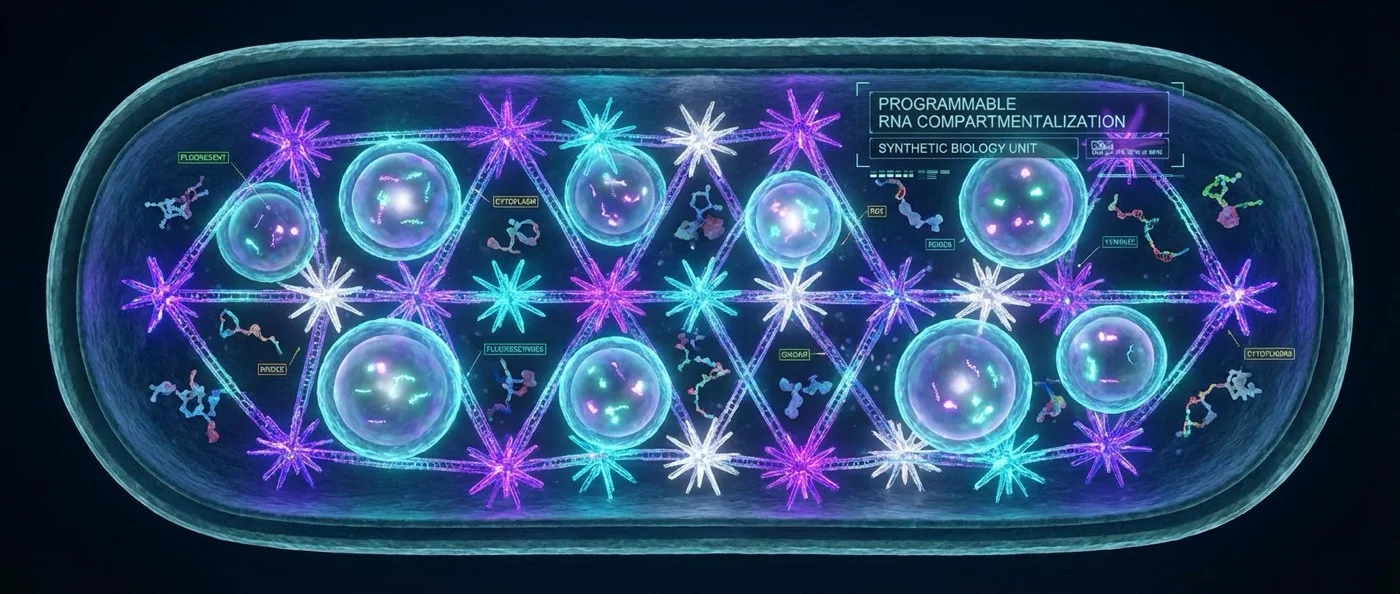
In the world of microbiology, bacteria are considered relatively “primitive” cells — no nucleus, no organelles, no internal organization. Now, a groundbreaking study from the University of Cambridge has turned this picture on its head: researchers managed to create artificial “compartments” inside bacteria using engineered star-shaped RNA molecules — opening new avenues for biotechnology and synthetic biology.
📖 Read more: Gut Bacteria 'Sense' Their Environment
🧬 What Are RNA Nanostars
RNA nanostars are synthetic, engineered RNA molecules that resemble four-armed stars at the molecular scale. Each “star” consists of four RNA arms joined through programmed base-pairing interactions. This structure is anything but random: the researchers designed the sequences so that individual molecules recognize each other and “snap together” automatically, forming larger assemblies.
The idea takes inspiration from nature. In eukaryotic cells — such as human cells — there exist organelles without membranes, known as biomolecular condensates. These form through a phenomenon called liquid-liquid phase separation — a natural process in which molecules self-organize into droplets within the cytoplasm, without needing a lipid membrane to enclose them.
Bacteria, however, lack such systems — at least naturally. This has been both a scientific challenge and a technological bottleneck: without internal organization, controlling biochemical reactions inside bacteria remains difficult. The Cambridge team set out to bring this capability to bacteria — artificially, through RNA nanotechnology.
🔬 How the Experiment Worked
The study, published in Nature Communications in February 2026, was carried out at the Department of Chemical Engineering and Biotechnology (CEB) at the University of Cambridge. It was led by Professor Lorenzo Di Michele, in collaboration with Dr. Graham Christie (CEB), Professor Pietro Cicuta (Department of Physics, Cambridge), and Professor Masahiro Takinoue (Institute of Science Tokyo). The first author was Brian Ng.
The approach was elegantly simple in concept but extraordinarily complex in execution. The researchers designed four-armed RNA nanostars to be genetically expressed inside Escherichia coli bacteria. Rather than introducing the molecules externally, they modified the bacteria to produce them internally. Once the bacteria began manufacturing the RNA stars, these self-assembled through their programmed interactions, forming droplet-like condensates resembling natural membraneless organelles.
The critical advantage of this approach is programmability. The researchers control the structure of each RNA arm, the number of arms, and the mode of interaction. This means they can “design to order” whatever compartments they need, rather than depending on natural processes. It represents a new level of control in synthetic biology.
📖 Read more: Chimpanzees Drink Alcohol in Wild — And Keep Coming Back
🧪 Reversible Compartments and Protein Capture
One of the most striking findings was that these artificial organelles are not permanent structures. Using fluorescence microscopy, the team demonstrated that the RNA condensates form and dissolve in response to temperature changes — predictable, reversible behavior fully consistent with phase separation. This means the “compartments” can be switched on or off at will, depending on requirements.
But the real innovation lies in an additional step. The researchers modified one of the four arms of each nanostar by attaching an aptamer — a specially designed RNA sequence that recognizes and “traps” specific proteins. In experiments with fluorescent proteins, the team proved that these were concentrated within the artificial organelles inside the bacterial cells. The RNA stars functioned, in effect, as molecular “traps” — gathering the right proteins in the right place.
"This is about using RNA nanotechnology to engineer synthetic organelles in bacteria that wouldn't otherwise have them. This could be very useful for biomanufacturing applications, including production and purification of synthetic proteins."
— Professor Lorenzo Di Michele, University of Cambridge🏭 Why a Bacterium Needs “Rooms”
Biomanufacturing — the use of living organisms as microscopic “factories” for producing proteins, drugs, and biofuels — currently depends heavily on bacteria, particularly E. coli. However, the lack of internal organization means that enzymes, substrates, and products get “lost” among thousands of other molecules in the cytoplasm, dramatically reducing reaction efficiency.
Imagine a factory with no walls or partitions: tools, materials, and products would be jumbled together in one vast open space. That is exactly what happens inside a bacterial cell. RNA nanostars offer, for the first time, “partitions” — virtual walls that can concentrate the right molecules in the right place, boosting reaction rates and improving purification of end products.
💡 Practical Applications
Artificial RNA compartments could impact multiple fields: production of therapeutic proteins (insulin, antibodies), construction of biosensors inside cells, study of biochemical pathways in vivo, and even development of new RNA-based vaccines. The ability to program cellular organization opens doors that were previously closed in microbial biotechnology.
🔮 A Star That Changes the Rules
The Nature Communications publication lays the foundation for an entirely new direction in synthetic biology. Di Michele's team is already exploring more complex designs: nanostars with five or six arms, materials that respond to chemical signals rather than temperature, and combinations of multiple organelle types within the same bacterial cell.
What makes this study stand out is the elegance of the approach: rather than modifying dozens of genes or introducing complex protein machinery, the researchers simply harnessed the physics of nucleic acids. RNA stars “know” how to self-organize — all someone needs to do is give them the right molecular instructions. In a world where demand for biologically produced drugs, biofuels, and biomaterials is rising rapidly, the ability to transform bacteria into more efficient “factories” could be a game-changer. And it all started with a tiny star made of RNA.
Sources: