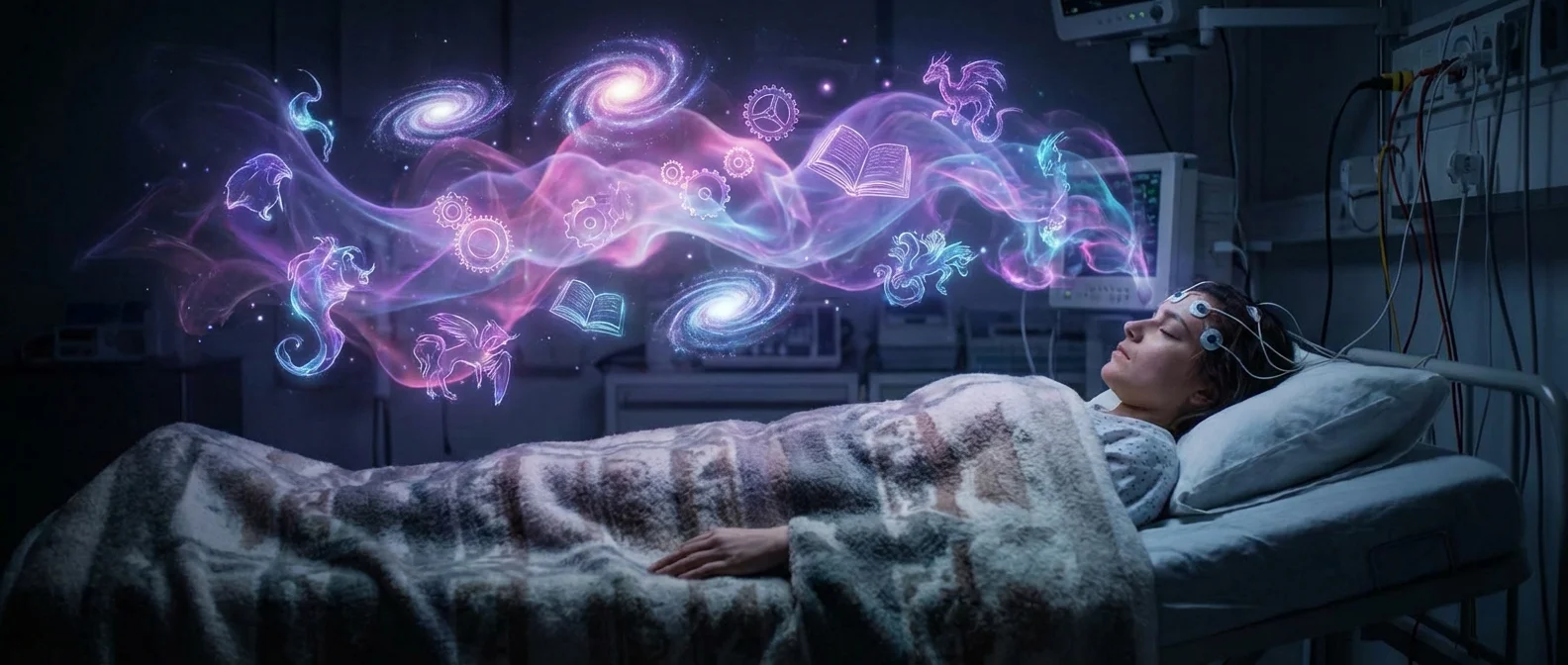
In the movie “Inception,” they needed a private jet and gallons of sedative gas to invade a dream. In reality, all it takes is a pair of electrodes, a steel-drum melody, and a comfortable bed in a research lab. A new study from Northwestern University shows that scientists can now “enter” dreams, guide their content — and the brain responds by solving problems it couldn't while awake.
📖 Read more: Scientists Finally Created Silicon Aromatic Ring After 50 Years
💭 The Idea: Sleep On It
The advice to “sleep on it” isn't just folk wisdom. Previous research had shown that sleep helps solve creative problems — but the mechanism remained unclear. Do dreams play a role? Or is it other sleep processes working behind the scenes?
"Our motivation was to see whether dreaming is related to the benefits of sleep for problem-solving," explains Ken Paller, a cognitive neuroscientist at Northwestern University and co-author of the study published in Neuroscience of Consciousness.
His team, led by researcher Karen Konkoly, recruited 20 volunteers with a history of or interest in lucid dreaming — a state where the dreamer knows they are in a dream and can, to some extent, control it.
🎵 Musical Cues During Sleep
Before falling asleep in the lab, volunteers received a series of creative thinking puzzles — such as rearranging matchsticks to form new shapes — with strict time limits. Each puzzle was paired with a unique musical piece: guitar riffs, whistling melodies, steel-drum sounds. The puzzles were difficult enough that each participant was left with several unsolved ones.
Next, the researchers attached electrodes to the volunteers' heads and faces to record brain activity and eye movements. While setting up the electrodes, they allowed the participants to watch “Inception” or “Waking Life” — films about the world of dreams.
Hours later, as the volunteers entered REM sleep, the team began playing the musical pieces corresponding to unsolved puzzles. Immediately after, they woke the participants and recorded their dreams. The process was repeated over two weeks, with one additional night in the lab.
The Results
Three-quarters (75%) of the volunteers reported dreams related to the unsolved puzzles — and more frequently about those that the researchers had “triggered” with sound. Six dreamers signaled to Konkoly that they were in a lucid dream, by moving their eyes or changing their breathing rate in pre-agreed patterns.
📖 Read more: Dopamine Isn't Gas—It's Motor Oil for Movement
📊 42% Versus 17%
The next day, all volunteers attempted the puzzles again. The numbers were striking: volunteers solved 42% of the puzzles they had dreamed about, but only 17% of those that hadn't appeared in their dreams. The connection between dreams and creativity was clear.
But a twist awaited the researchers: volunteers who had lucid dreams — meaning they knew they were dreaming — were less likely to solve the puzzles compared to those who had regular, “uncontrolled” dreams. Emma Peters, a dream researcher at the University of Bern, explains: "The idea is that you can do creative problem-solving in dreams because they are so weird — they make associations you wouldn't make if you were consciously there."
In other words, the “madness” of dreaming may be exactly what makes it creative. Excessive awareness — knowing you're dreaming, trying to take control — may actually diminish that chaotic creativity.
📖 Read more: Exercise Beats Depression Better Than Medication
🔬 The Foundation: Two-Way Communication with Dreamers
The 2026 study builds on a groundbreaking 2021 study published in Current Biology. Back then, four independent laboratories — at Northwestern (USA), the Sorbonne (France), the University of Osnabrück (Germany), and Radboud (Netherlands) — achieved something many considered impossible: real-time two-way communication with people who were dreaming.
They studied 36 volunteers in REM sleep. The researchers asked them math questions, yes/no questions, and even questions in Morse code. The dreamers responded with eye movements or facial muscle contractions — a broad smile for “yes,” a furrowed brow for “no.” In 158 attempts, correct responses were received 18.4% of the time.
🚀 The Road Ahead
"Our experimental goal is akin to finding a way to talk to an astronaut who is in another world," the researchers write in their publication. "Only in this case, the world is entirely constructed from memories stored in the brain."
The possibilities extend far beyond academic puzzles. The researchers envision “personalized” dreams designed around the dreamer's goals: practicing musical or athletic skills within a dream, therapeutic dreams to reduce the impact of psychological trauma, and even creative sessions that combine “the creative advantages of dreaming with the logical advantages of wakefulness.”
Artists and writers could draw inspiration directly from their sleep — with researchers receiving real-time feedback. For Paller, these unanswered mysteries are what keep science fascinating. “I think science is fun when there are still things you need to figure out,” he says, “and you haven't gotten there yet.”