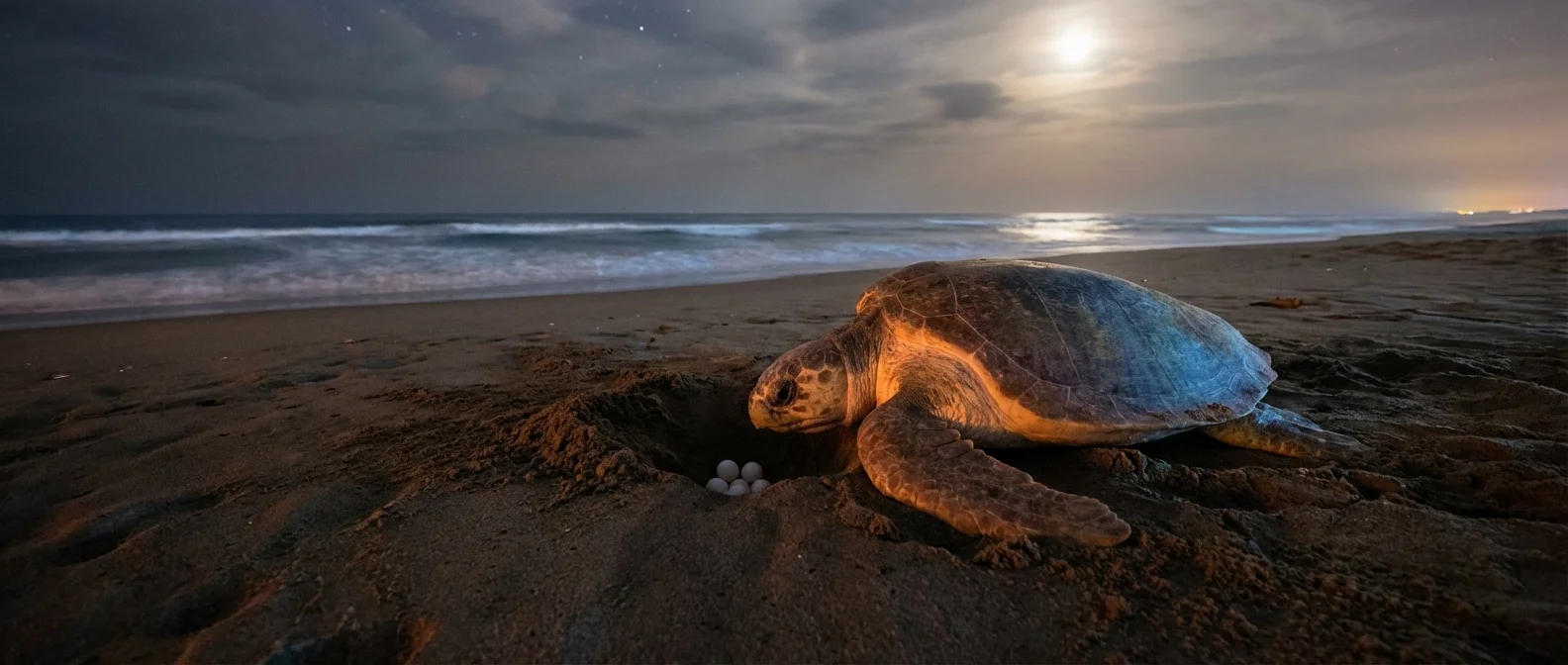
🐢 A Warming Planet, a Changing Turtle
Sea turtles have existed for over 100 million years — they survived the mass extinction that wiped out the dinosaurs. Today, however, they face a threat unprecedented in speed: ocean temperatures are rising faster than they can adapt. Researchers from Queen Mary University of London, in collaboration with the NGO Associação Projeto Biodiversidade, systematically monitored the Caretta caretta population in Cape Verde (Cabo Verde) — one of the most important nesting sites worldwide, with tens of thousands of females each year.
The study, led by Fitra Nugraha, analyzed data from 2009 to 2025 and revealed that ocean surface warming is pushing females to arrive at nesting beaches earlier each year. Higher temperatures accelerate egg maturation within their bodies, shortening the interval between successive nests in the same season.
🔬 The Invisible Crisis in Foraging Areas
This early nesting, however, conceals a deeper crisis. Sea turtles are “capital breeders” — they store energy for years in their foraging areas before migrating thousands of kilometers to reproduce. The study revealed that oceanic productivity in foraging grounds off West Africa is gradually declining — as measured through satellite chlorophyll estimates.
This means less food, and therefore fewer energy reserves. The result: females dramatically increased the interval between reproductive periods — from about 2 years to 4 years within 17 years of monitoring. When they finally return to lay eggs, they make fewer nests and lay fewer eggs per nest.
🌡️ Temperature and Sex: The Critical Connection
A second, equally alarming phenomenon is emerging in parallel from research by the University of Exeter in Cyprus. In sea turtles, the environmental temperature during incubation determines the biological sex of the hatchlings — this is known as temperature-dependent sex determination (TSD). Warmer environments produce more females, while cooler ones produce more males.
With the steady rise in temperature, extreme “feminization” of populations is already observed. On some beaches, the percentage of female hatchlings exceeds 95%. Although in the short term this may increase the number of reproductive females, in the long term the near-total absence of males threatens the genetic diversity and viability of the population.
The Exeter study, based on three decades of data, found that females are already adapting — nesting 6.47 days earlier for every 1°C increase in ocean temperature. This shift “buys time,” but it cannot continue indefinitely.
🌊 Multiple Fronts of Climate Pressure
Climate change doesn't affect turtles through just one mechanism — it operates simultaneously on multiple levels. Warming alters the timing of reproduction, declining oceanic productivity limits the energy status of females, rising sea levels destroy nests, stronger storms flood beaches, and increased sand temperatures skew sex ratios.
"Temperature alone doesn't tell the whole story," explains Christophe Eizaguirre, Professor of Evolutionary and Conservation Genetics at Queen Mary University. "You need to protect turtles on their nesting beaches, but that's not enough. What happens thousands of kilometers away, in their foraging grounds, determines how many eggs they can produce — and consequently, the next generation of turtles."
Annette Broderick from the University of Exeter adds: "There is no guarantee they will continue to adapt. It depends largely on how fast temperatures rise, but also on what they eat. If the timing of food production shifts, they could become ecologically disconnected between their foraging ground and their breeding site."
🛡️ What Can Be Done
Protecting nesting beaches remains essential, but it is no longer enough. Researchers emphasize that strategies extending beyond the shoreline are needed: protecting marine foraging habitats, reducing pressures on marine ecosystems, and recognizing that climate change can undermine reproduction even in populations that appear to be thriving.
Some promising interventions include shading nests to reduce incubation temperatures, relocating eggs to cooler sites, creating marine protected areas along migratory corridors, and addressing collateral threats such as egg poaching, plastic pollution, bycatch, and beach lighting that disorients hatchlings.
Long-term monitoring proves to be a critical tool. As the study shows, subtle but significant biological changes become visible only through decades of systematic recording — something that short-term studies cannot capture.
"To safeguard sea turtles on a warming planet, we need conservation strategies that extend beyond the shoreline. This includes protecting foraging habitats, reducing pressures on marine ecosystems, and recognizing that climate change can undermine reproduction even in populations that appear to be thriving."
— Kirsten Fairweather, Associação Projeto Biodiversidade🔮 Why This Concerns Us All
Sea turtles are not merely an iconic species. They are critical “engineers” of the ocean ecosystem: they transport nutrients from the sea to beaches through their eggs, regulate jellyfish populations, and maintain healthy seagrass meadows — which store enormous amounts of CO₂. Declining turtle populations will trigger chain reactions throughout the entire marine food web.
As oceans continue to warm and productivity shifts, the future of these ancient creatures will depend not only on their own ability to adapt — but also on the speed at which human conservation efforts can adapt alongside them.
📚 Sources
- Phys.org — Sea turtles are nesting earlier but producing fewer eggs, 17-year study finds (Feb 2026)
- Nugraha et al. — Animals (2026), DOI: 10.3390/ani16040552
- ScienceDaily — Turtles change nesting patterns in response to climate change (Feb 2025)
- Rickwood et al. — Proceedings of the Royal Society B (2025), DOI: 10.1098/rspb.2024.1809
- Witt et al. — Endangered Species Research (2024), DOI: 10.3354/esr01382