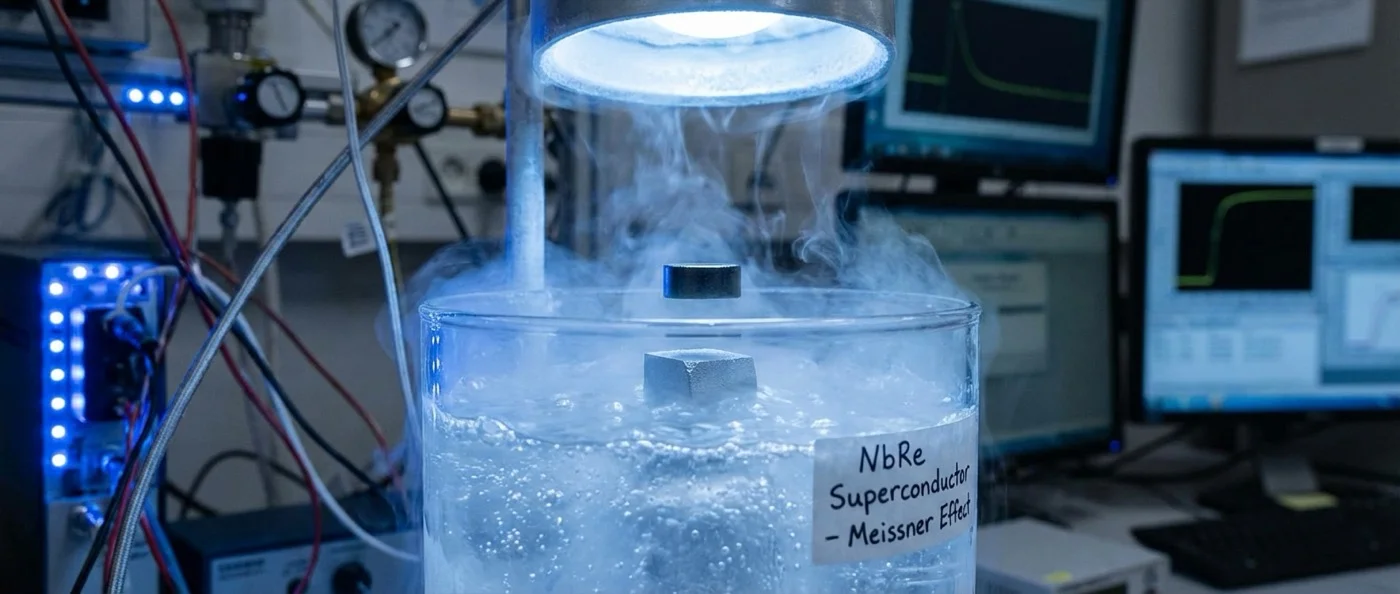
In the world of quantum physics, few materials are as eagerly sought as the triplet superconductor. Unlike conventional superconductors that carry electrical current with zero resistance, a triplet superconductor goes further: it transmits both electricity and electron spin — with absolutely no energy loss. It is, many physicists believe, a holy grail of quantum technology.
Now, researchers from the Norwegian University of Science and Technology (NTNU) and QuSpin research centre, in collaboration with Italian partners, report strong evidence that the alloy NbRe (niobium-rhenium) is exactly that material. Their findings, published in Physical Review Letters (DOI: 10.1103/q1nb-cvh6) and selected as an editors' recommendation, have electrified the quantum materials community.
Singlet vs Triplet: What's the Difference?
Conventional superconductors are singlet superconductors. In these materials, electrons pair up with opposite spins — one spin-up, one spin-down — forming so-called Cooper pairs that carry current without resistance. The spin information cancels out; only the charge is transmitted.
In a triplet superconductor, electrons pair with parallel spins. The Cooper pairs carry both charge and spin angular momentum. This means a triplet superconductor can transmit spin currents — streams of pure spin information — with zero resistance. The implications for spintronics and quantum computing are immense.
The Evidence in NbRe
Lead researcher Prof. Jacob Linder (Department of Physics, NTNU) and co-authors from Italy (F. Colangelo, M. Modestino, F. Avitabile, A. Galluzzi, Z. Makhdoumi Kakhaki, Abhishek Kumar, M. Polichetti, C. Attanasio, C. Cirillo) measured inverse spin-valve effects in NbRe — a characteristic signature that is incompatible with conventional singlet superconductivity.
"The results demonstrate that the material behaves completely unlike what we would expect from a conventional singlet superconductor," Linder stated. The non-centrosymmetric crystal structure of NbRe — which lacks mirror symmetry — is theoretically predicted to support mixed-symmetry pairing, including triplet components.
Why 7 Kelvin Matters
NbRe superconducts at approximately 7 Kelvin (−266°C). While that is still extremely cold by everyday standards, it is remarkably warm in the superconductor world. Other candidate triplet superconductors operate near 1 Kelvin — demanding cooling systems that are expensive, complex, and impractical for most applications.
At 7K, NbRe is accessible with standard liquid helium cooling equipment used in research laboratories worldwide. This makes it a far more practical candidate for real-world device development than sub-1K alternatives.
Applications: Faster, Cooler Computers
"We can now transmit not only electrical currents but also spin currents with absolutely zero resistance," Linder explained. “This means even faster computers that run on almost zero electricity.”
Quantum computers currently struggle with qubit decoherence — qubits lose their quantum state because spin information dissipates. Triplet superconductor interconnects could stabilize qubits dramatically, potentially enabling the fault-tolerant quantum computers that have remained out of reach.
In spintronics, where information is encoded in electron spin rather than charge, zero-resistance spin transmission would allow devices operating at unprecedented speeds with minimal power — a transformative advance for everything from AI processors to satellite communications.
Independent Verification Required
The NTNU team is careful to note that the discovery must be independently replicated. "Among other things, the finding needs to be verified by other experimental groups," Linder said. “It is also necessary to conduct further tests of triplet superconductivity.”
This caution is appropriate: the history of superconductor research includes several high-profile claims that later could not be reproduced. But the combination of theoretical motivation (non-centrosymmetric structure), experimental evidence (inverse spin-valve effects), and the 7K operating temperature makes NbRe the strongest candidate triplet superconductor yet identified. If it holds up, the implications for quantum technology will be profound.