📖 Read more: Microplastics Found in 90% of Prostate Cancers
🏛️ The Discovery That Changes Everything
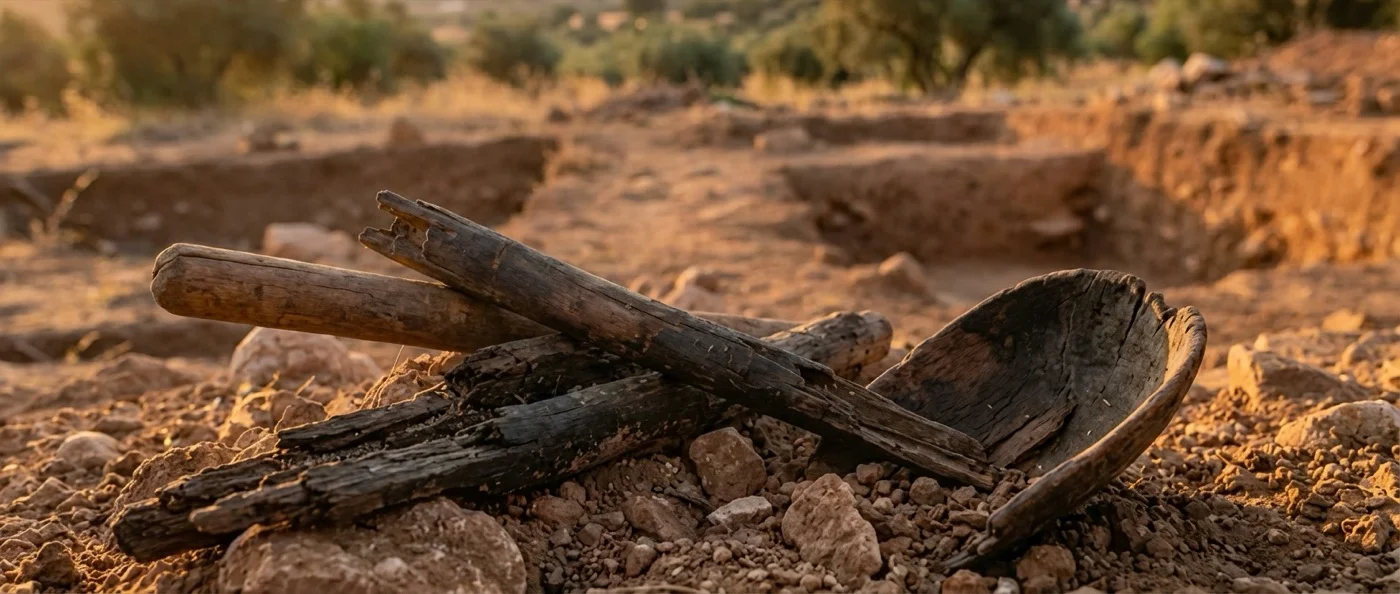
The excavation took place at a Paleolithic site near the Megalopolis basin in the Peloponnese, an area known for its rich sedimentary layers that exceptionally preserve organic materials. In waterlogged deposits — similar to those that preserved the famous Schöningen spears in Germany — 12 wooden objects were found in remarkable condition.
The finds include pointed sticks (probable digging tools), smoothed rods, a worked branch that appears to have served as a handle for a stone tool, and a shaped piece of wood possibly used as a club. The dating is based on stratigraphic analysis and radiometric methods (thermoluminescence — TL) on flints found in the same layer.
Digging Tools
Pointed sticks with clear signs of working on the edges, probably used for digging roots, bulbs, and insects — staple foods of hunter-gatherers.
Tool Handles
Pieces of hardwood with notches at the edges, designed to hold stone blades. This indicates complex technological thinking — combining two materials into one tool.
Wood Selection
The tools were made primarily from hard fir and oak wood. The selection of specific types of wood shows knowledge of the properties of each tree species.
Exceptional Preservation
Waterlogged sediments (lake/marsh) created an anaerobic environment that prevented decomposition. The same mechanism preserved the Schöningen spears.
📖 Read more: Microplastics Found in Antarctica's Only Native Insect
🔬 Why They Are So Rare
Wooden tools most likely formed the foundation of technology for early humans — far more so than stone tools. However, while stone survives for millions of years, wood decomposes within a few years under normal conditions. This means our picture of Paleolithic-era technology is extremely biased toward stone tools.
Why Does It Matter?
Until now, the oldest known wooden tools were the Schöningen spears in Germany (~300,000–400,000 years old), the Clacton spear point in England (~400,000 years old), and the Lehringen spear (~120,000 years old). If the Greek findings are confirmed at ~450,000 years, they would be the oldest worked wooden objects in the world.
🗺️ Greece as a Crossroads of Human Evolution
The discovery fits into a broader context of findings highlighting the central role of Greece in ancient human history:
Major Paleolithic Sites in Greece
Greece's geographic location — at the crossroads of Europe, Asia, and Africa — made it a natural corridor for the migrations of early human species from Africa to Europe. The mild Mediterranean climate, combined with abundant water resources, created ideal conditions for long-term habitation.
📖 Read more: 190-Million-Year-Old 'Sword Dragon' Found in Dorset
🧬 Who Made Them?
The most likely maker is Homo heidelbergensis, a human species that lived in Europe from 700,000 to 200,000 years ago. H. heidelbergensis is considered the common ancestor of both Homo neanderthalensis (Neanderthals) and Homo sapiens.
Complex Intelligence
The construction of composite tools (wood + stone) requires abstract thinking, planning, and working memory — abilities only recently attributed to early humans.
Social Organization
The variety of tools suggests division of labor and possible knowledge transfer between generations — fundamental characteristics of culture.
"The wooden tools represent only the tip of the iceberg. For every object we find, thousands of others have been lost to time. This discovery forces us to rethink the entire archaeology of the Lower Paleolithic."
📖 Read more: Depression: An Early Sign of Parkinson's or Dementia?
⚡ Dating Methods
Dating wooden finds of this age is extremely challenging. Radiocarbon dating with carbon-14 (¹⁴C) only works up to ~50,000 years ago. For older finds, researchers use:
Dating Methods for Paleolithic Finds
📖 What We Learn About the Ancient World
The wooden tools, combined with the stone tools and fossilized animal bones found in the same layer, paint a vivid picture of daily life half a million years ago. Elephants, deer, horses, and cattle dominated the landscape, while the flora included pines, oaks, and shrubs — a climate similar to today's Mediterranean but more humid.
The working marks on the wood reveal techniques such as: scraping with stone tools, notching for securing blades, and fire-hardening of tips — demonstrating a complex production chain.