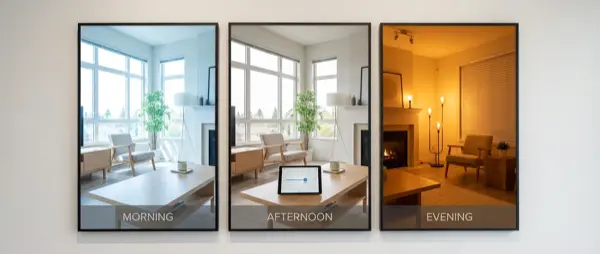
What You Need for Lighting Automation
To create lighting automation scenarios you need:
- Smart bulbs (Philips Hue, IKEA TRÅDFRI, Govee, LIFX) or smart switches
- Hub/Bridge (Hue Bridge, IKEA DIRIGERA, Zigbee2MQTT + Home Assistant)
- Sensors — motion, presence (mmWave), ambient light, door/window contact
- Automation platform — Philips Hue app, Google Home, Alexa Routines, Home Assistant
The most advanced scenarios (e.g., circadian lighting, multi-room fading) require Home Assistant or Node-RED. Basic ones (sunset on, motion on) work fine through the Hue app or Google Home.
Scenario 1: Sunrise Wake-Up
Instead of an alarm, lights gradually brighten over 15-30 minutes before your wake-up time. They start at very low brightness (1%) in warm white (2200K) and reach 80% in cool white (4000K). Your brain perceives the gradual change and you wake up more naturally, without the shock of a loud alarm.
Setup
- Trigger: Time (e.g., 06:30 Monday-Friday)
- Action: Transition 30 min, brightness 1%→80%, color temp 2200K→4000K
- Platform: Hue app (Wake Up routine), Home Assistant (light.turn_on with transition)
Scenario 2: Leaving Home
When you leave, all lights turn off automatically. How? Via geofencing (phone GPS), door sensor, or simply a button/scene at the entrance.
- Geofencing: Phone exits 100m radius → lights off, thermostats lower, cameras activate
- Door sensor: Front door closes + no motion for 5 minutes → all lights off
- Physical button: A smart button at the entrance — one press turns everything off
Scenario 3: Evening Relaxation
After 8 PM, lighting automatically dims to 30% brightness and shifts to warm white (2200-2700K). This supports your circadian rhythm — the body prepares for sleep. If you have RGB bulbs, you can add a subtle orange or amber tone for extra warmth.
Timing Tips
- Start dimming 1 hour before bedtime
- Below 2700K after 9 PM — avoid blue light exposure
- In the bedroom: 1-5% brightness is enough as a night light
Scenario 4: Motion-Activated Lights
The classic automation: motion detected → lights turn on. Ideal for hallways, bathrooms, stairs, and storage rooms. Use PIR motion sensors (Aqara, Hue) or mmWave sensors (Aqara FP2) for greater accuracy.
- Hallway: Motion → lights at 50% → off after 2 minutes with no motion
- Bathroom: Motion → light on → off after 10 minutes with no motion
- Night mode: Motion after 11 PM → lights only at 5% in warm white
Scenario 5: Movie Time
One voice command or button press and: all lights turn off except bias lighting behind the TV (RGB strip at 10% in deep blue), thermostat adjusts to 22°C, curtains close. Create a "Movie" scene in the Hue app or Home Assistant for one-tap activation.
Scenario 6: Vacation Mode
When you're away: lights turn on and off randomly in different rooms, simulating someone being home. In Home Assistant use random delay + time range automations. The Hue app has a built-in “Mimic Presence” feature that does this automatically.
Automation Platform Comparison
| Platform | Scenarios | Triggers | Difficulty |
|---|---|---|---|
| Philips Hue App | Basic-Medium | Time, Sensors, Geofencing | Easy |
| Google Home | Basic | Time, Sunrise/Sunset, Voice | Easy |
| Alexa Routines | Medium | Time, Voice, Echo Sensors | Easy |
| Home Assistant | Unlimited | Everything | Medium-Hard |
Common Automation Mistakes
- Conflicting automations: One turns lights on, another turns them off — set priorities
- PIR in the kitchen: Steam triggers the sensor as motion — use mmWave instead
- Timeout too short: Lights turn off while you're still in the room — mmWave solves this
- No time condition: Motion lights blast full brightness at night — add a night mode condition
Conclusion
Lighting automation isn't a luxury — it's practicality and comfort. Start with 2-3 basic scenarios (motion lights, sunset on, bedtime dim) and add more gradually as you get comfortable. Home Assistant offers unlimited possibilities for advanced users, but even the Hue app or Alexa Routines are perfectly sufficient for everyday basics. The 20-30% energy savings are a nice bonus — the real value is never having to think about your lights again, because they always do exactly what you need.