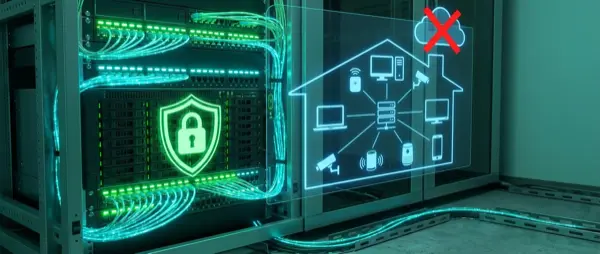
The “smart home” promised convenience — but what's the real price you're paying? Every time you say “OK Google, turn off the lights,” your command travels to a data center, gets processed in the cloud, and returns. If the internet goes down, your home goes down too. If the company shuts down its API, your devices become useless boxes. And your data — voice recordings, camera footage, usage patterns — lives on third-party servers, beyond your real control.
Local control changes this model. In February 2026, with tools like Home Assistant, protocols like Zigbee, Z-Wave, and Matter, and hardware that costs less than a yearly cloud subscription, you can build a smart home that runs 100% locally — fast, reliable, private, and entirely yours.
Why Go Cloud-Free?
The reasons more users are abandoning cloud-dependent solutions are numerous and well-documented:
Service outages: In December 2025, a major Google Cloud Services outage left millions of Google Home users without control for over 8 hours. Alexa faced a similar issue in October. When your home's “intelligence” sits in a data center thousands of kilometers away, every outage means dark rooms, locked doors, and inactive sensors.
Latency: A cloud command passes through DNS lookup → TLS handshake → cloud processing → response. That means 200-800ms delay. Locally, the same command executes in 5-30ms. The difference is noticeable, especially in motion-triggered automations.
Privacy: Cameras sending video to the cloud, microphones constantly “listening,” thermostats learning your schedule — all of this creates a detailed digital profile. Data breaches on IoT platforms have exposed the data of millions of users. With local control, your data never leaves your home.
Subscription creep: The “hardware as a service” trend means you pay monthly for features that should be basic. Wink demanded $5/month, Nest increased Aware prices, Eufy added cloud charges. Locally, you pay once for hardware and that's it.
Vendor lock-in & discontinued services: Remember the Samsung SmartThings Hub v2? Works with Nest? Insteon? When a company decides to shut down a product, customers are left with useless hardware. With open protocols and local control, your devices don't depend on anyone.
Cloud vs Local: The Comparison
| Feature | Cloud Smart Home | Local Smart Home |
|---|---|---|
| Response Time | 200-800ms | 5-30ms |
| Requires Internet | Yes, always | No (except remote access) |
| Privacy | Data on third-party servers | Everything stays local |
| Reliability | Depends on cloud uptime | Always works locally |
| Setup Difficulty | Very easy | Moderate (initially) |
| Cost | Subscriptions + hardware | Hardware only (one-time) |
| Remote Access | Built-in | VPN / WireGuard / Nabu Casa |
| Vendor Lock-in | High | Non-existent |
Home Assistant: The Heart of Local Smart Home
Home Assistant (HA) is the leading open-source platform for local smart home control. In February 2026, it's at version 2026.2 with over 2,500 integrations, millions of active users worldwide, and a community that grows daily.
What it does: Connects and controls practically every smart device — lights, thermostats, cameras, locks, sensors, media players, blinds, irrigation systems. Creates automations that run 100% locally, without needing internet connectivity. Offers an excellent dashboard (Lovelace) for control from any browser or mobile app.
Where it runs:
- Home Assistant Green / Yellow: Dedicated hardware, plug-and-play installation
- Raspberry Pi 4/5: The classic, economical approach — Home Assistant OS on SD card or SSD
- Mini PC (Intel NUC, Beelink): Better performance, ideal for large installations with many cameras
- Virtual Machine / Docker: For those who already have a homelab or NAS (Proxmox, Unraid, Synology)
Installing Home Assistant OS on a Raspberry Pi 5 takes literally 15 minutes. With a Zigbee dongle, you're ready to add dozens of devices with zero cloud dependency.
Protocols for Local Control
Protocol choice is critical for a local smart home. Let's examine the top options:
Zigbee — The most popular protocol for local smart home. Mesh network, low power consumption, thousands of compatible devices. Used with Zigbee2MQTT (the most flexible option — supports 3,000+ devices) or ZHA (built into HA, easier setup). Ideal for sensors, bulbs, switches, plugs.
Z-Wave — Mesh protocol with stricter certification, meaning fewer compatibility issues. The Z-Wave JS integration in HA is excellent. Lower frequency (868MHz in Europe), so better wall penetration. Ideal for locks, TRVs, blinds.
Thread / Matter — The future of smart home. Designed from the ground up for local control — local by design. IPv6-based mesh network with extremely low latency. Adoption is accelerating in February 2026, with devices from Apple, Google, Samsung, Eve, Nanoleaf. HA supports Thread via the SkyConnect dongle or any Thread Border Router.
Bluetooth / BLE (ESPHome) — With ESPHome-based ESP32 boards, you can create custom sensors (temperature, humidity, motion, light, CO2) that communicate locally via WiFi or Bluetooth Proxy. Cost: €3-8 per sensor.
WiFi (Tasmota / ESPHome) — WiFi devices (plugs, bulbs, switches) flashed with Tasmota or ESPHome firmware become fully local. They send no data anywhere, run a local web server, and integrate automatically with HA.
Hardware: What You Need
The transition to local smart home starts with the right hardware:
Zigbee Coordinators:
- SONOFF ZBDongle-P (CC2652P): ~€18, the value king — excellent range, supports 50+ direct connections
- SONOFF ZBDongle-E (EFR32MG21): ~€20, newer chip, also supports Thread/Matter
- ConBee II / III: ~€30-40, premium quality, easy firmware upgrades
Z-Wave:
- Aeotec Z-Stick 7: ~€35, Gen7 chip, excellent Z-Wave JS compatibility
- Zooz ZST10 700: ~€30, compact and reliable
Thread / Matter:
- Home Assistant SkyConnect: ~€25, Zigbee + Thread in one dongle — the most comprehensive solution
- Apple TV 4K / HomePod Mini: Function as Thread Border Routers
Hub / Server:
- Raspberry Pi 5 (8GB): ~€85, sufficient for 100+ devices, boot from NVMe SSD for reliability
- Beelink Mini S12 Pro: ~€150, Intel N100, 16GB RAM — ideal for large installations with Frigate NVR, ESPHome, Node-RED
- Intel NUC (used): ~€80-120, excellent performance-to-price ratio
- Home Assistant Green: ~€99, the official plug-and-play solution
Devices That Work Locally
You don't need to buy “special” devices. Many popular brands already support local control:
Shelly: A DIY favorite. Shelly devices (1, 2.5, Plus, Pro series) have a native local API — no cloud needed, no firmware flashing, no hacks. Simply integrate them into HA via REST or CoAP. Perfect for relays behind switches, blinds, and water heaters.
IKEA DIRIGERA / TRÅDFRI: IKEA's Zigbee products (bulbs, plugs, blinds, sensors) work locally with Zigbee2MQTT or ZHA without IKEA's hub. Excellent quality-to-price ratio — bulbs from €8, plugs €10, motion sensor €12.
Philips Hue: The Hue Bridge supports local API (v2), meaning lights, switches, sensors, LED strips work locally via HA. Premium quality, but higher cost.
Sgreverse (Tasmota/ESPHome): Sgreverse Basic, Mini, TH16, POW and others can be flashed with Tasmota or ESPHome, transforming them into fully local devices. OTA updates, web interface, MQTT integration.
ESP32 DIY Sensors: With an ESP32 board (€4) and ESPHome, you build custom sensors — temperature (DHT22, BME280), humidity, air quality (SGP30, SCD40), brightness, water level. Data stays 100% local.
Aqara: Excellent Zigbee sensors (temperature, door/window, motion, humidity, vibration) at €8-15 prices. Work locally via ZHA or Zigbee2MQTT without the Aqara Hub.
Setting Up a Secure Local Network
A local smart home needs a secure network. Here are the best practices:
VLANs — IoT Device Isolation: Create a separate VLAN (e.g., VLAN 30) for IoT devices. This means even if a cheap smart plug gets compromised, it can't access your computer or files. Managed switches and routers like UniFi, MikroTik, or pfSense/OPNsense support this.
Firewall Rules: Allow IoT devices to communicate only with the Home Assistant server. Block all internet access (since they don't need it!) and all access to other VLANs. Exceptions: NTP (time sync) and DNS.
DNS Blocking: Use AdGuard Home or Pi-hole as your DNS server. Block domains that send telemetry — many “local” devices still phone home to manufacturers. AdGuard runs as an add-on inside Home Assistant.
WireGuard for Remote Access: Instead of exposing HA to the internet, use WireGuard VPN. It runs as a HA add-on, creates an encrypted tunnel, and gives you full local network access from anywhere. Alternatively, Nabu Casa (€6.50/month) offers easy, secure remote access without port forwarding, while also supporting HA development.
Automations That Work Without Internet
The real power of local smart home shows in automations. Here are examples that work 100% offline:
Motion-Triggered Lighting: Aqara motion sensor (Zigbee) → HA automation → Shelly relay turns on lights. Response: <20ms. If no one is detected for 3 minutes, lights turn off automatically. Perfect for hallways, bathrooms, garages.
Smart Lock: Door sensor (Zigbee) + Nuki Smart Lock (Bluetooth/Zigbee). If the door closes and nobody is home (presence detection), it locks automatically after 60 seconds. Notification to your phone via local push notification.
Heating Schedule: Zigbee TRVs (Aqara E1 or TuYa) in every room. Heating schedule based on time, day, and presence. Window sensor automatically stops heating if a window opens. Saves 20-35% on heating costs.
Alarm System: Door/window sensors + motion sensors + Zigbee siren. Arm/disarm via NFC tag, keypad, or automatically based on presence. Notifications via local push and/or 4G dongle backup. No monthly security company subscription required.
Presence Detection (BLE): ESP32 boards in every room as Bluetooth Proxy. Detect BLE beacons (Apple Watch, smartband, Tile) for room-level presence detection. Know who is in which room, without cameras, without cloud, without privacy concerns.
Final Verdict: Local Control Is the Future
In February 2026, local smart home control is no longer a hobby for “advanced users.” It's a realistic, practical, and superior solution for every user who values reliability, speed, and privacy.
Our practical advice: start small. A Raspberry Pi 5 + SONOFF ZBDongle-P + 3-4 Zigbee sensors + 2 Shelly relays is enough to see the difference. Cost: around €120-150 — less than an annual subscription to many cloud services.
With Matter maturing, Thread spreading, and Home Assistant improving every month, the transition to a fully local smart home is easier than ever. Your data, your devices, your automations — all yours, no dependencies. That's the truly “smart” home.