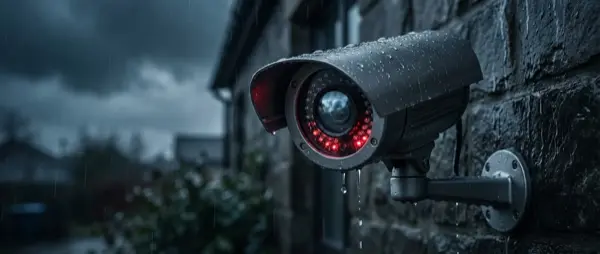
An outdoor security camera is arguably the most important smart home device for any home. But an outdoor camera faces very different challenges than an indoor one: rain, heat, humidity, dust, and adverse lighting conditions. In this guide we analyze the 10 key points to check before buying, the best options for 2026, and practical installation tips.
📖 Read more: Home Security Cameras: 2026 Buying Guide
1. Waterproofing (IP Rating)
The most important feature. Look for a camera with IP66 or IP67 protection rating:
- IP65: Withstands water jets — suitable for spots under a canopy
- IP66: Withstands heavy rainfall and dust — the most common standard
- IP67: Withstands water submersion — full protection
In Southern Europe, with summer heat (40°C+) and winter rains, IP66 is the minimum acceptable rating.
2. Night Vision
There are three night vision technologies:
| Technology | Result | Cost |
|---|---|---|
| IR LED (black & white) | Basic image, no color distinction | Low |
| Spotlight (white LED) | Full color, illuminates the area | Medium |
| Starlight Sensor | Color image without lighting — sensor captures ambient light | High |
Our recommendation: Starlight + Spotlight combo. The camera uses starlight under normal conditions, and activates the spotlight only on motion detection — which also deters intruders.
📖 Read more: Arlo vs Ring vs Eufy: Security Camera Comparison 2026
3. PoE vs WiFi
The big question for every outdoor installation:
| Connection | Pros | Cons |
|---|---|---|
| PoE (Ethernet) | 100% reliable, one cable for power+data, long distances (100m) | Requires Ethernet wiring |
| WiFi | Easy installation, wireless | Interference, disconnections, separate power needed |
| Battery/Solar | 100% wireless, install anywhere | Limited battery life, lower quality |
For permanent home installation, PoE is clearly the best choice. For rentals or locations without wiring options, WiFi or battery cameras work well.
4. Resolution & Field of View
For outdoor use, resolution should be at least 2K (4MP) — ideally 4K (8MP). At 1080p you won't be able to identify faces beyond 3-4 meters distance. The difference between 2K and 4K is significant: 4K delivers four times the pixel count, meaning you can zoom in on recorded footage and still see clear details like license plates or facial features.
📖 Read more: Eufy Security 2026: Subscription-Free Cameras
Field of view: 100-130° covers a large area and is ideal for monitoring driveways, yards, or wide open spaces. If you want to focus on a narrow point (door, driveway), 80-90° is better — it provides greater detail per pixel.
5. AI Detection
Without AI, the camera sends notifications for every movement — leaves, shadows, cats, even clouds. Offline AI detection distinguishes:
- People — the most important category
- Vehicles — useful for parking areas and driveways
- Animals — if you want to monitor pets in the yard
- Packages — some cameras recognize delivery parcels
6. Two-Way Audio & Siren
Many outdoor cameras have built-in microphone and speaker. This lets you talk to someone at the door or deter suspicious individuals. Some models also have a 90-100dB siren that activates automatically or manually via the app.
📖 Read more: Ring Doorbell 2026: Is It Worth It?
7. Installation Tips
- Mount at 2.5-3.5 meters height — high enough to be out of reach, low enough for face recognition
- Avoid direct sunlight on the lens — it causes glare
- Point north or east if possible — fewer reflections
- Use waterproof junction boxes for cables
- Check WiFi signal at the installation point before drilling
8. Temperature Resistance
An outdoor camera needs to withstand a temperature range of -10°C to +55°C. Check the specs before purchasing — especially if the camera will be on a south-facing wall in direct sunlight. Many budget cameras can't handle temperatures above 45°C during extreme summer heat.
📖 Read more: Ring vs Google Nest Doorbell: Comparison 2026
9. Physical Camera Security
An outdoor camera can become a target for vandalism or theft. For maximum security:
- Install at a height difficult to reach without a ladder
- Use anti-theft security screws for the mounting bracket
- Choose a camera with IK10 rating if vandalism is a risk (impact resistant)
- Store video both locally AND in the cloud — if the camera is stolen, footage remains safe
10. Legal Framework
In the EU, outdoor camera installation is subject to GDPR rules. Key rules: the camera should only record your own property (not sidewalks or neighboring houses), there should be a notification sign, and recordings should be deleted within 15 days unless there is a reason for retention.
Top Picks 2026
| Camera | Type | Resolution | Price € |
|---|---|---|---|
| Reolink RLC-810A | PoE | 4K | €55 |
| Reolink Duo 3 PoE | PoE | Dual 4K (180°) | €130 |
| TP-Link Tapo C520WS | WiFi | 2K QHD | €60 |
| Eufy S340 Outdoor | WiFi/Solar | 3K | €140 |
| Reolink Argus 4 Pro | Battery/Solar | 4K | €145 |
Conclusion
For outdoor cameras in February 2026, our recommendation is clear: PoE if you can run a cable (Reolink RLC-810A at €55 is unbeatable), WiFi for easy installation (Tapo C520WS), and battery/solar for locations without power (Reolink Argus 4 Pro). Remember: IP66+, AI detection, color night vision — these three are the must-have features. Start with one camera at the main entrance and gradually expand to the yard and back of the house.