📖 Read more: Zigbee2MQTT: Installation and Setup Guide 2026
Why You Need a Water Leak Sensor
Water damage is one of the most devastating home incidents. According to insurance data, the average water damage claim exceeds €10,000, while severe cases (burst pipes, flooding) can reach tens of thousands. In apartment buildings, the problem multiplies — a leak on the 3rd floor can damage every floor below it.
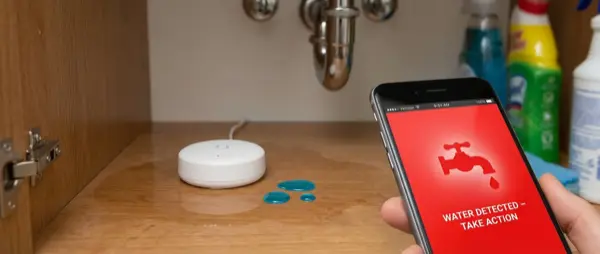
A smart water leak sensor costs €8-50 and can:
- Alert you instantly via push notification on your phone
- Sound a loud alarm (65-100dB siren depending on model)
- Automatically shut off the main water supply (with a smart valve)
- Trigger lights, SMS, or phone calls through automations
How It Works
The mechanism is simple but effective. On the bottom of the sensor are two metal contacts. When water touches both simultaneously, it creates an electrical circuit (conductivity) and the sensor triggers its alarm. At the same time, it sends a wireless signal (Zigbee, WiFi, or Thread/Matter) to the hub or cloud, which pushes a notification to your smartphone.
Some premium models (like the Eve Water Guard) feature an extended sensing cable (2-5 meters) that detects water along its entire length — ideal for basements, laundry areas, or behind washing machines.
Best Water Leak Sensors 2026
1. IKEA Klipbok — €8
The cheapest smart water leak sensor on the market. The new IKEA Klipbok supports Matter over Thread, meaning it works with Apple HomeKit, Google Home, Samsung SmartThings, and Amazon Alexa without needing a proprietary hub. Requires 2 AAA batteries. The 65dB alarm is audible in a room but won't reach through an entire house. No temperature or humidity sensor included.
Pros: Unbeatable price, Matter, available at IKEA stores.
Cons: No extension cable, no thermometer.
2. Aqara Water Leak Sensor T1 — €15-20
The value-for-money king of water leak sensors. Uses Zigbee 3.0 (requires Aqara Hub or compatible Zigbee hub). Extremely compact (33×33×9.5mm), waterproof IP67, CR2032 battery that lasts 2-3 years. 85dB audible alarm. Works flawlessly with Home Assistant via Zigbee2MQTT or ZHA integration.
Pros: Tiny size, IP67, excellent HA integration, long battery life.
Cons: Requires Zigbee hub.
3. Eve Water Guard — €80-100
The premium choice with a 2-meter sensing cable (extendable up to 150m). Uses Thread/Matter, works perfectly with Apple HomeKit. Alarm at 100dB — audible throughout the entire home. Detects water along the full cable length. German-engineered, no cloud — data stays completely local.
Pros: Extensible cable, 100dB, Thread/Matter, privacy-first.
Cons: Expensive, primarily Apple ecosystem.
📖 Read more: Homey Pro Mini: The Best Smart Home Hub?
4. Fibaro Flood Sensor (FGFS-101) — €55-70
A round “eye-shaped” sensor using Z-Wave Plus protocol. Beyond water detection, it measures temperature and includes a tilt sensor (detects if it's been moved). 97dB alarm. Requires a Z-Wave controller (SmartThings or Home Assistant with a Z-Wave stick).
5. Flo by Moen Smart Water Detector — €45-55
Tom's Guide's top pick overall. WiFi-connected, includes a 4-foot sensing cable, and can pair with Moen's shutoff valve for automatic water cutoff. Measures temperature and humidity. CR123A battery lasts up to 2 years. Works with Alexa but not Google Home or HomeKit.
| Model | Price | Protocol | Alarm | Best For |
|---|---|---|---|---|
| IKEA Klipbok | €8 | Matter/Thread | 65dB | Beginners, budget |
| Aqara T1 | €15-20 | Zigbee 3.0 | 85dB | Value, Home Assistant |
| Eve Water Guard | €80-100 | Thread/Matter | 100dB | Premium, Apple users |
| Fibaro Flood | €55-70 | Z-Wave Plus | 97dB | Z-Wave setups |
| Flo by Moen | €45-55 | WiFi | 51dB | Moen ecosystem |
Where to Place Your Sensors
Correct placement is the difference between prevention and disaster. Here are the critical spots in your home:
Top 7 Placement Locations
- Under the washing machine/dishwasher — The #1 source of leaks in apartments
- Near the water heater — Especially older units prone to corrosion
- Under the kitchen sink — Pipe connections, drain lines
- Under bathroom sinks — Siphon, faucet connections
- Next to the toilet — Water supply connection, potential overflow
- On balconies/terraces — Rain, clogged drainage
- In the basement/storage room — Moisture, water ingress
Tip: For a typical apartment (80-100 m²), you need 3-5 sensors. With IKEA Klipbok, that costs just €24-40. With Aqara T1, €45-100. Minimal cost for maximum protection.
Automations & Smart Integration
A sensor alone alerts you — but with automations it can act on its own:
Google Home / Alexa
Basic automations: when water is detected → push notification, announcement on smart speakers ("Water detected in the kitchen!"), turn lights red as a visual alert.
Home Assistant — Advanced Scenarios
This is where the real magic happens. With Home Assistant you can create:
- Automatic water shutoff: Aqara leak sensor + smart valve → automatic shutoff in less than 5 seconds
- Escalation alerts: 1st push notification → 2nd in 2 minutes if no response → 3rd SMS → 4th phone call via Twilio
- Kill the washing machine: Smart plug on washing machine → if leak sensor triggers → cuts power
- Neighbor notification: If you're away on vacation, automatic email/SMS to a trusted neighbor
- CCTV recording: Activate security camera for recording (useful for insurance claims)
Smart Valves: Automatic Water Shutoff
The sensor alerts you, but if you're not home, who turns off the tap? That's where smart water valves come in:
📖 Read more: Philips Hue 2026: Complete Beginner's Setup Guide
| Model | Price | Protocol | Installation |
|---|---|---|---|
| Aqara Smart Valve Controller T1 | €45-55 | Zigbee | DIY (screws onto valve) |
| Zigbee Valve Actuator (generic) | €25-40 | Zigbee | DIY |
| Grohe Sense Guard | €350-450 | WiFi | Professional plumber (inline) |
| Flo by Moen Shutoff | €400+ | WiFi | Professional plumber (inline) |
For most homeowners, the best solution is the Aqara Valve Controller combined with Aqara leak sensors: it attaches to your main shutoff valve without a plumber, costs ~€50, and paired with 3-4 leak sensors gives complete automatic protection for under €100.
Protocols: Zigbee, WiFi, Thread, Z-Wave
Which protocol is best for water leak sensors?
- Zigbee: Ideal — low power consumption (2+ year battery life), mesh networking, reliable. Aqara, Xiaomi, SONOFF all use Zigbee.
- Thread/Matter: The future — IKEA Klipbok, Eve Water Guard. Low power, mesh, cross-platform. Will dominate in 2-3 years.
- WiFi: Avoid for battery sensors — high power consumption means battery lasts months not years. Fine for plug-in models only.
- Z-Wave: Reliable but expensive and less common in Europe. Fibaro is the main option.
Full Setup Cost
| Scenario | Equipment | Cost |
|---|---|---|
| Budget (IKEA) | 4× Klipbok + Google Home | €32 |
| Best Value (Aqara) | 4× Aqara T1 + Aqara Hub M2 | €110-130 |
| Full Auto (Aqara + Valve) | 4× Aqara T1 + Hub + Valve Controller | €160-180 |
| Premium (Eve) | 2× Eve Water Guard + Apple Home | €160-200 |
Even the cheapest solution (€32 for 4 IKEA Klipbok) provides solid basic protection. When you compare that to the potential damage cost (€5,000-50,000+), the investment pays for itself the moment it catches its first leak.
Final Recommendation
If you want the cheapest option → 4× IKEA Klipbok (€32 total). They work with Matter, need no hub, and install in 5 minutes.
If you want the best value → Aqara T1 + Aqara Hub M2 + Home Assistant automations. The ideal solution for users who want fully automatic protection.
If you want the complete package → Aqara T1 + Valve Controller + Home Assistant. Automatic water shutoff in under 5 seconds. The most comprehensive DIY solution for under €180.
Don't wait for the leak. €8-50 today can save you €10,000+ tomorrow.