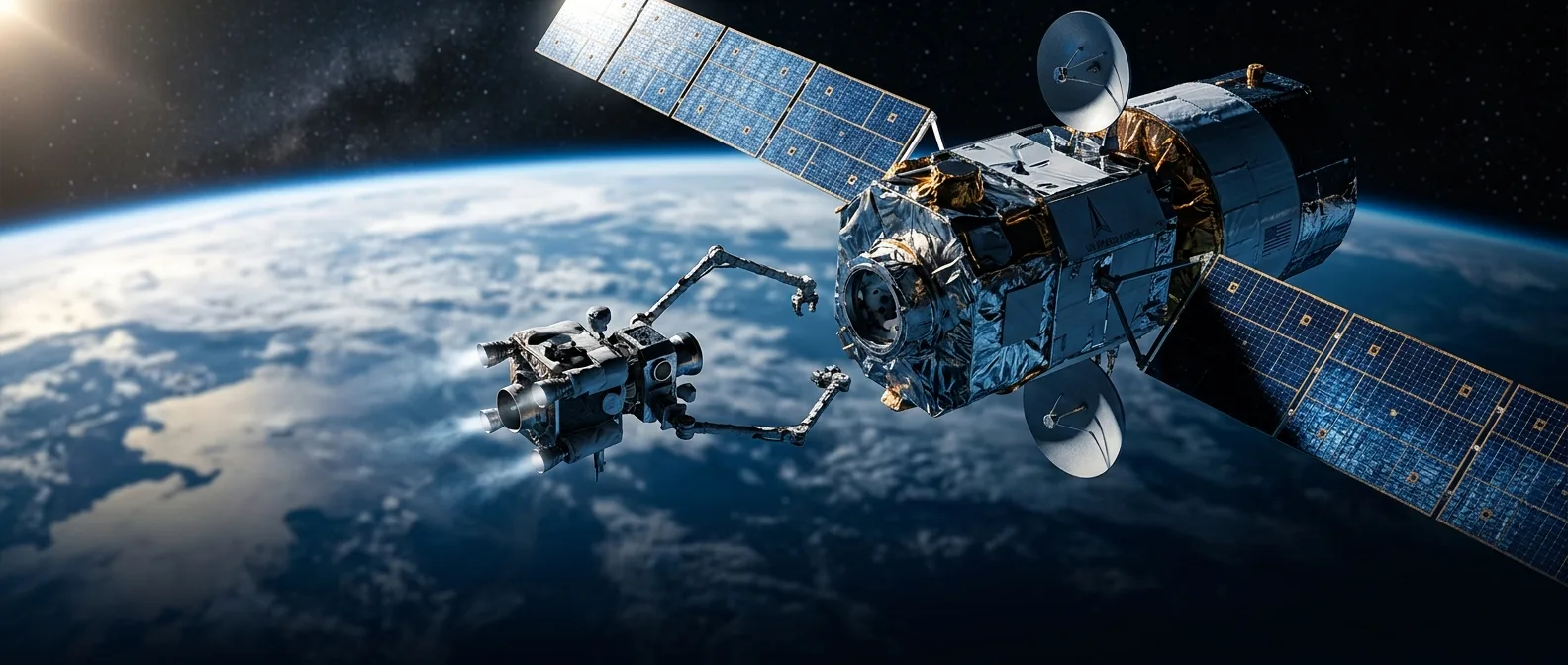
Four robots will test something that sounds like science fiction in 2026: satellite refueling in orbit. Instead of watching fuel run out and losing hundreds of millions in investments, Space Force is betting on the first generation of robotic "space mechanics."
In the world's most expensive "garage" — geosynchronous orbit 22,000 miles above Earth — sit over 500 satellites worth half a billion dollars each. When they run out of fuel, they become useless despite their systems working perfectly. China already pulled ahead, completing the first GEO refueling mission last June. Now the Americans are answering with four different satellite servicing missions.
📖 Read more: Axiom Space: First Commercial Space Station After ISS
🛰️ RSGS: The Robotic "Mechanic" for GEO
The most ambitious mission is SpaceLogistics' Mission Robotic Vehicle (MRV). This autonomous robotic satellite comes equipped with a robotic arm developed by the Naval Research Laboratory. DARPA funds it through the Robotic Servicing of Geosynchronous Satellites (RSGS) program.
The MRV isn't just a "fuel truck" with propellant. It can approach a satellite, grab it using the same docking rings used during launch, and install Mission Extension Pods — essentially extra fuel tanks that give the satellite new life.
Why GEO matters so much
In geosynchronous orbit, satellites stay fixed relative to a point on Earth. This makes them ideal for communications, weather, and military applications. Every year, 10-20 GEO satellites reach end-of-life simply because they exhaust their fuel.
Rob Hauge, SpaceLogistics president, explains the MRV can "do this again and again and again." It's not just about refueling — the robot can solve technical problems that crop up three times per year on average. Stuck solar panels or jammed antennas won't automatically spell mission death anymore.
📖 Read more: History of Space Exploration: A Complete Timeline
⛽ Three "Gas Stations" for Space
Beyond RSGS, the Pentagon funds three additional refueling missions for 2026. Each tests a different approach to the space maintenance problem.
Astroscale US Refueler: The First American
The U.S. subsidiary of Japan's Astroscale will perform the first American hydrazine refueling operation in GEO. The 660-pound spacecraft launches summer 2026 and will execute two refueling operations on a U.S. military satellite.
Funding comes from Space Force's Space Systems Command. Ron Lopez, Astroscale U.S. president, claims they're "changing the reality of what's possible." The mission aims to prove private companies can deliver operational capabilities on schedule and budget.
Tetra-5: Autonomous Docking in Space
Space Force's collaboration with the Air Force Research Laboratory targets autonomous Rendezvous, Proximity Operations and Docking technologies. Tetra-5 will combine autonomous approach learning with real inspection and refueling operations.
Kamino: The Mobile Fuel Tank
Funded by the Defense Innovation Unit, Kamino will place a satellite system in orbit that carries hydrazine specifically for transfer and delivery to other GEO satellites. Essentially, it's a floating gas station in space.
🔧 The Technical Challenge: Surgery in Vacuum
Satellite refueling is the closest thing to space surgery you can imagine. Robots must operate autonomously for hours, since communication delays with Earth can reach 3 seconds each way. One wrong move and a multimillion-dollar satellite gets destroyed.
Satellites were never designed for maintenance. It's like trying to change oil in a car without a hood. DARPA's James Shoemaker explains that often ground operators don't even know what exactly went wrong — they just see "something's not right" with a solar panel or antenna.
"Typically, DARPA does things first to prove you can do them, and then we hand them off and start doing something different."
James Shoemaker, DARPA program manager
DARPA had already proven refueling technology in 2007 with the Orbital Express program. But that happened in low orbit, where the economics don't work — satellites are cheaper and replacement is easier.
📖 Read more: Hubble Space Telescope: 35 Years of Cosmic Discovery
💰 The Economics of Space "Gas Stations"
The revolution lies in the economics. Greg Richardson from the Consortium for Space Mobility (COSMIC) puts it simply: "When you fill up your car, you don't need to buy the whole gas station." In GEO, one robotic "station" can serve multiple customers, dramatically cutting costs.
The math is clear: in low orbit, satellites cost a few million and are easy to replace. In GEO, they cost hundreds of millions and changing orbital inclination requires massive fuel. This makes maintenance investment not just logical, but necessary.
GEO Advantages
Stable coverage, high-value satellites, many customers in limited space
Technical Challenges
Autonomous operation, precise handling, radiation and temperature resistance
📖 Read more: Space Debris: The Growing Danger Orbiting Earth
🇨🇳 The Chinese Threat That Accelerated Everything
It's no coincidence that 2026 will see four American satellite servicing missions. In June 2024, two Chinese satellites performed the first refueling operation in geosynchronous orbit. Despite having a smaller satellite fleet, China led in this strategically critical technology.
Space Force sees "dynamic space operations" — the ability for satellites to maneuver as needed to approach or avoid hostile systems — as essential for winning a space conflict. Without this capability, every fuel-consuming maneuver shortens satellite life.
Already three times per year something goes wrong with a GEO satellite — a stuck solar panel joint, an antenna that won't deploy properly. Until now, ground operators try to "shake" the satellite to fix problems, burning precious fuel. With robotic servicing systems, they can send a "mechanic" to the location.
🎯 The Half-Billion Dollar Bet
The space servicing market isn't theoretical. Right now, over 300 commercial satellites in GEO provide television, radio, data transfer, weather, and telephony. Dozens of government satellites are also there. Each cost hundreds of millions to build and launch.
If governments and private companies could actively repair their GEO satellites — and move them to new orbits as needed — they could extend their investments and significantly delay the cost of building and launching replacements.
The stakes are enormous. If these technologies work, they could be the first steps toward space construction projects like massive solar arrays that can beam power back to Earth, robots that could mine asteroids and deflect those threatening Earth.
The Classic Chicken-and-Egg Problem
Satellites aren't designed for servicing because there are no robotic servicers to be compatible with. Nobody builds robotic servicers because there are no satellites to service them. This situation has persisted for decades.
The solution the 2026 missions are testing bypasses the dilemma entirely. Instead of waiting for satellite manufacturers to change designs, the robots will work with existing satellites — ones never designed for servicing.
If the quadruple bet of 2026 proves satellite servicing can be commercially viable, safe, and reliable, it will fundamentally change how we think about space investments. Instead of disposable satellites, we'll have long-term systems that evolve and get repaired in space.