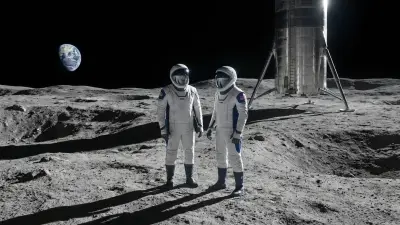
For the first time in over 50 years, humanity is preparing to set foot on the Moon again. The Artemis III mission, targeting a launch in 2027–2028, will send two astronauts to the Moon's south pole — a region no human has ever visited. Among the crew will be the first woman and the first person of color to walk on the lunar surface.
🌙 The Mission in Numbers
The mission will last approximately 30 days in total. Four astronauts will launch aboard the SLS rocket and Orion spacecraft. Upon reaching lunar orbit, two crew members will transfer to SpaceX's Starship HLS (Human Landing System) and descend to the surface. The other two will remain in orbit inside Orion.
🚀 The Spacecraft of Artemis III
🔧 SLS (Space Launch System)
The most powerful rocket ever built. The Block 1 configuration will launch the crew from Kennedy Space Center. Standing 98 meters tall with 39.1 meganewtons of thrust, it's the only rocket capable of sending Orion to the Moon.
🛸 Orion
The only spacecraft capable of returning crews to Earth at deep space reentry velocities. It will carry the 4 astronauts and dock with Starship HLS in lunar orbit.
🌑 Starship HLS (SpaceX)
SpaceX's lunar lander, based on Starship. Two astronauts will descend to the surface. It's the first commercial Human Landing System, selected by NASA in April 2021 for $2.89 billion.
🧑🚀 AxEMU (Axiom Space)
The new moonwalk spacesuit designed by Axiom Space. It offers greater mobility, protection from lunar dust, and integrated HD camera lights for transmitting images back to Earth.
🗺️ Where Will They Land? The South Pole
NASA has identified 9 candidate landing regions near the Moon's south pole. Each region contains multiple potential sites, evaluated based on access to permanently shadowed craters, solar illumination for power, and terrain slope for safe landing.
💧 Why the South Pole? The permanently shadowed craters at the south pole are believed to contain vast amounts of water ice beneath the surface. This water could be used for drinking, oxygen production, and even as rocket fuel (hydrogen + oxygen) — making the Moon a refueling station for future missions to Mars.
🔬 Science Objectives
NASA has defined three core areas of scientific research for Artemis III:
- Field geology: In-situ study of lunar terrain, rock photography, and analysis of the south pole's geological history.
- Sample collection: Collection and return of lunar samples to Earth for laboratory analysis — the first new lunar samples since Apollo 17 (1972).
- Surface experiments: Installation of scientific instruments that will remain on the Moon, measuring seismicity, temperature, and radiation.
The Moon is often referred to as the “cornerstone” of the solar system. The findings from Artemis III are expected to help scientists understand fundamental planetary processes that operate across the entire solar system.
⏰ Timeline: When Will It Happen?
Artemis III originally targeted a 2024 launch. That target has been gradually pushed back, and now NASA aims for 2027–2028. Readiness depends on three critical factors:
- Artemis II success: The first crewed flight around the Moon must be completed successfully before NASA can proceed to the third step.
- Starship HLS readiness: SpaceX's Starship must complete several test flights, including orbital flight, in-orbit refueling, and autonomous lunar landing.
- Spacesuits: Axiom Space's AxEMU suits must complete certification — a process that has faced delays.
"The Moon is often referred to as the cornerstone of the solar system. The Artemis III investigations aim to help scientists understand fundamental planetary processes."
🔭 After Artemis III: What Comes Next
Artemis III isn't the end, but the beginning. NASA plans annual landing missions: Artemis IV (2027–2028) will help build the Gateway station in lunar orbit, while Artemis V (2028–2029) will perform the second crewed landing. Artemis VI–VIII are planned for 2029–2031, gradually leading to permanent human presence on the Moon — and ultimately paving the road to Mars.
The Artemis III mission represents more than a return. It's the beginning of a new era where the Moon won't just be a destination, but a stepping stone for the deeper exploration of our solar system.