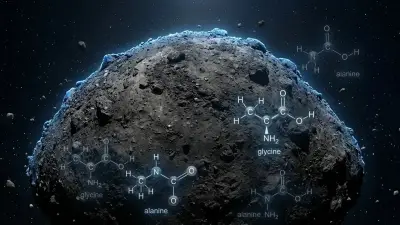
In September 2023, a capsule plummeted through Earth's atmosphere and landed in the Utah desert, carrying something priceless: 121.6 grams of dust and rocks from asteroid Bennu. NASA's OSIRIS-REx mission had just completed a seven-year journey, returning the most pristine extraterrestrial material ever collected. What scientists found inside the sample could fundamentally change our understanding of how life began in the universe.
📖 Read more: Europa Clipper: NASA's Mission to Jupiter's Ocean Moon
🪨 Asteroid Bennu
Bennu is a carbonaceous B-type asteroid with a diameter of approximately 500 meters — just slightly larger than the Empire State Building. It belongs to the category of “rubble pile” asteroids, meaning it is not a solid body but rather a loose collection of rocks held together by gravity. This structure makes it particularly interesting to scientists, as its material has remained virtually unchanged since the birth of our solar system, 4.5 billion years ago.
🚀 The OSIRIS-REx Mission
The OSIRIS-REx (Origins, Spectral Interpretation, Resource Identification, and Security–Regolith Explorer) mission launched in September 2016 and arrived at Bennu in December 2018. For nearly two years, the spacecraft meticulously mapped the asteroid's surface, searching for the ideal sampling location.
In October 2020, the TAGSAM (Touch-And-Go Sample Acquisition Mechanism) briefly touched Bennu's surface, firing a burst of nitrogen gas to disturb and collect material. The procedure was so successful that it gathered nearly triple the original target of 60 grams. The spacecraft then began its return journey, traveling 6.2 billion kilometers before the capsule landed on September 24, 2023.
📖 Read more: Habitable Exoplanets and the Chemistry of Life
🧬 The Findings
Analysis of the samples at NASA's Johnson Space Center revealed findings that exceeded every expectation. Scientists discovered:
- Amino acids: The fundamental building blocks of proteins, essential for every known form of life. Bennu contains multiple types of amino acids in remarkable quantities.
- Nucleobases: The molecules that form the basis of DNA and RNA, the molecules that encode genetic information.
- Phospholipids: Components that form cell membranes — the “envelope” that separates a cell from its environment.
- Hydrated clay minerals: Minerals containing water trapped in their crystal structure, proving that Bennu once interacted with liquid water.
💡 Why are phospholipids significant? Phospholipids are the molecules that form cell membranes in every living organism on Earth. Their discovery on an asteroid means that the basic “building materials” for creating cells may have arrived on Earth via cosmic bombardments billions of years ago.
⏳ Material Older Than the Sun
One of the most astonishing findings was the discovery of pre-solar grains within Bennu's samples. These are microscopic particles that formed in other stars before our Sun was even born. These grains are literally older than our solar system.
The Bennu sample is considered the most pristine extraterrestrial material ever analyzed. Unlike meteorites that pass through the atmosphere and become contaminated, this sample was collected directly and sealed in a sterile environment. Its analysis is expected to produce discoveries for decades, as only a small fraction has been examined so far — the rest is being preserved for future generations of scientists.
📖 Read more: Is There Life Elsewhere in the Universe?
⚠️ Impact Risk
Beyond its scientific value, Bennu concerns us for a more practical reason: it is a potentially hazardous asteroid. According to NASA's calculations, there is approximately a 1 in 2,700 chance it could impact Earth around 2182. While the probability seems small, a 500-meter object would cause catastrophic regional damage.
Detailed knowledge of Bennu's composition, structure, and orbit is a critical step for planetary defense. NASA's DART mission (2022) already proved that we can deflect an asteroid, and data from Bennu will help design future protection missions.
🔭 Next Up: Asteroid Apophis
After successfully delivering the sample, the spacecraft was not retired — it was renamed OSIRIS-APEX (OSIRIS-Apophis Explorer) and is now heading toward asteroid Apophis. The encounter is expected in April 2029, when Apophis will pass just 31,000 kilometers from Earth — closer than our geostationary satellites.
OSIRIS-APEX will study how the close approach to Earth affects Apophis's physics: changes in rotation, seismic activity on its surface, and potential landslides. The results will be invaluable for understanding near-Earth asteroids and planetary defense strategy. The OSIRIS-REx/APEX mission proves that asteroid exploration is not just a matter of curiosity — it is a matter of survival.