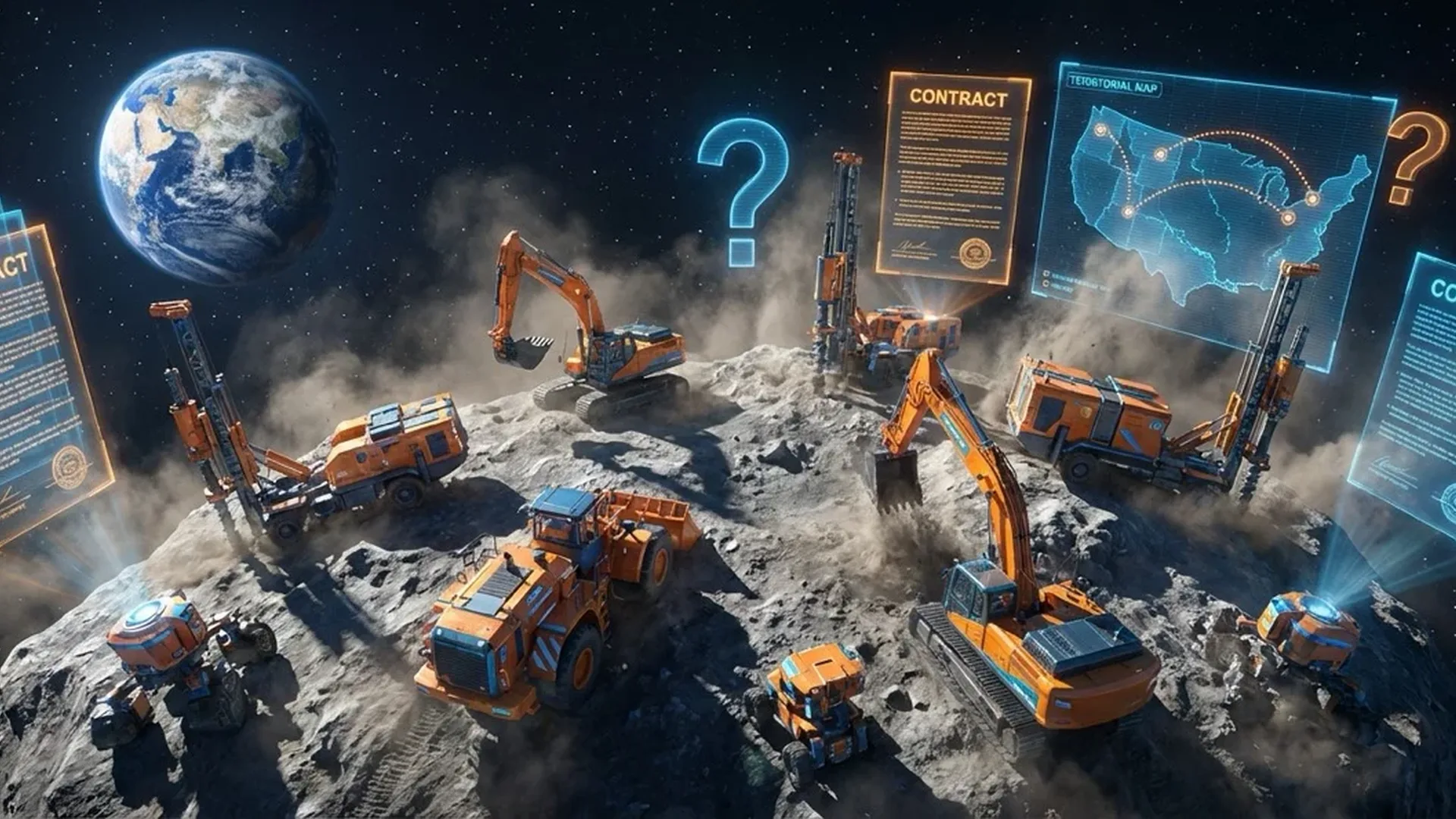
A California company successfully retrieved material from asteroid 33 Polyhymnia in early 2026. It was a breakthrough: AstroForge, an asteroid mining startup, deployed a robotic arm to extract and analyze a sample in situ, announcing findings of platinum, iridium, and rhodium traces. The result was celebrated across industry.
📖 Read more: Artemis II: Launch Delay Due to Hydrogen Leaks
But a new question immediately arose: who owns these metals? That question is examined extensively in a new analysis published in the journal Space on February 25, 2026, led by Prof. Frans von der Dunk of the Nebraska College of Law.
The Outer Space Treaty of 1967 and the Nations of Asteroids
The foundation of international space law is the Outer Space Treaty of 1967: signed by 114 countries, it states no nation may claim sovereignty over celestial bodies. It characterizes outer space as a “global commons” — shared heritage of humanity.
The problem: the treaty forbids national sovereignty but does not explicitly address ownership of resources. This gap was exploited by the American SPACE Act (2015), Luxembourg legislation (2017), UAE law (2019), and Norway. Prof. von der Dunk says: “Companies are operating under national legal frameworks with different gaps, not governed by universal rules. This leads to chaos.”
The Prize of the New Space Economy
Asteroids fall into two categories of interest for mining:
📖 Read more: Artemis III: When Will Humans Walk on the Moon Again?
— Metallic type: rich in iron, nickel, cobalt, platinum, rhodium, rare earths. Asteroid 16 Psyche alone is estimated at $10,000 quadrillion
— Water-rich type: contain water and oxygen that could fuel future deep space missions
Industry calculates that with 2030s technology, mining metallic asteroids will become economically viable. The platinum-group metals market alone could be worth trillions for companies that invest in this activity.
The Question of Ownership
Companies claim extracted asteroid materials under national laws. But opposing views in international law create tensions. According to von der Dunk, the SPACE Act allows American companies to retain what they extract — but doesn’t control the extraction itself under international space law. Conversely, countries like Russia and China argue there is no valid legal basis for claiming asteroid resources.
“There is currently no international body with jurisdiction to resolve disputes between companies or states about asteroid resources,” says Michelle Hanlon, general counsel of For All Moonkind. “We are flying into an explosive legal environment.”
📖 Read more: Asteroid Bennu: Amino Acids and the Building Blocks of Life
Proposals for Regulation
Von der Dunk and co-authors propose three alternative approaches:
1. A new international treaty specifically for asteroid extraction, under the aegis of COPUOS (UN Committee on the Peaceful Uses of Outer Space)
2. ISL-type regulation akin to the Seabed Treaty (non-binding)
3. Invalidation of national laws that violate the Outer Space Treaty
“The technology companies are moving faster than legislation can respond,” says von der Dunk. “If we don’t act now, we will find ourselves in a company-versus-company lawsuit over space pebbles.”
The analysis was funded by the University of Nebraska (Space, Cyber – Global Communications Program) and For All Moonkind, a nonprofit space law organization.