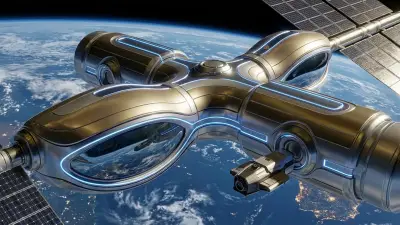
The International Space Station (ISS), the largest structure humanity has ever built in space, is approaching the end of its operational life. By 2030, the ISS is expected to be retired — but human presence in low Earth orbit won't stop. Axiom Space, a company headquartered in Houston, Texas, is building the world's first commercial space station — and simultaneously constructing the spacesuits that astronauts will wear on the Moon.
🏗️ The First Private Station
Axiom Space's plan is methodical and innovative. Rather than building a station from scratch in space, the company will attach commercial modules to the ISS. The first module is expected to dock with the ISS in the coming years, followed by additional modules for research, habitation, and Earth observation. When the ISS retires around 2030, the Axiom modules will detach and form a standalone station.
NASA selected Axiom Space in 2020 as the first commercial provider of an ISS module. This selection is part of NASA's strategy to transition from government-owned to commercial stations — reducing costs and freeing resources for lunar and Mars missions.
🧑🚀 Axiom Missions
Axiom Space has already completed multiple missions to the ISS. Ax-1 (April 2022) was the first fully private mission to the ISS, with a four-person crew spending 17 days in space. It was followed by Ax-2 and Ax-3, the latter featuring an international crew that included the first Turkish astronaut and members from Sweden and Italy. Ax-4 continues this series of “sovereign missions” — missions funded by countries that want to send their own astronauts to space.
These missions aren't simply space tourism. Each includes dozens of research experiments in microgravity — from pharmacology and biology to new materials and technologies.
🔧 Technology
Axiom's modules are designed with next-generation technology for life support, research capabilities, and larger Earth-observation windows than those on the ISS. The station will support continuous human presence in low Earth orbit, serving diverse needs.
🔬 Research
Microgravity labs for pharmaceuticals, biotechnology, and materials science. Companies and universities will lease space for experiments.
🌍 Tourism
Seats for private travelers who want to experience spaceflight. Greater comfort and larger Earth-viewing windows.
🏛️ Sovereign Missions
Countries without their own space programs can send astronauts. Turkey, Saudi Arabia, and Poland have already participated.
🏭 In-Space Manufacturing
Production of materials and products that can only be manufactured in microgravity — from optical fibers to bioprinted tissues.
👔 The Team
Leading Axiom Space is Michael Suffredini, former ISS program manager at NASA. His experience managing the largest space station in history gives Axiom a unique advantage: he knows exactly what a station needs to function, what fails, and how to avoid it.
The company is headquartered in Houston, Texas — next to NASA's Johnson Space Center — and employs hundreds of engineers and space technology specialists.
🧑🚀 AxEMU — The Moonwalk Suit: Beyond the station, Axiom Space is building the new AxEMU (Axiom Extravehicular Mobility Unit) spacesuit for the Artemis III mission. This will be the first new moonwalk suit in over 50 years — designed for greater mobility, protection from lunar dust, and integrated HD cameras for live broadcast to Earth.
🔮 After the ISS
When the ISS retires, Axiom won't be alone in low Earth orbit. Blue Origin is developing Orbital Reef in partnership with Sierra Space. Vast is designing Haven-1, a smaller but faster-to-deploy station. Northrop Grumman is also working on a commercial station. Competition is fierce, but Axiom has a significant head start: it's already flying missions.
The transition from the government-owned ISS to commercial stations marks a new era in space exploration. Instead of the government being owner and operator, it becomes a customer — purchasing services from private companies. This model, similar to what already applies for launches (SpaceX, ULA), promises lower costs and greater innovation in low Earth orbit.