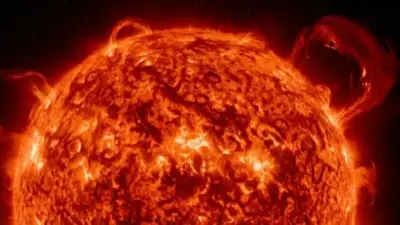
In the constellation of Orion, a reddish giant has drawn humanity's gaze for centuries. Betelgeuse (α Orionis) is a red supergiant — one of the largest and brightest stars known to us. And at some point, cosmically speaking «soon», it will explode in one of the most catastrophic events the universe knows: a supernova.
Quick Facts: Betelgeuse is approximately 700 light-years from Earth, has a diameter ~1,000× larger than the Sun, and is so enormous that if placed at the Sun's location, it would engulf Jupiter. Its mass is ~20 solar masses.
A Star Near the End
Betelgeuse is in the final stage of its life. It has already exhausted the hydrogen fuel in its core and is now fusing helium, carbon, and progressively heavier elements in successive «shells». When an iron core eventually forms — which can no longer release energy through fusion — the star will collapse in fractions of a second, and the sudden energy release will blast the outer layers into space.
The Great Dimming of 2019–2020
In October 2019, astronomers worldwide noticed something unusual: Betelgeuse became noticeably dimmer. By February 2020, its brightness had dropped to 40% of its normal value — an unusually large drop in recorded history. Headlines worldwide asked: «Is Betelgeuse about to explode?»
«The observed dimming was exciting, but ultimately crushing for our theorists — it was not a sign of imminent supernova.»
— Andrea Dupree, Harvard-Smithsonian Center for Astrophysics, 2021In 2021, the European Southern Observatory (ESO) announced the cause: Betelgeuse had ejected a massive cloud of material — a «Surface Mass Ejection» equivalent to 400 billion times normal solar wind events. This cloud partially obscured our view of the star, cooled and formed dust, temporarily reducing its brightness. Additionally, large convective cells of hot gas inside (surface convection) affected its behavior.
What Happens When It Explodes?
When Betelgeuse goes Type II supernova, it will be visible even in daylight — a «second Moon» in the sky for weeks or months. Models predict peak magnitude of -12 to -13, brighter than a full moon. The explosion will produce a neutron star or possibly a black hole.
Neutrino Burst
In a fraction of a second, Betelgeuse will emit an enormous number of neutrinos. Neutrino detectors worldwide, such as Super-Kamiokande in Japan, are expected to record thousands of events — well before visible light arrives, providing astronomers with minutes-to-hours of advance warning.
Is There Any Danger to Earth?
Despite sounding alarming, Betelgeuse is at a safe distance. At ~700 light-years, the radiation from a supernova poses no threat to Earth. The minimum dangerous distance for harmful radiation is estimated at 25–50 light-years — at least another order of magnitude closer. We will observe a spectacular astronomical event from perfect safety.
Remnant: Nebula or Black Hole?
Depending on the exact core mass at collapse, Betelgeuse will leave behind either a neutron star (pulsar) or a stellar-mass black hole. The ejected material will form a glowing nebula, similar to the Crab Nebula — remnant of the 1054 AD supernova recorded by Chinese astronomers. This nebula will be visible through telescopes for thousands of years.
Related Articles
Neutron Stars: The Universe's Zombies
What remains after a supernova? The densest objects outside black holes.
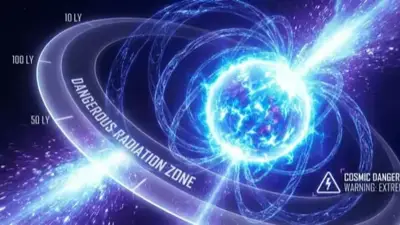
Magnetars: The Strongest Magnetic Fields
SGR 1806-20: 0.2 seconds of energy = 100,000 Sun-years in 2004.
Fermi Paradox: Where Is Everybody?
If the universe is teeming with life, why haven't we heard anything?
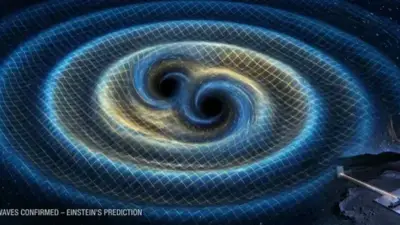
Gravitational Waves: The New Astronomy
LIGO 2015: the first detection of gravitational waves changed science forever.
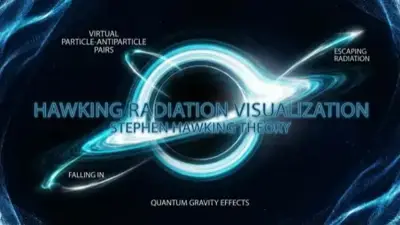
Hawking Radiation: Black Holes Evaporate
Hawking predicted in 1974 that black holes are not eternal.
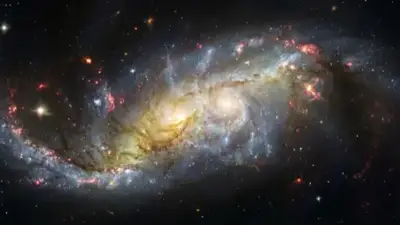
Milky Way-Andromeda Collision
In 4.5 billion years, both galaxies will perform a slow cosmic dance.