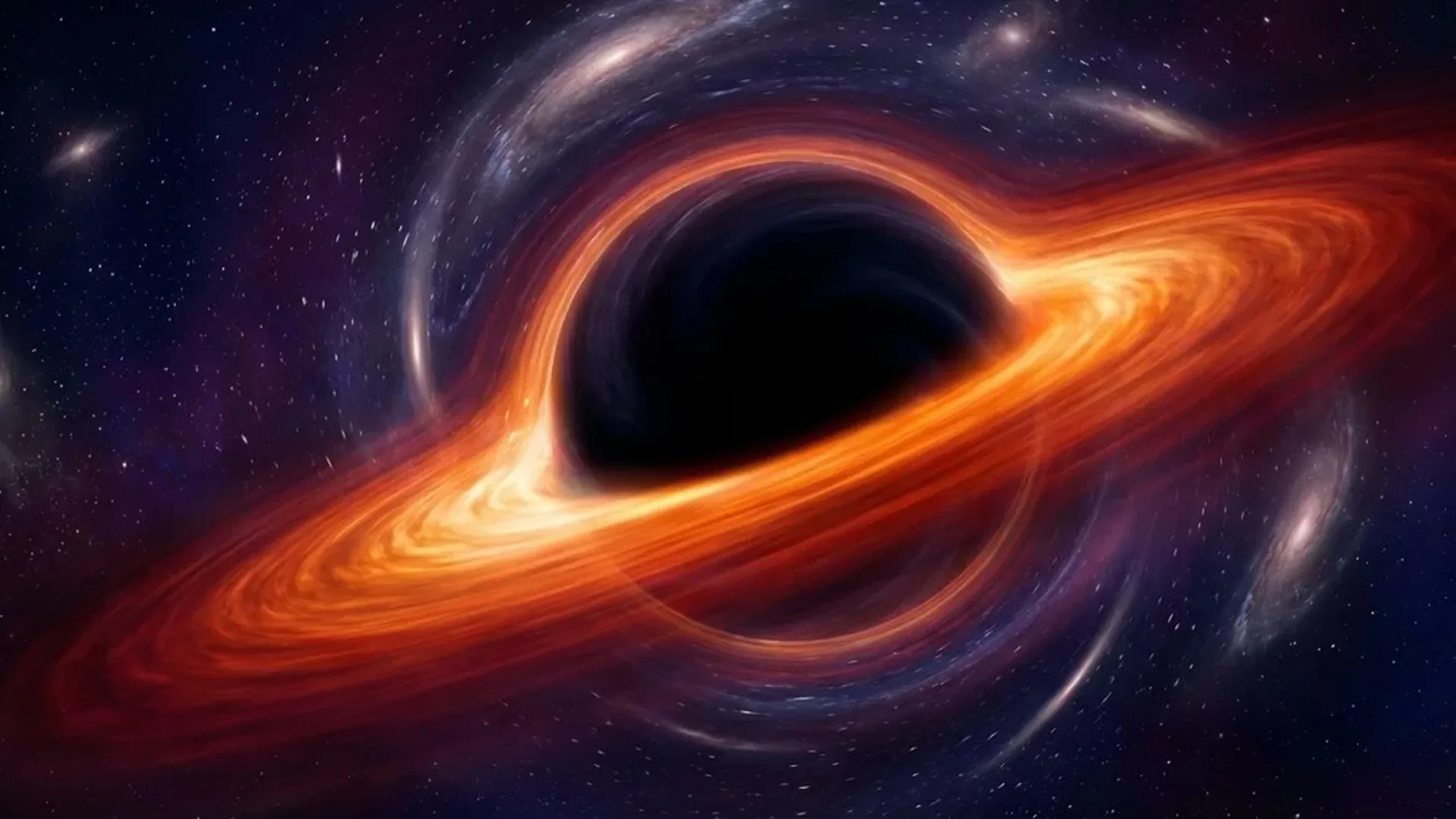
A black hole growing 13 times faster than the laws of physics should allow — while simultaneously blasting out intense X-rays and a powerful radio jet. This paradoxical, rule-breaking behavior was discovered in January 2026 by an international team of astronomers, forcing scientists to reconsider the foundations of cosmology itself.
🔭 The Eddington Limit — And How It Was Broken
There is a built-in “speed governor” for black hole growth: the Eddington limit. As gas and dust fall into a black hole, the process releases enormous amounts of radiation. This radiation pushes outward, creating a natural barrier: beyond a certain point, the outward pressure blows away the very material the black hole is trying to consume, slowing its growth. This theoretical maximum is tied to the black hole's mass and is called the Eddington luminosity.
The vast majority of known black holes respect this limit. Some extreme cases may slightly exceed it for brief periods — a phenomenon called super-Eddington accretion. But 13 times over the limit? That was in a completely different league.
🔭 The Discovery: A Quasar That Breaks All the Rules
An international team led by researchers from Waseda University and Tohoku University in Japan used the Subaru Telescope's MOIRCS near-infrared spectrograph to study an unusual quasar in the early Universe. The results were published in the Astrophysical Journal on January 21, 2026.
By tracking the motion of gas around the quasar and analyzing the Mg II (2800 Å) emission line, the astronomers estimated the black hole's mass. Its redshift — z=3.4 — means the light reaching us today began its journey 12 billion years ago, when the Universe was young and still chaotic.
The startling finding: the quasar is accreting matter at a rate roughly 13 times the Eddington limit based on X-ray measurements. This isn't just unusual — it is theoretically very difficult to explain.
"This discovery may bring us closer to understanding how supermassive black holes formed so quickly in the early Universe."
🔭 The Paradox: X-rays + Radio Jet at the Same Time
Even more puzzling than the growth rate was the combination of emissions. During super-Eddington accretion, most theoretical models predict that the inner structure of the accretion disk changes drastically — the corona region (source of X-rays) weakens and radio jet activity is suppressed.
Instead, this quasar remained extremely bright in X-rays while also sustaining a powerful radio jet. This paradoxical combination has almost never been observed in systems growing at such a pace, making this object a unique find at the time of publication.
💡 Why Is This So Rare?
In most models, super-Eddington accretion leads to structural changes in the inner disk that “quench” the X-ray corona and suppress the radio jet. For all three to coexist — extreme accretion rate, intense X-rays, and a radio jet — is a theoretical puzzle requiring new physics to explain.
🔭 The “Transitional Phase” Theory
The researchers suggest the quasar is being caught in a rare transitional period: a sudden influx of gas has pushed it into a super-Eddington state. During this phase, both the active X-ray corona and the powerful radio jet remain energized — but only for a limited time, before the system gradually settles into a more typical mode of growth.
If this interpretation holds, then such objects can only be studied if caught at exactly the right moment, making them extraordinarily rare in surveys. This explains why no comparable example had been observed with such clarity before.
🔭 Implications for Galaxy Evolution
The powerful radio signal indicates the jet carries enough energy to affect the host galaxy. Such jets can heat or disrupt gas within galaxies, potentially influencing star formation rates and shaping the co-evolution of galaxies and their central black holes.
The observation also adds vital evidence to a question that has long puzzled astronomers: how did supermassive black holes become so massive so quickly after the Big Bang? Existing models struggle to explain the existence of billions of solar masses in objects dating back mere hundreds of millions of years after the beginning. Brief episodes of extreme accretion like this one could be part of the answer.
🔬 Subaru Telescope
Japan's national optical-infrared telescope in Hawaii was used for spectral analysis. The MOIRCS spectrograph enabled black hole mass measurement via the Mg II emission line.
⚡ Super-Eddington Accretion
A state where the black hole consumes matter faster than theoretically “permitted.” Observed rarely, it is thought to last for a limited time before the system dynamics stabilize.
📡 The Radio Jet
Launched across cosmic distances, this quasar's jet carries enough energy to reshape the host galaxy itself, affecting star formation rates for millions of years to come.
🔭 What Comes Next
Lead author Sakiko Obuchi (Waseda University) announced that the team plans to investigate what powers the unusually strong X-ray and radio emissions, and whether similar objects may be hiding in existing survey databases. With the next generation of space telescopes — the James Webb Space Telescope and future Roman Space Telescope — such quasars will be catalogued in far greater numbers, giving astronomers a sample large enough for statistical analysis.
The discovery was published as Obuchi et al., "Discovery of an X-ray Luminous Radio-Loud Quasar at z=3.4: A Possible Transitional Super-Eddington Phase" in the Astrophysical Journal on January 21, 2026 — placing a giant question mark over everything we thought we knew about the infant Universe.