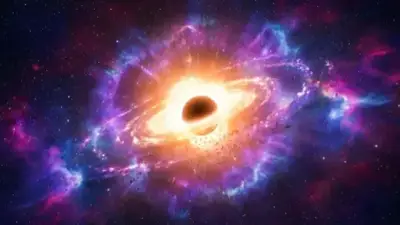
They are the strangest and most mysterious objects in the universe: enormous amounts of matter compressed into such a small space that not even light can escape their gravitational pull. Black holes are no longer just theoretical constructs — in 2019, the Event Horizon Telescope gave us the first real photograph of a black hole at the center of galaxy M87, and in 2022 came Sagittarius A*, the supermassive black hole at the heart of our own Milky Way. But how exactly is this astronomical monster created? What path does a star or a gas cloud follow to become one of the most powerful entities in the cosmos?
⚫ What Is a Black Hole, Really?
A black hole is not a void or a hole in space. It is real, extremely dense matter — so compressed that its gravity becomes insurmountable. According to NASA, a black hole is an enormous concentration of matter packed into an extraordinarily small space.
Surrounding every black hole is the event horizon — the point of no return. Once anything crosses this boundary, whether a photon, matter, or energy, escape is impossible. At the absolute center lies the singularity, a point where the known laws of physics cease to apply. Importantly, black holes do not indiscriminately “suck in” everything around them. From a sufficient distance, their gravity behaves exactly like any other object of equal mass, NASA emphasizes.
The existence of black holes was mathematically predicted in 1915 by Karl Schwarzschild, through the equations of Einstein's General Theory of Relativity. The term “black hole” was coined much later, in 1967, by American astronomer John Wheeler.
💥 The Death of Massive Stars: The Primary Mechanism
The main mechanism for creating black holes is stellar collapse. When a very large star — with an initial mass at least 8–10 times that of the Sun — exhausts the hydrogen fueling its nuclear reactions, it loses the internal pressure resisting gravity. It then collapses inward at tremendous speed and explodes in a supernova.
If the remnant of the explosion has a mass greater than ~3 solar masses, gravity continues to compress it relentlessly — until a stellar black hole forms. Lower-mass stars leave behind neutron stars or white dwarfs — not black holes.
There is also a rarer, remarkable phenomenon: some very massive stars can collapse directly into a black hole without producing a supernova — as if they simply “switch off” in the universe. According to Space.com, in January 2025, astronomers witnessed exactly this in real time: a star in the Andromeda galaxy vanished abruptly, leaving behind a new black hole.
🔑 What Does It Take to Form a Black Hole?
A star must have an initial mass at least 8–10 times greater than the Sun to be able to form a black hole after its death. The supernova remnant must exceed ~3 solar masses — the so-called Tolman–Oppenheimer–Volkoff limit. Below this threshold, a neutron star forms instead. Our Sun, with its relatively modest mass, does not meet these criteria — it will become a white dwarf.
🔭 The Three Types of Black Holes
Scientists have identified three main categories of black holes, each with a different origin and scale.
Stellar black holes: The smallest and most common — mass up to a few dozen solar masses but roughly the size of a city. According to Space.com, the Milky Way is estimated to harbor between 10 million and 1 billion stellar black holes.
Supermassive black holes: Millions to billions of times heavier than the Sun. Found at the center of nearly every large galaxy — including ours, where Sagittarius A* weighs in at 4 million solar masses.
Intermediate black holes (IMBHs): With masses in the thousands of solar masses. Theoretically formed from chain-reaction stellar collisions in star clusters — several IMBHs in the same region can eventually merge and form a supermassive black hole. For years their existence was theoretical; recently, observations from NASA's Chandra X-ray Observatory and gravitational waves from LIGO have begun revealing the first credible candidates.
🌌 Supermassive Black Holes: The Great Mystery
How supermassive black holes formed remains one of the central open questions in astrophysics. The main scenarios under study include four possibilities:
- Gradual merging: Hundreds or thousands of small stellar black holes merged progressively during the first millions of years of the universe.
- Direct gas collapse: A large gas cloud collapsed directly, bypassing star formation, producing a black hole “seed” with a mass of 1,000 to 100,000 solar masses.
- Stellar cluster collapse: An entire group of stars collapsed simultaneously toward its center.
- Dark matter: Large concentrations of dark matter in the early universe may have served as “seeds” for supermassive black holes.
The James Webb Space Telescope (JWST) recently discovered mysterious “Little Red Dots” in the early universe — candidate evidence for the direct collapse model, according to Space.com.
"Black holes are expected to form via two distinct channels. According to the first pathway, they are stellar corpses — they form when massive stars die. Another way that black holes form is from the direct collapse of gas, a process that is expected to result in more massive black holes and is believed to operate in the early universe."
— Priyamvada Natarajan, Theoretical Astrophysicist, Yale University (Space.com)📡 How Do We Detect Black Holes?
Black holes neither emit nor reflect light — they are invisible to conventional telescopes. Astronomers detect them exclusively through indirect means, using four key methods according to NASA:
First, the accretion disk — a ring of gas and dust spinning at enormous speed around the black hole — emits X-ray radiation. This is how Cygnus X-1 was identified in 1964, the first recognized candidate.
Second, observing star orbits around galactic centers proves the presence of a supermassive black hole — this methodology earned astronomers Andrea Ghez and Reinhard Genzel the Nobel Prize in Physics 2020.
Third, gravitational waves detected by LIGO (and Virgo) since 2015 provide direct evidence of black hole mergers — tremors in the fabric of spacetime.
Fourth, gravitational lensing reveals “dark” black holes that would otherwise remain invisible, as their gravity bends light from behind them.
🚀 Current Research: What Are We Learning Today?
In February 2026, archival data from the NASA/NEOWISE satellite revealed, in unprecedented detail, the transformation of a star into a black hole — confirming the “silent collapse” (failed supernova) phenomenon that had been theoretically predicted for decades.
JWST is continuously rewriting our understanding of the earliest black holes in the universe, detecting objects that appear far more massive than the current cosmological model should allow. Meanwhile, NASA and ESA are advancing LISA (Laser Interferometer Space Antenna) — a space-based gravitational wave observatory that promises to answer questions about the birth of supermassive black holes that remain unanswered today.