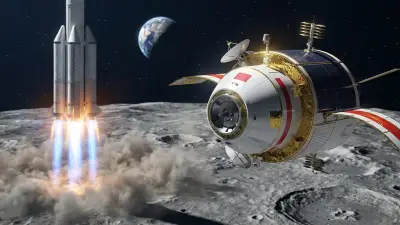
China has evolved into one of the most ambitious space powers of the 21st century, with its lunar program serving as the cornerstone of its strategy. From the first robotic Chang'e missions to the goal of a crewed lunar landing by 2030, the China National Space Administration (CNSA) is methodically advancing a program that encompasses sample collection, south pole exploration, and the construction of a permanent lunar base.
🌙 The Chang'e Program: From Orbit to the Far Side
The Chang'e program — named after the Chinese goddess of the Moon — began in 2007 with the Chang'e-1 orbiter. Since then, each mission has progressively increased in complexity and ambition:
- Chang'e-1 & 2 (2007-2010): Mapping orbiters that created detailed three-dimensional models of the lunar surface.
- Chang'e-3 (2013): China's first lunar landing — the Yutu rover explored Mare Imbrium, making China the third country to achieve a soft landing on the Moon.
- Chang'e-4 (2019): The first mission in history to land on the far side of the Moon — a historic first that neither the US nor the Soviet Union had achieved.
- Chang'e-5 (2020): Collected and returned 1.73 kilograms of lunar samples to Earth — the first new samples since the Soviet Luna 24 in 1976.
- Chang'e-6 (2024): The first mission ever to collect samples from the far side of the Moon — an entirely pioneering achievement.
🚀 Chang'e-7 and Chang'e-8: The Road to the South Pole
The next two missions are critical for China's future plans on the Moon. Chang'e-7, planned for 2026, will explore the lunar south pole — a region of tremendous scientific interest. Its primary objective is the search for water ice in permanently shadowed craters, using a rover, a mini flying drone, and specialized sensors.
Chang'e-8, expected around 2028, will test ISRU (In-Situ Resource Utilization) technologies — using lunar resources on-site. This includes extracting oxygen from lunar soil, 3D printing with lunar dust, and experiments that will pave the way for permanent human habitation.
👨🚀 Crewed Lunar Mission: The 2030 Target
China is not hiding its ambition: the goal is for Chinese astronauts (taikonauts) to walk on the Moon by 2030. To achieve this, three critical systems are being developed simultaneously:
- Long March 10: The new heavy-lift rocket, specifically designed for crewed lunar missions. With thrust exceeding 26 meganewtons, it can send 27 tons to trans-lunar injection orbit. Engine testing is already underway.
- Mengzhou (Dream Vessel): The new crew capsule, capable of carrying 3 astronauts to lunar orbit and returning them to Earth. Designed for reusability, it can accommodate up to 6 astronauts for low-orbit missions.
- Lanyue (Lunar Lander): The lander that will carry 2 astronauts from lunar orbit to the surface. It can transport 200 kilograms of equipment for exploration within a radius of kilometers.
In February 2026, CNSA conducted a successful test of the Long March 10 alongside an abort test of the Mengzhou capsule — a critical safety milestone confirming the program is on schedule.
🏗️ ILRS Lunar Base: Permanent Presence on the Moon
Beyond individual missions, China is planning something bigger: the creation of a permanent lunar base. The International Lunar Research Station (ILRS) is a joint program with Russia (Roscosmos), targeting operations in the 2030s.
The base will be built in phases, starting with robotic missions and evolving into a facility capable of hosting humans for extended periods. The location will be near the south pole, for access to water ice and near-permanent sunlight. Besides Russia, countries including Pakistan, Belarus, Venezuela, and South Africa have expressed interest in participating.
🏆 Historic First: In 2019, China became the first and only country to successfully land on the far side of the Moon — a technological first that neither the USA nor the Soviet Union had achieved. The Chang'e-4 mission used the Queqiao relay satellite, positioned at the L2 Lagrange point, to communicate with Earth from behind the Moon.
⚡ Why the Moon? Resources and Strategic Importance
The Moon is not merely a symbol of prestige — it is a treasure trove of resources. Water ice at the south pole can be converted into drinking water, breathable oxygen, and rocket fuel (hydrogen + oxygen). This would make the Moon a refueling station for missions deep into the solar system.
Of particular interest is Helium-3, an isotope rare on Earth but abundant on the lunar surface. It is considered a potential fuel for future nuclear fusion reactors, with the capacity to produce enormous amounts of energy without radioactive waste. The Chinese government has repeatedly cited Helium-3 as a long-term incentive for lunar mining.
Geopolitically, the Moon represents a field of strategic competition. With the Tiangong station fully operational in Earth orbit and an ambitious lunar program underway, China is establishing itself as the second-largest space power in the world — and in some areas, perhaps the first.