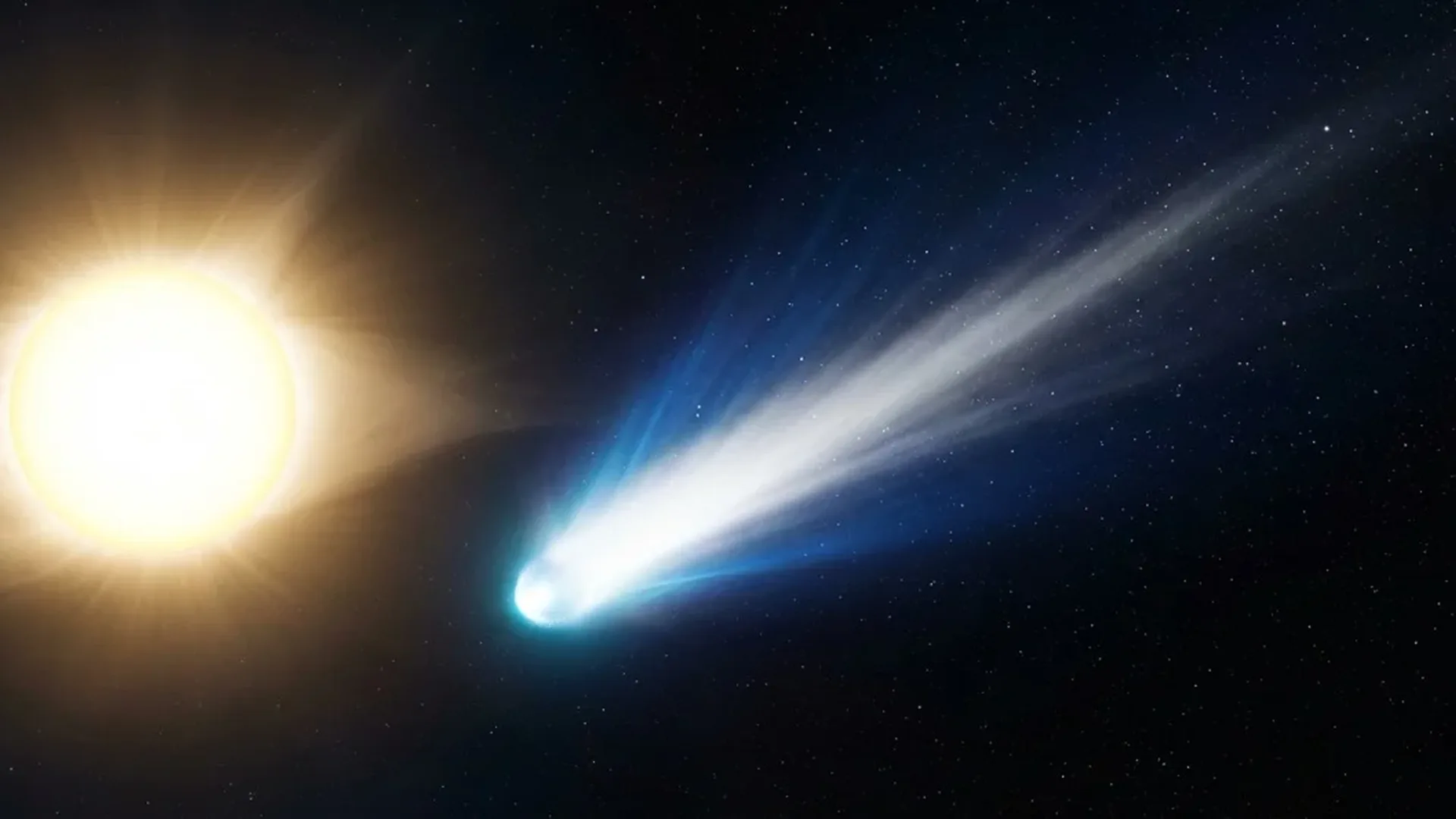
On July 1, 2025, the ATLAS survey telescope in Chile detected a faint object moving unusually fast. Within 48 hours, its orbit was confirmed as hyperbolic — it was not gravitationally bound to the Sun. Comet 3I/ATLAS became only the third known interstellar object to pass through our solar system, after the mysterious 1I/ʻOumuamua (2017) and 2I/Borisov (2019).
📖 Read more: Betelgeuse: Will We Witness the Supernova?
🔭 Discovery and First Observations
Initially cataloged as A11pl3Z, the object was first detected at a distance of roughly 670 million kilometers from the Sun. Just two days later, the Gemini North Observatory in Hawaii captured the first detailed images, revealing a fuzzy object with a short tail — a clear sign of outgassing activity.
Peter Veres, an astronomer at the International Astronomical Union's Minor Planet Center, stated: "It looks kind of fuzzy — it seems that there is some gas around it, and one or two telescopes reported a very short tail." Astronomers worldwide immediately searched archival data and traced the comet's path back to at least June 14. Furthermore, NASA's TESS mission revealed it had captured images of the object two months before its official discovery.
🔭 The Oldest Comet Ever Observed
The orbit of 3I/ATLAS revealed something extraordinary: it doesn't travel in the usual galactic plane, but follows a steep trajectory suggesting an origin in the “thick disk” — a region of ancient stars above and below the main disk of our Milky Way galaxy.
Matthew Hopkins of the University of Oxford calculated that the comet may be over 7 billion years old — meaning it formed before our own solar system was born. "All non-interstellar comets, such as Halley's Comet, formed with our solar system, so are up to 4.5 billion years old," he explained. “But interstellar visitors have the potential to be far older.”
"We think there's a two-thirds chance this comet is older than the solar system, and that it's been drifting through interstellar space ever since."
🔭 Composition: What SPHEREx Revealed
As the comet approached the Sun, heating triggered ice sublimation — the direct conversion of solids into gases. Before perihelion (August 2025), the SPHEREx observatory detected barely detectable H₂O and primarily CO₂. In new observations in December, after the perihelion passage (October 29), the data were dramatic:
- CO and H₂O emissions increased 20-fold
- New gases were detected: CN, organic C-H compounds (methanol, formaldehyde, methane)
- The dust exhibited a pear-shaped coma pointing toward the Sun
The study reached a remarkable conclusion: the composition of 3I/ATLAS is consistent with comets in our own solar system. This suggests similar formation processes operate in different star systems across the galaxy.
💡 What Is an “Interstellar Object”?
An interstellar object (ISO) is a body not gravitationally bound to any star. It travels on a hyperbolic orbit — at a speed so great that the Sun's gravity cannot capture it. Models estimate that hundreds of thousands of such objects may be passing through our solar system at any given time.
🔭 Comparison with Its Predecessors
3I/ATLAS differs significantly from the two previous interstellar objects:
☄️ 1I/ʻOumuamua (2017)
The first — strangely elongated, no visible tail, unexplained acceleration. Some (Avi Loeb, Harvard) suggested artificial origin, but newer studies indicate hydrogen sublimation.
☄️ 2I/Borisov (2019)
The first recognized interstellar comet. Roughly 1 km in size, CO-rich, with a typical cometary tail. Detected early enough for extended study.
☄️ 3I/ATLAS (2025)
Possibly the largest (10-20 km), water ice-rich, extremely fast (>60 km/s). Imaged by ESA, CNSA, and SPHEREx. Potentially the oldest comet ever observed.
🔭 Observation Missions and the Future
Observing 3I/ATLAS became a global astronomical campaign. ESA's Mars Express and ExoMars TGO missions captured it passing near Mars in October. China's Tianwen-1 mission obtained images with its high-resolution camera in November. Radio telescopes even searched (unsuccessfully) for signs of artificial origin.
Looking ahead, ESA's Comet Interceptor, scheduled for launch in 2029, could intercept a similar target — perhaps even a new interstellar object. The development of telescopes like the Vera C. Rubin Observatory is expected to detect 5 to 50 new such objects by the 2030s.
📚 Sources
- Phys.org — “Third-ever confirmed interstellar object blazing through solar system” (July 2025)
- Phys.org / Royal Astronomical Society — “3I/ATLAS: Interstellar object may be oldest comet ever seen” (July 2025)
- Phys.org — “SPHEREx imaging reveals increased sublimation activity on 3I/ATLAS” (January 2026)
- Hopkins et al. — "From a Different Star: 3I/ATLAS in the context of the Ōtautahi-Oxford interstellar object population model" arXiv (2025)