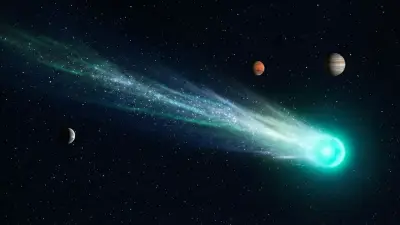
Comets are perhaps the most spectacular sights the night sky has to offer. Since ancient times, these “stars with tails” have appeared suddenly, inspiring awe and wonder. In recent years, a series of extraordinary comets has lit up our skies — from the dazzling C/2024 G3 (ATLAS) to the unforgettable Neowise. Let's explore the most spectacular comets of our era and the mechanism that makes them shine.
📖 Read more: Meteor Showers 2026: Your Complete Guide
☄️ Comet ATLAS C/2024 G3: The Sungrazer of 2025
In January 2025, Comet C/2024 G3 (ATLAS) passed within just 0.09 AU of the Sun — closer than Mercury's orbit. This extremely close passage made it a “sungrazer,” a comet that skims the Sun. At its perihelion on January 13, 2025, the surface temperature exceeded 1,000°C, while the ice core remained below -40°C in its interior.
ATLAS C/2024 G3 was one of the brightest comets in recent years, although its low position on the horizon made observation difficult for most viewers. Sungrazing comets can become spectacularly bright, but many disintegrate during their passage, shattered by the enormous gravitational and thermal stresses near the Sun.
🌟 Tsuchinshan-ATLAS: The Comet of 2024
Just a few months earlier, in October 2024, Comet C/2023 A3 (Tsuchinshan-ATLAS) earned the title of “comet of the year.” Discovered in January 2023 by the Purple Mountain Observatory in China and the ATLAS system, it gradually brightened as it approached the Sun. By October 2024, it became visible to the naked eye, displaying a stunning dust tail stretching tens of degrees across the sky.
📖 Read more: Total Lunar Eclipse March 2026: When and Where to See It
Tsuchinshan-ATLAS was the first comet since Neowise (2020) to become truly visible without a telescope, offering a celestial show that reminded many of the great cometary appearances of the past.
🔭 The ATLAS System: Eyes Scanning the Sky
Behind many recent comet discoveries lies the ATLAS (Asteroid Terrestrial-impact Last Alert System), a NASA-funded telescope network. With stations in Hawaii, Chile, and South Africa, ATLAS scans the entire visible sky every 24 hours, searching for asteroids and comets approaching Earth.
The system was originally designed as a “last warning system” for asteroids that could strike Earth, but it proved exceptionally capable at discovering comets. It detects objects moving against background stars, allowing astronomers to direct larger telescopes for detailed study.
📖 Read more: Black Hole Growing 13 Times Faster Than Physics Allows
💫 How Comets Work
A comet is essentially a “dirty snowball” — a mix of ice, dust, and rocky materials originating from the outer edges of our Solar System. As it approaches the Sun, the ice sublimates (turns directly from solid to gas), creating a glowing atmosphere around the nucleus known as the coma.
Solar radiation and solar wind push the gases and dust, creating two distinct tails: the gas (ion) tail always points directly away from the Sun and appears bluish. The dust tail follows a curved path and appears yellowish-white. Some comets develop tails extending millions of kilometers.
💫 Halley's Comet: The most famous periodic comet returns every ~76 years. Its last appearance was in 1986, and the next is expected in 2061. It is the only short-period comet regularly visible to the naked eye — meaning a lucky person can see it twice in their lifetime.
📖 Read more: Comet 3I/ATLAS: The New Interstellar Visitor Has Arrived
🌌 Famous Comets in History
Comet Neowise (C/2020 F3) appeared in July 2020 and was undoubtedly the most spectacular comet in decades. Visible to the naked eye even from urban areas, it created a stunning tail photographed millions of times around the world. Its orbit brings it back in approximately 6,800 years.
Hale-Bopp (C/1995 O1) dominated the sky in 1997, remaining visible to the naked eye for a record 18 months. It was perhaps the most widely observed comet in history, thanks to its great brightness and prolonged visibility. Before that, Comet West (1976) had stolen the show with its spectacular fan-shaped dust tail.
📅 What to Expect: Future Comets
Cometary astronomy continues to surprise us. Telescopes like ATLAS, the Vera Rubin Observatory (expected to begin full operations soon) and the James Webb Space Telescope will discover new comets at an increasing rate. Long-period comets — those coming from the Oort Cloud at distances of thousands of AU — can appear at any time, making every night potentially exciting.
For amateur astronomers, comet observation doesn't require expensive equipment. A good pair of binoculars (7×50 or 10×50) is enough to see most bright comets, while a small telescope can reveal details in the coma and tails. Mobile astronomy apps like Stellarium help you locate exactly where each comet is in the sky.