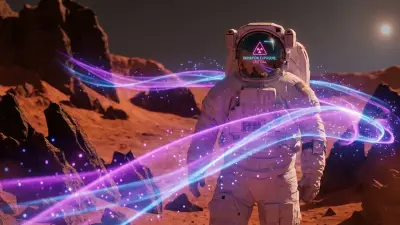
Space is a hostile environment for the human body. And the greatest invisible danger is not the vacuum or microgravity — it is cosmic radiation. For future missions to the Moon and Mars, radiation represents the single greatest health challenge.
☢️ Types of Space Radiation
Space radiation comes from three main sources. Galactic Cosmic Rays (GCRs) are high-energy particles originating from supernova explosions and other violent cosmic events. They are the most dangerous type because they penetrate deep into tissues and shielding against them is extremely difficult.
Solar Particle Events (SPEs) originate from solar flares and coronal mass ejections (CMEs). They can be extremely intense but brief — lasting hours to days. A strong SPE can be lethal to an astronaut without shelter.
The Van Allen Belts are regions of trapped radiation around Earth, formed by the planet's magnetic field. Spacecraft must pass quickly through these belts during launch.
🧬 Effects on the Body
Cosmic radiation causes DNA damage, breaking chains and inducing mutations. The consequences include increased cancer risk, cataracts, cardiovascular disease, and effects on the Central Nervous System (CNS).
On the ISS, astronauts receive 0.5–1 mSv per day. Compare this to the 3 mSv that the average person receives in an entire year on Earth. In 6 months on the ISS, an astronaut receives approximately 100–180 mSv — that is 30–60 times more than the annual dose on Earth.
In 2022, NASA updated its career radiation limit to 600 mSv for all astronauts — regardless of age and sex. This means a Mars mission (~1.2 Sv) would exceed the career limit in a single mission.
🛡️ Shielding
Current shielding uses polyethylene, which is hydrogen-rich and offers partial protection against SPEs. However, against GCRs it is nearly powerless: heavy ions (HZE) penetrate almost any material.
Water and hydrogen-rich materials are the best available shielding materials. Some proposals include using water tanks as habitat walls — simultaneously providing protection and potable water storage.
🔴 The Danger on Mars
Mars has no global magnetic field and no dense atmosphere. This means its surface receives much higher radiation than Earth. Curiosity measured approximately 0.67 mSv/day on the Martian surface.
For a typical Mars mission (6–9 months travel, 500 days on the surface, 6–9 months return), the total dose is estimated at around 1.2 Sv. This increases the cancer risk by approximately 5%.
⚠️ Comparison: An astronaut on the ISS receives in one day as much radiation as the average person on Earth receives in 2–4 months. For the trip to Mars, the dose is even greater.
🔬 BioSentinel
NASA's BioSentinel mission launched in 2022 to study the effects of radiation on yeast in deep space. It is the first biological experiment in deep space in decades. The results will help understand how radiation affects living organisms beyond the protection of Earth's magnetosphere.
🔮 Future Solutions
Researchers are exploring various solutions. Active magnetic shielding would create an artificial magnetic field around the spacecraft, deflecting charged particles — similar to what Earth's magnetic field does. On Mars, underground habitats or dwellings covered with Martian regolith would provide natural protection.
Pharmacological solutions are also being researched — drugs that enhance DNA repair mechanisms or protect cells from damage. Radiation remains the greatest obstacle to human deep space exploration — but science is making progress toward solutions.