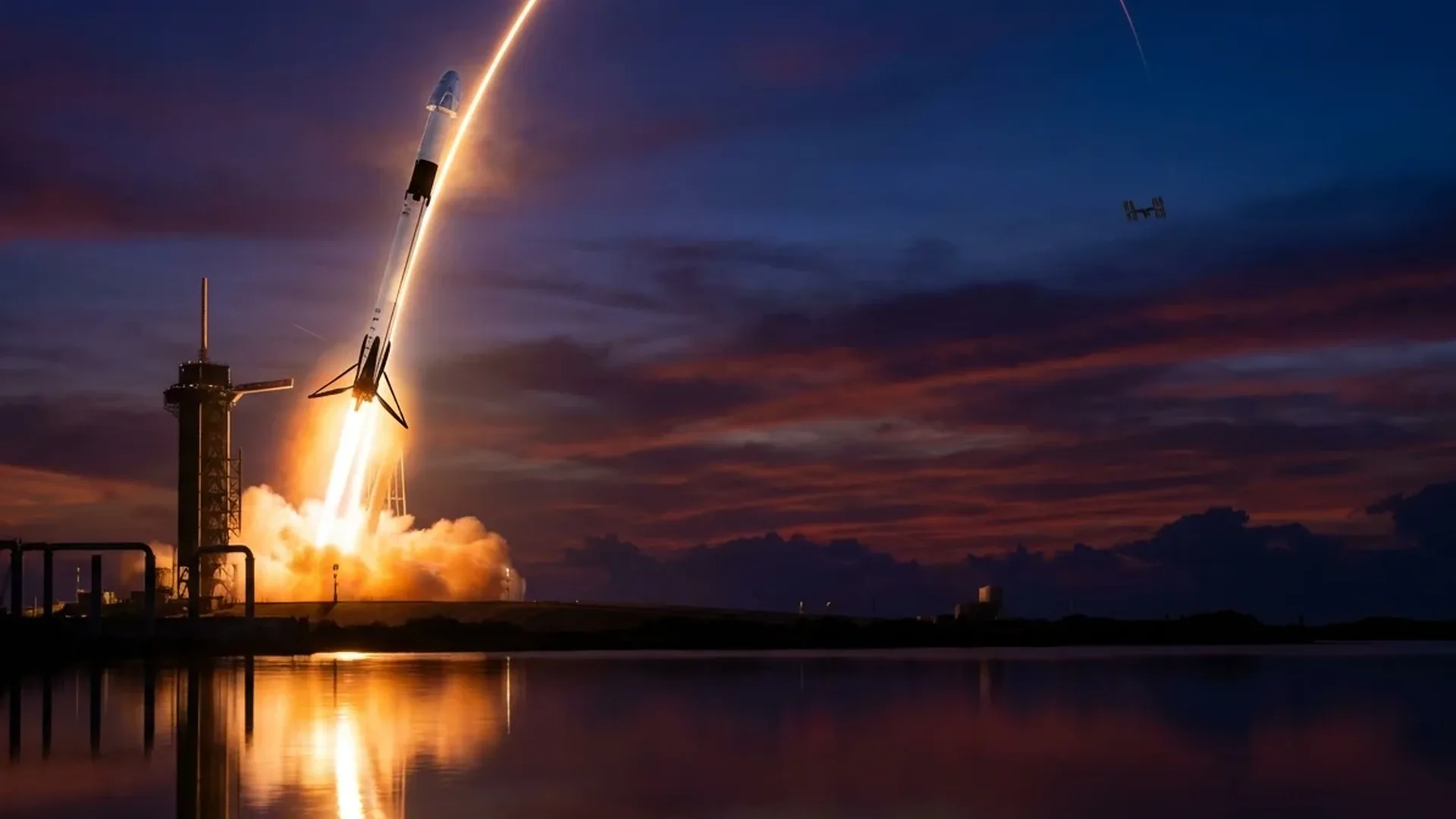
The Crew-12 mission launched in February 2026, bringing four new astronauts to the ISS after a month of reduced crew operations. The Crew Dragon's docking at the International Space Station on Valentine's Day marked the restoration of a full crew complement, following a crisis that forced NASA to bring the Crew-11 mission home early.
📖 Read more: History of Space Exploration: A Complete Timeline
🚀 Launch and Docking
The SpaceX Crew Dragon spacecraft, carrying a crew of four astronauts, successfully docked with the International Space Station (ISS) on Valentine's Day, February 14, 2026. The hatches opened at 5:14 PM Eastern Time (ET), and all four crew members entered the station, where they were welcomed by the three crew members already on board.
The launch was carried out on a SpaceX Falcon 9 rocket, completing a mission that had been significantly accelerated due to emergency circumstances. NASA and SpaceX worked intensively to push forward the Crew-12 launch timeline, as the station had been operating with a reduced crew on the American side (US Orbital Segment — USOS) for approximately one month.
👨🚀 The Crew-12 Team
The Crew-12 mission consists of four members representing three space agencies, reflecting the international nature of the ISS:
Jessica Meir — NASA
Jessica Meir, a NASA astronaut, serves as the mission commander. Meir has previous ISS experience, having participated in an earlier expedition where she conducted historic spacewalks. Her return to the station represents a significant moment for NASA's crewed spaceflight program.
Jack Hathaway — NASA
Jack Hathaway is a NASA astronaut and member of the Crew-12 team. His participation reflects NASA's commitment to continuing scientific activities on the station, especially after the crisis caused by Crew-11's early departure.
Sophie Adenot — ESA
Sophie Adenot represents the European Space Agency (ESA) on this mission. Her presence underscores the continued European participation in the ISS program. As a pilot and engineer, she brings invaluable skills to the crew, and her expertise will be utilized in ongoing European experiments on the station.
Andrey Fedyaev — Roscosmos
Andrey Fedyaev, a Roscosmos cosmonaut, completes the four-member crew. His participation is part of the seat-exchange agreement between NASA and Roscosmos, which ensures that both sides always have representation on the station. Fedyaev has previous flight experience with Crew Dragon.
⚠️ The Crew-11 Crisis
The acceleration of the Crew-12 mission came as a result of an unexpected crisis. On January 15, 2026, NASA was forced to bring the Crew-11 mission home early due to a health emergency involving an unnamed crew member. According to NASA, the astronaut is recovering on Earth.
Crew-11's early departure left the station with a significantly reduced crew. In the US Orbital Segment (USOS) of the ISS — which includes trained astronauts from the US, Canada, Europe, and Japan — only one astronaut remained: NASA's Chris Williams.
🛰️ One person, one entire segment: NASA's Chris Williams single-handedly managed the entire US Orbital Segment of the ISS for approximately one month — a tremendous technical and physical achievement. Williams had arrived at the station in November aboard a Soyuz capsule, alongside Roscosmos cosmonauts Sergey Kud-Sverchkov and Sergei Mikaev.
Williams, who arrived at the station in November 2025 on a Soyuz capsule with two Russian cosmonauts — Sergey Kud-Sverchkov and Sergei Mikaev — was called upon to single-handedly manage the daily operations, maintenance, and experiments of a massive section of the station. This meant exhausting work schedules and enormous responsibility for maintaining the safety and functionality of the USOS.
🤝 International Cooperation on the ISS
The Crew-12 mission serves as yet another example of the impressive international cooperation that defines the ISS. With representatives from NASA, the European Space Agency (ESA), and Roscosmos, the mission reflects the philosophy that has made the station possible for over 25 years.
The response to the Crew-11 crisis highlighted the strength of this partnership. While NASA and SpaceX accelerated the Crew-12 launch, Roscosmos cosmonauts in the Russian segment of the station continued their activities normally, ensuring overall ISS operations remained functional.
With Crew-12's arrival, the station crew was restored to seven members in total: the four newcomers alongside Chris Williams (NASA), Sergey Kud-Sverchkov (Roscosmos), and Sergei Mikaev (Roscosmos), as part of Expedition 74.
"This mission has shown, in many ways, what it means to be mission focused at NASA. In the last couple of weeks we brought Crew 11 home early, we pulled forward Crew 12, all while simultaneously making launch preparations for the Artemis II mission. It's only possible because of the incredibly talented workforce we have here at NASA alongside our contractors, and our commercial and international partners."
🔬 What Awaits the Crew
The Crew-12 team is expected to remain on the ISS for approximately six months, during which they will conduct hundreds of scientific experiments. These include research in microgravity, biomedicine, materials science, and Earth observation.
Beyond experiments, the crew will need to manage the station's ongoing maintenance, which includes routine systems checks, possible spacewalks for external repairs, and receiving resupply spacecraft.
Meanwhile, Expedition 74 takes place during a critical period for the future of the ISS. NASA is simultaneously preparing for the Artemis II mission, while planning the transition to commercial space stations that will eventually replace the ISS. Crew-12 will contribute to this preparation by testing new technologies and procedures.
The successful response to the Crew-11 crisis and the rapid restoration of the crew demonstrate the resilience and flexibility of the crewed spaceflight program. With NASA simultaneously advancing multiple major programs, the Crew-12 mission serves as a reminder that human presence in space demands dedication, cooperation, and readiness to face any challenge.