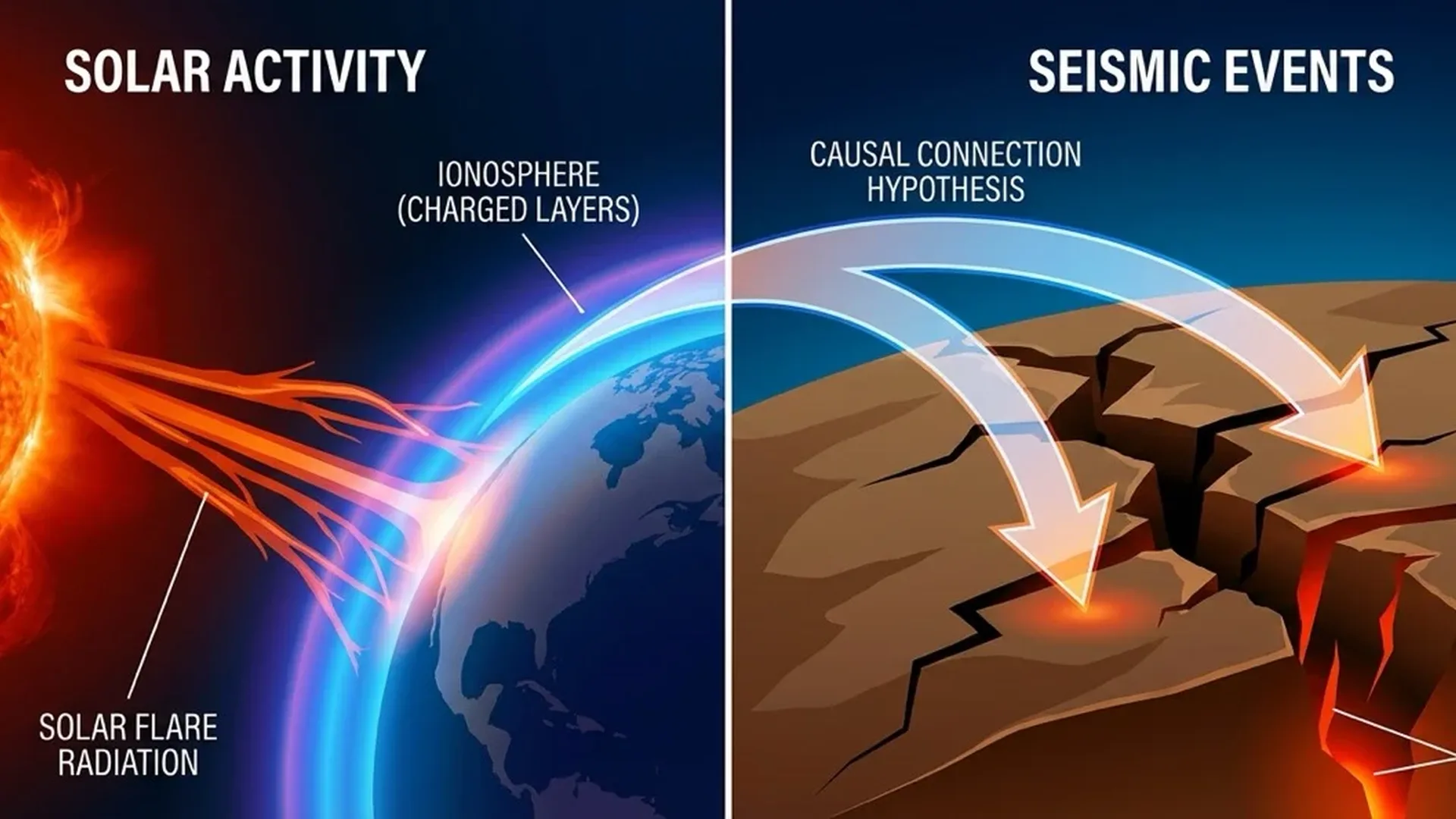
A new study from Kyoto University proposes a scientifically grounded mechanism linking solar flares to earthquakes on Earth: electric fields from solar-storm-disrupted ionospheres may penetrate fault zones in the crust, adding electrostatic pressure to fractures already near their breaking point. The research doesn't claim solar flares cause earthquakes — but it offers a plausible pathway by which space weather may act as one of several factors contributing to seismic events.
📖 Read more: Solar Cycle 25: Stronger Than Expected, Peaking in 2025
☀️ From the Sun to the Epicenter: How the Mechanism Works
Solar flares release enormous bursts of X-ray radiation and charged particles. When these reach Earth, they ionize and disturb the ionosphere — a layer of charged particles 60–600 km above the surface — causing spectacular auroras and disrupting satellite communications and GPS signals.
According to the research team, the disturbed ionosphere also generates electric fields that penetrate downward through the crust and into fault zones. These fractured zones can behave like enormous electrostatic capacitors, charged by the ionosphere above. When the total electron content (TEC) of the ionosphere rises by tens of TEC units — a common effect of solar flares — the resulting electrostatic pressure inside crustal voids can reach several megapascals.
This is comparable in magnitude to tidal and gravitational stresses already known to influence fault behavior. These are well-accepted forces in earthquake science, which makes the new electrostatic mechanism physically plausible.
🔑 The Proposed 4-Step Mechanism
1. Solar flare erupts, releasing X-rays and solar particles | 2. Particles disrupt the ionosphere, sharply raising TEC | 3. Resulting electric fields penetrate the crust and reach fault zones | 4. Faults already near failure threshold receive additional electrostatic stress and may slip.
📖 Read more: James Webb Maps Uranus Auroras in 3D for the First Time
🇯🇵 The 2024 Noto Peninsula Earthquake: A Case Study
The research team analyzed the devastating M7.6 Noto Peninsula earthquake in Japan (January 2024) in light of this hypothesis. In the days before the quake, researchers observed notable ionospheric anomalies above the region: an increase in electron density (elevated TEC) and a measurable drop in the working altitude of the ionosphere — both signs of solar flare activity interacting with the ionosphere.
These correlations do not establish a direct causal chain. The solar activity did not single-handedly “cause” the earthquake — but the timing suggests that electrostatic stress from the ionospheric disturbance may have been a contributing factor, adding to the stress that was already building on the Noto fault system.
📊 Ionospheric Anomalies: Pre-Earthquake Warning Signals?
Multiple previous studies have noted ionospheric anomalies before large earthquakes — electron spikes, altitude drops — but lacked a clear physical mechanism to connect them. This study fills that gap with a concrete electrostatic coupling model.
For these anomalies to serve as genuine earthquake warnings, two conditions would be needed:
- An ionospheric disturbance must be present above the specific fault zone
- The fault must already be accumulating stress from tectonic forces and approaching failure
Future research aims to combine real-time GNSS-based ionospheric tomography from satellite networks with space weather data, enabling a comprehensive picture of ionosphere–crust electrostatic coupling that could be incorporated into multi-signal seismic hazard systems.
📖 Read more: Northern Lights in Greece: 2026 Solar Maximum Explained
"We suggest that the ionosphere and the Earth's surface crust form a feedback-coupled electrostatic system — with fault zones acting as the capacitors between them."
— Kira Mizuno, Minghui Kao, Ken Umeno, Kyoto University, IJPEST 2026🔮 Scientific Significance: A New Layer in Earthquake Physics
This research opens a new chapter in the intersection of space weather science and geophysics. If confirmed, the mechanism would suggest that solar activity monitoring — already essential for telecommunications and power grids — should also be integrated into seismic risk assessment models.
It doesn't replace traditional earthquake prediction methods, which remain limited. But it does add another dimension: the physical state of space above us may have a subtle, measurable influence on the geological forces below our feet.