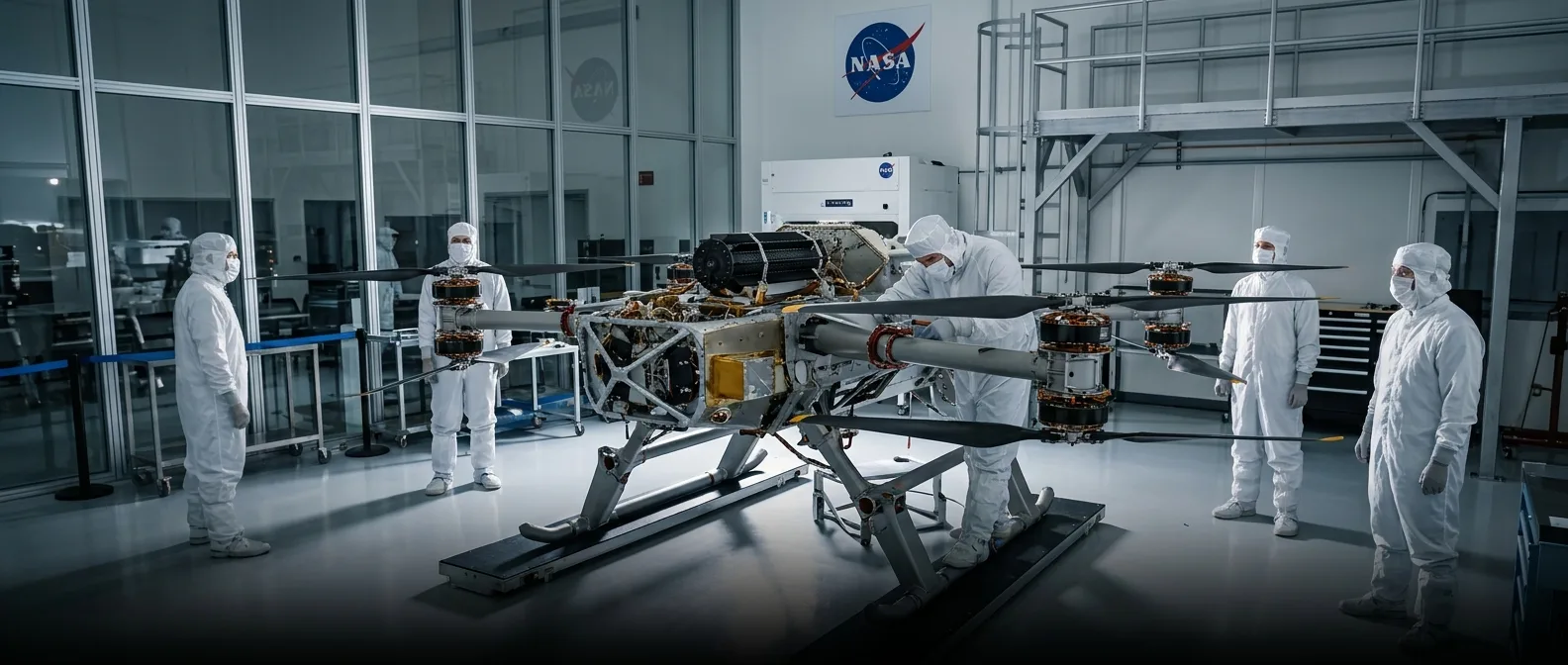
Eight rotors spinning through Titan's frozen skies — that's NASA's vision for the most ambitious space helicopter ever built. Dragonfly has officially entered final testing before its 2028 launch, bringing us one step closer to answering the ultimate question: is there life out there?
Inside the Johns Hopkins Applied Physics Laboratory (APL) in Maryland, engineers have officially kicked off the integration and testing phase for the nuclear-powered helicopter destined for Saturn's largest moon. After years of computer simulations and design work, real hardware is finally coming to life.
Two critical systems fired up successfully for the first time. The Integrated Electronics Module (IEM) serves as the spacecraft's "brain" — combining navigation, communications, and data management into one energy-efficient cube. Meanwhile, the Power Switching Units (PSUs) handle power distribution between flight systems, communications, and scientific instruments.
📖 Read more: Elon Musk's Pivot: From Mars Dreams to Moon Reality
🚁 A Car-Sized Helicopter for Alien Skies
What makes Dragonfly special? It's an octocopter — yes, eight rotors — designed to fly through Titan's thick atmosphere. The atmospheric density there is four times Earth's, making flight relatively easy despite the lower gravity.
Why Titan? Saturn's moon is the only other world in our solar system with liquids on its surface — not water, but methane lakes. Beneath its frozen crust, scientists suspect an ocean of salty water exists.
The vehicle runs on a radioisotope thermoelectric generator (RTG), the same nuclear technology powering NASA's Mars rovers. In Titan's frozen conditions — with temperatures around -179°C — solar panels would be useless.
The Complex Integration Process
Elizabeth Turtle, the mission's principal investigator, describes this stage as "giving birth to the flight system." Every component they install and every test they run brings NASA one step closer to launching toward Titan.
But testing isn't limited to Maryland. Simultaneously, engineers at Lockheed Martin in Colorado are testing the aeroshell that will protect the vehicle during its six-year journey to Saturn and the dangerous entry into Titan's atmosphere.
📖 Read more: Voyager Golden Record: Earth's Music Journey Through Space
🧪 Extreme Testing for Extreme Conditions
One of the most critical challenges is surviving Titan's extreme cold. At APL, a specialized environmental test chamber recreates the moon's surface conditions — including temperatures that plunge to -179°C.
To handle these conditions, Dragonfly will be wrapped in 7.6 centimeters of Solimide foam insulation. This specialized covering has passed durability and thermal tests to confirm it will maintain its shape and protect the scientific instruments.
Aerodynamic Testing in Virginia
At NASA Langley Research Center's Transonic Dynamics Tunnel, engineers completed a fascinating series of tests. Using heavy gas that mimics Titan's dense atmosphere, they studied the aerodynamic behavior of the rotors.
What exactly are they measuring? Stress on rotor arms, vibration effects on the blades and helicopter body — information that will eventually be integrated into Dragonfly's navigation software and flight plans.
📖 Read more: NASA: 3 Rockets Launched Into the Northern Lights Aurora
🔬 Cutting-Edge Scientific Instruments
One of the most impressive components is the Dragonfly Mass Spectrometer (DraMS), being developed at NASA Goddard Space Flight Center. The Ion Trap Mass Spectrometer — DraMS's "heart" — has successfully passed acceptance review and is preparing for space environment testing.
This instrument will analyze chemical components and processes on Titan, including potentially biologically significant compounds. It might sound technical, but it's essentially the mission's "life detector."
Communications Across Billions of Kilometers
How will Dragonfly communicate with Earth from so far away? APL engineers have completed the Frontier radios — flight radios that will function as communication receivers and transmitters. These software-defined radios have proven themselves on missions from the Sun to Pluto and beyond.
Spectrometry
Analysis of life-related chemical compounds
Imaging
Cameras for exploration and navigation
Environment
Temperature, pressure, and wind measurements
Sampling
Collection and analysis of soil samples
📖 Read more: Europa Clipper: NASA's Mission to Jupiter's Ocean Moon
⚡ The Timeline to 2028
Integration and testing will continue until early 2027. During this period, scientific instruments from organizations worldwide will be delivered and integrated into the system. Lockheed Martin will then conduct system-level testing before returning the completed mission to APL for final space environment checks.
If everything goes according to plan — and let's be honest, that's an optimistic assumption — Dragonfly will be transported to NASA's Kennedy Space Center in summer 2028 for launch aboard a SpaceX Falcon Heavy rocket.
Six Years in Space
After launch, the helicopter will spend six years traveling toward the Saturn system. That's no small distance — roughly 1.4 billion kilometers from Earth when it arrives in 2034.
What will it do when it gets there? It will spend over three years exploring different regions of Titan's surface, flying from location to location like a giant drone. It will study the moon's chemistry, geology, and weather, searching for clues about how Titan formed and potentially for the chemical origins of life.
🎯 Frequently Asked Questions
Why does it need nuclear power?
On Titan, solar energy is extremely limited due to distance from the Sun and the thick atmosphere. A radioisotope thermoelectric generator (RTG) provides steady power for decades, regardless of environmental conditions.
How much does the mission cost?
The total cost of the Dragonfly mission is estimated at approximately $3.1 billion, including development, construction, launch, and operations for the entire mission duration.
What happens if it finds life?
Dragonfly is designed to search for life's chemical precursors and study habitability conditions. If it discovers evidence of biological activity, future missions would be needed for confirmation and further research.
"We're building the first-of-its-kind vehicle to fly over another ocean world in our solar system — this pushes us to the limits of what's possible, but that's exactly why it's so exciting."
Elizabeth Turtle, Dragonfly Principal Investigator
2026 holds even more testing, more integration, and probably some anxiety — as always happens with pioneering space missions. But if Dragonfly succeeds, it will mark a new chapter in solar system exploration. Maybe even in the search for extraterrestrial life.
The coming period will be critical. Every test, every integration, every small step brings us closer to one of humanity's most ambitious missions ever attempted. And if all goes well, in about a decade we'll be seeing images from a frozen world with methane lakes — from the perspective of a robotic helicopter flying through the clouds.