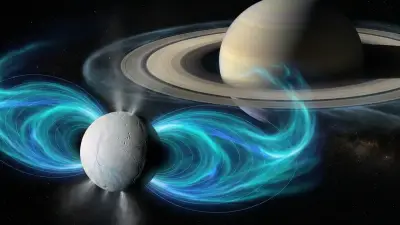
In Saturn's system, a microscopic moon just 500 kilometers in diameter — only 1/7 the size of our Moon — hides beneath its frozen surface an ocean, water geysers that shoot into space, and electromagnetic interactions that could fuel life. Enceladus may be the most promising candidate for extraterrestrial life in our solar system.
💧 Water Geysers at Saturn
In 2005, NASA's Cassini spacecraft made a discovery that changed everything: jets of water and ice were erupting from Enceladus's south pole, through massive cracks in the ice known as "tiger stripes". These four parallel fractures, each roughly 130 kilometers long, function like valves that let the subsurface ocean “breathe” into space.
The geysers eject material to heights of hundreds of kilometers above the surface, at speeds reaching 1,400 kilometers per hour. Some of this material escapes Enceladus's gravity and feeds Saturn's E ring — one of the planet's outer rings. Over 100 distinct geysers have been documented, making Enceladus's south pole one of the most geologically active regions in the solar system.
⚡ Electromagnetic Interaction
Enceladus isn't merely a frozen moon with geysers — it's embedded within Saturn's magnetosphere, an enormous magnetic field extending millions of kilometers into space. The jets of water and ice erupting from the moon interact with this magnetic field, generating powerful electromagnetic waves.
Recent studies show that this interaction between ionized particles from the geysers and Saturn's magnetosphere creates electric currents that flow along magnetic field lines. These currents produce electromagnetic waves detectable at distances of hundreds of thousands of kilometers — a remarkable phenomenon for such a small moon.
This electromagnetic energy could theoretically play a role in the subsurface ocean's chemistry. The energy transferred through these interactions may drive chemical reactions inside the moon, adding another energy source beyond tidal heating.
🧬 Ingredients of Life
During multiple passes through the geysers, Cassini detected a series of substances that excited scientists. Molecular hydrogen (H₂) — a key fuel for chemosynthetic microorganisms — was found in abundance. This suggests hydrothermal reactions are occurring on the ocean floor, as hot water reacts with rock.
Beyond hydrogen, Cassini detected organic molecules — complex carbon compounds that are the building blocks of life. Some were large and complex, similar to those found in biological systems on Earth. Combined with liquid water, salts, and energy, Enceladus has all the basic ingredients considered essential for life.
🔍 Cassini's "Sniff": In one of its boldest maneuvers, Cassini flew through Enceladus's geysers at just 25 kilometers above the surface, literally “sniffing” the ocean without landing. Its mass spectrometers detected water, hydrogen, carbon dioxide, methane, and complex organic molecules — a “menu” that on Earth would mean only one thing: life.
🚀 Future Mission
After Cassini's spectacular discoveries, NASA is seriously considering a Flagship-class mission dedicated exclusively to Enceladus. Such a mission could repeatedly fly through the geysers with specialized instruments designed specifically to detect biosignatures — molecular signatures that can only be produced by living organisms.
Unlike Jupiter's Europa, where the ocean is hidden beneath kilometers of ice, Enceladus “serves” samples of its ocean directly into space through its geysers. This means we don't need to drill through ice — we just need to fly through the “spray” to analyze the ocean's composition.
🤔 Why Enceladus?
Compared to Europa — the other major candidate for extraterrestrial life — Enceladus offers a unique advantage: accessibility. While Europa's ocean lies beneath 15–25 kilometers of ice, Enceladus actively ejects ocean material into space. A future mission need only fly through the geysers to “taste” the ocean.
Additionally, the presence of molecular hydrogen on Enceladus is particularly significant. On Earth, methanogens — microorganisms living in anoxic environments — use hydrogen and carbon dioxide to produce energy and methane. Enceladus has both in abundance. If life exists in our solar system beyond Earth, Enceladus may be where we find it first.