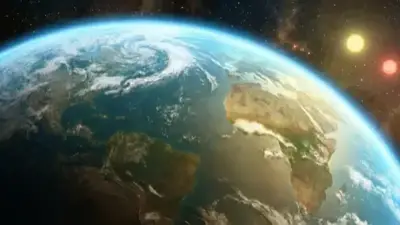
← Back to SpaceArtist's concept of exoplanets orbiting within the habitable zone of their host star
🚀 Space: Exoplanet Discovery

Exoplanets with Favorable Conditions for Life: The Most Promising Worlds We've Discovered

There are over 5,600 confirmed exoplanets discovered so far — and the number grows every year. But the real question isn't “do they exist?” — it's “which ones could support life?” The habitable zone, the presence of liquid water, a suitable atmosphere, and biosignatures are the most critical answers modern astronomy seeks. And now, with the James Webb Space Telescope, we are for the first time analyzing exoplanet atmospheres for signs of life.

📖 Read more: Habitable Exoplanets and the Chemistry of Life

🌍 The Habitable Zone — The “Goldilocks Zone” of Life

The habitable zone is the region around a star where liquid water can exist on a planet's surface. Not too close (radiation evaporates the water), not too far (the radiation is too weak to keep the surface warm). For our Sun, the habitable zone extends roughly between 0.95 and 1.37 AU. Earth sits precisely within this range.

However, being in the habitable zone is not sufficient by itself. Scientists also require: a rocky planet of roughly Earth's size, enough mass to hold an atmosphere, and an atmosphere containing water, nitrogen, or oxygen. The habitable zone is necessary but not sufficient for life as we know it.

⭐ The TRAPPIST-1 System — The Most Promising Candidate

In 2017, NASA announced one of the most exciting discoveries in the history of astronomy: the TRAPPIST-1 system, a cool dwarf star 40 light-years away, with 7 rocky exoplanets similar to Earth. Three of them (TRAPPIST-1e, 1f, 1g) lie within the habitable zone of TRAPPIST-1.

TRAPPIST-1e is considered the most promising candidate. It has similar size to Earth, is located in the habitable zone, and may have liquid water on its surface. The James Webb telescope has already analyzed the atmosphere of TRAPPIST-1b (2023) and confirmed it lacks a thick atmosphere — but the colder 1e remains the focus of intense scientific interest.

🐍 Biosignatures — Physical Evidence of Life

Biosignatures are atmospheric or chemical signals that may indicate life. On Earth, the simultaneous presence of O2 + CH4 is a strong biosignature — because these two gases are chemically reactive and cannot coexist without constant biological replenishment. The ozone layer (O3) is also indicative of photosynthesis.

5,600+Confirmed Exoplanets
7TRAPPIST-1 Planets
3In TRAPPIST-1 HZ
40Light-years to TRAPPIST-1

🔭 Detection Methods — Transit and Radial Velocity

Exoplanets are too distant to see directly, but scientists devised ingenious methods. The "Transit Method": when a planet passes in front of its star, we see a tiny brightness dip (ΔI/I ≈0.01%). Used by Kepler to discover over 2,600 exoplanets. The “Radial Velocity” method measures the tiny wobble a planet induces on its star — this is how 51 Pegasi b, the first exoplanet orbiting a Sun-like star, was found in 1995.

"The number of questions that can be answered by exoplanet exploration is staggering: if life exists elsewhere, what kind of life is it?"

— Dr. Sara Seager, MIT, exoplanet research pioneer

🔭 James Webb and the Future of Exoplanet Search

James Webb made the first CO2 detection in an exoplanet atmosphere in 2022 (WASP-39b). Next target: O2 in a rocky Earth-like world. Scientists estimate there could be hundreds of millions of habitable worlds in our galaxy. If even a small fraction developed life, that discovery could be the most profound in human history. The path to that answer runs through exoplanet atmospheric research.

exoplanets habitable zone TRAPPIST-1 astrobiology James Webb telescope Kepler-452b biosignatures space discovery

Sources:

TRAPPIST-1 system showing seven Earth-sized exoplanets and their potential for liquid water
Space

Exoplanets: Which Ones Have Conditions for Life?

There are over 5,600 confirmed exoplanets discovered so far — and the number grows every year. But the real question isn't “do they exist?” — it's “which ones could support life?” The habitable zone, the presence of liquid water, a suitable atmosphere, and biosignatures are the most critical answers modern astronomy seeks. And now, with the James Webb Space Telescope, we are for the first time analyzing exoplanet atmospheres for signs of life.

📖 Read more: K2-18b: Unusual Signals Detected from Exoplanet

🌍 The Habitable Zone — The “Goldilocks Zone” of Life

The habitable zone is the region around a star where liquid water can exist on a planet's surface. Not too close (radiation evaporates the water), and not too far (the radiation is too weak to keep the surface warm). For our Sun, the habitable zone extends roughly between 0.95 and 1.37 AU (Astronomical Units). Earth sits precisely within this range.

However, being in the habitable zone is not sufficient by itself. Scientists also require: a rocky planet of roughly Earth's size (super-Earths or rocky planets), enough mass to hold an atmosphere, and an atmosphere containing elements like water, nitrogen, or oxygen. The habitable zone is a necessary but not sufficient condition for life as we know it.

⭐ The TRAPPIST-1 System — The Most Promising Candidate

In 2017, NASA announced one of the most exciting discoveries in the history of astronomy: the TRAPPIST-1 system, a cool dwarf star 40 light-years away, with 7 rocky exoplanets similar to Earth. Three of them (TRAPPIST-1e, 1f, 1g) lie within the habitable zone of TRAPPIST-1.

TRAPPIST-1e is considered the most promising candidate. It has similar size to Earth, is located in the habitable zone, and may have liquid water on its surface. The James Webb telescope has already analyzed the atmosphere of TRAPPIST-1b (2023) and confirmed it lacks a thick atmosphere — but the colder 1e remains the focus of intense scientific interest.

🐍 Biosignatures — Physical Evidence of Life

Biosignatures are atmospheric or other chemical signals that may indicate the presence of life. On Earth, the simultaneous presence of O2 + CH4 is a strong biosignature — because these two gases are chemically reactive and cannot coexist without constant biological replenishment. Additionally, the ozone layer (O3) is indicative of photosynthesis.

5,600+Confirmed Exoplanets
7TRAPPIST-1 Planets
3In TRAPPIST-1 HZ
40Light-years to TRAPPIST-1

🔭 Detection Methods — Transit and Radial Velocity

Exoplanets are far too distant to observe directly, but scientists have developed ingenious detection methods. The most popular is the "Transit Method": when a planet passes in front of its star, we observe a tiny dimming of the star's brightness (ΔI/I approximately 0.01%). This method was used by the Kepler telescope to discover over 2,600 exoplanets.

The “Radial Velocity” method measures the slight wobble induced in a star by a planet's gravity. This creates tiny Doppler shifts in the star's spectral lines (measured in nanometers) that we can detect with precise spectrographs. This method was used to discover the first exoplanet orbiting a Sun-like star, 51 Pegasi b, in 1995.

"The number of questions that can be answered by exoplanet exploration is staggering: if life exists elsewhere, what kind of life is it?"

— Dr. Sara Seager, MIT, exoplanet research pioneer

🔭 James Webb and Atmospheric Analysis

The James Webb Space Telescope, launched in 2021, made the first detection of CO2 in an exoplanet atmosphere in 2022 (WASP-39b). This was a historic demonstration that we can analyze exoplanet atmospheres. The next goal: detecting O2 in the atmosphere of a rocky, Earth-like planet — which would be a definitive biosignature.

Scientists estimate that in our galaxy alone there could be hundreds of millions of habitable worlds. If even a tiny fraction have developed life, it could be the most profound answer in human history. The path to that answer runs directly through exoplanet atmospheric research with James Webb and future space telescopes.

Sources: