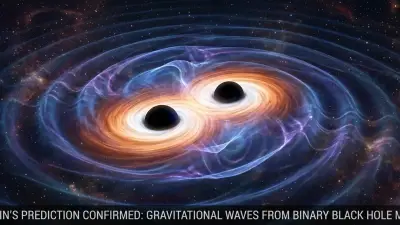
Albert Einstein predicted the existence of gravitational waves in 1916, as a consequence of his General Theory of Relativity. Nearly a century later, on September 14, 2015, LIGO recorded these ripples in spacetime for the first time — confirming one of the boldest predictions in the history of physics. This discovery opened an entirely new window on the universe.
📖 Read more: Gravitational Waves: How Are They Caused and Detected?
🌊 What Are Gravitational Waves
Gravitational waves are ripples in the very fabric of spacetime. When masses accelerate — such as two black holes spiraling around each other — they create “wrinkles” that spread in all directions at the speed of light. Imagine dropping a stone into a pond: the ripples on the water surface resemble what gravitational waves do to spacetime.
📖 Read more: Time Slows Down Near Massive Objects
Einstein described them mathematically in 1916, but believed they would be too weak to ever detect. As they travel, they stretch and squeeze space along perpendicular axes — a deformation so microscopic that it required decades of technological development to become measurable.
🔭 LIGO — The Detection That Changed Everything
On September 14, 2015, LIGO's two detectors (Laser Interferometer Gravitational-Wave Observatory) — one in Hanford, Washington and the other in Livingston, Louisiana — simultaneously recorded a signal designated GW150914. It was the sound of two black holes, with masses of 36 and 29 solar masses, merging into one, 1.3 billion light years away.
The signal lasted just 0.2 seconds, but contained a treasure trove of information. The frequency increased rapidly — a characteristic “chirp” — as the two black holes spiraled closer together. The energy released in gravitational waves equaled three solar masses, converted to pure energy according to E=mc².
The detection method relies on laser interferometry. A laser beam is split in two, travels along two perpendicular 4-kilometer arms, bounces off mirrors, and returns. If a gravitational wave passes through, it slightly changes the length of one arm relative to the other, creating a measurable phase difference. The 2017 Nobel Prize in Physics was awarded to Rainer Weiss, Kip Thorne, and Barry Barish for this achievement.
💥 GW170817 — Neutron Stars and Gold
On August 17, 2017, LIGO and Virgo recorded something different: gravitational waves from the collision of two neutron stars, 130 million light years away. Two seconds later, the Fermi satellite detected a gamma-ray burst from the same direction. It was the first “multi-messenger” observation in history.
The collision created a “kilonova” — a massive explosion that forged heavy elements like gold, platinum, and uranium. Scientists estimated that the collision produced gold equivalent to several times the mass of Earth. This discovery proved that neutron star collisions are a primary mechanism for creating heavy elements in the universe.
📖 Read more: Is Gravity a Real Force or a Curvature of Spacetime?
🌍 Global Detector Network
Today, a global network of detectors monitors the sky for gravitational waves. LIGO in the USA consists of two detectors with 4-kilometer arms. Virgo in Italy has 3-kilometer arms. KAGRA in Japan operates underground to minimize vibrations. Together, they enable precise localization of sources in the sky through triangulation.
LIGO's fourth observing run (O4, 2023-2025) has already yielded dozens of new detections, dramatically expanding the catalog of known sources. The coordinated operation of multiple detectors improves both sensitivity and localization ability.
💡 Remarkable fact: LIGO's precision can measure changes in distances smaller than the width of a proton — approximately 10⁻¹⁸ meters. This is equivalent to measuring the distance to the nearest star with the accuracy of a single human hair!
🚀 LISA — A Detector in Space
ESA in collaboration with NASA is designing LISA (Laser Interferometer Space Antenna), a gravitational wave detector in space. Three spacecraft will form a triangle with sides of 2.5 million kilometers, exchanging laser beams between them. Launch is expected around 2035.
LISA will detect gravitational waves at much lower frequencies than LIGO — opening an entirely new observation spectrum. It will be able to “hear” supermassive black holes merging in the depths of the universe, thousands of binary star systems in our galaxy, and potentially even signals from the first moments after the Big Bang.
🔮 Einstein Telescope — The Next Generation
In Europe, the Einstein Telescope is being planned — a next-generation detector that will be built underground. Its triangular design, with 10-kilometer arms, will make it 10 times more sensitive than the current LIGO. Cryogenically cooled mirrors and advanced quantum noise technology will allow it to see nearly to the edges of the universe.
Meanwhile, in the USA, the Cosmic Explorer is proposed, with 40-kilometer arms — ten times larger than LIGO's. These next-generation detectors will transform “gravitational astronomy” from an exotic discovery into an everyday observation tool, revealing thousands of events each year and testing General Relativity under extreme conditions.
A hundred years after Einstein's prediction, gravitational waves are no longer theory — they are a tool for exploration. From LIGO's first detections to the ambitious designs of LISA and the Einstein Telescope, humanity is learning to “hear” the universe in an entirely new way.