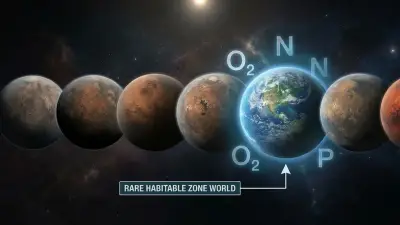
What makes a planet habitable? The answer lies in chemistry. From CHON elements to atmospheric biosignatures, the search for life-friendly worlds is narrowing. With over 5,000 known exoplanets, which ones have the right “recipe”?
🧬 The Ingredients of Life
Life as we know it is based on four elements: Carbon (C), Hydrogen (H), Oxygen (O), and Nitrogen (N) — the so-called CHON elements. Phosphorus is also critical — it forms the backbone of DNA. In 1969, the Murchison meteorite delivered over 90 amino acids to Earth, proving that life's building blocks exist everywhere in space.
One mystery remains: homochirality. Life exclusively uses left-handed amino acids — why not right-handed? No one knows yet.
🌍 What Makes a Planet Habitable
For life, you need: liquid water, carbon-based chemistry, an energy source, and protection from radiation. The planet must be in its star's “habitable zone” — the right distance for liquid water. An atmosphere for protection and a magnetic field to shield against cosmic radiation are also essential.
🪐 Super-Earths and Hycean Worlds
"Super-Earths" are rocky planets 1–10 times Earth's mass, some in habitable zones. Hycean worlds are planets covered by ocean with hydrogen atmospheres. K2-18b is considered a possible Hycean world — JWST detected potential biological molecules in its atmosphere. These worlds dramatically expand where life could exist.
🔬 Biosignatures
How do we detect life from afar? Through atmospheric biosignatures. The simultaneous presence of oxygen and methane in an atmosphere suggests biology — these gases react with each other and cannot coexist without continuous replenishment (chemical disequilibrium). Phosphine and dimethyl sulfide (DMS) are also strong biosignatures.
⚗️ The Miller-Urey Experiment (1953): Scientists Stanley Miller and Harold Urey simulated primordial Earth conditions: gases (methane, ammonia, hydrogen), water, and electrical discharges (lightning). The result? Amino acids — the building blocks of proteins — formed spontaneously. Life can start from simple ingredients.
🔭 TRAPPIST-1 and Kepler-442b
The TRAPPIST-1 system, 40 light-years away, contains 7 rocky planets, at least 3 in the habitable zone. It's the best candidate for atmospheric analysis with JWST. Kepler-442b, at 1,206 light-years, is considered one of the most Earth-like planets known, with an ESI (Earth Similarity Index) of about 0.84.
🚀 Future Telescopes
NASA's Roman Space Telescope will discover thousands of new exoplanets. The Habitable Worlds Observatory (HWO) will be the first telescope designed specifically for direct imaging of exoplanets and detecting biosignatures in their atmospheres. Direct imaging — seeing the planet as a dot next to its star — will allow analysis of its light to find signs of life.
The chemistry of life isn't rare — it's everywhere in the universe. The question isn't “if” life exists elsewhere, but “when” we'll find it.