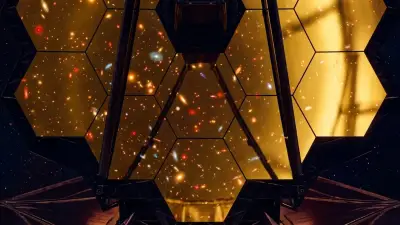
The James Webb Space Telescope (JWST) is not merely a larger telescope — it is a time machine. By peering into the most distant corners of the universe, it captures light that began its journey over 13 billion years ago. Light that was emitted when the first galaxies were barely forming. But how exactly does a telescope see so far into the past?
🌌 Why Infrared?
The answer lies in the nature of light itself. Light travels at a finite speed — 300,000 kilometers per second. This means that when we observe a distant object, we see the light it emitted long ago. We are literally looking into the past.
But there is a complication: the universe is expanding. As light travels for billions of years, the space it passes through stretches. This stretches the light itself, increasing its wavelength. Visible light gets “redshifted” — pushed toward red wavelengths and eventually into the infrared, invisible to the human eye.
This is precisely why JWST was designed as an infrared telescope. The most distant galaxies emit their light in the infrared due to redshift. Hubble, which primarily observes in visible light, cannot detect these extremely distant objects. JWST can — and that changes everything.
🔭 The First Galaxies
In June 2024, the JADES (JWST Advanced Deep Extragalactic Survey) team announced a historic discovery: the galaxy JADES-GS-z14-0, the most distant galaxy ever observed. With a redshift of z ≈ 14.32, this galaxy existed just 290 million years after the Big Bang.
To put this in perspective: the universe is 13.8 billion years old. We are seeing this galaxy not as it is today, but as it was when the universe was barely 2% of its current age. It is like looking at a photograph of an 80-year-old person taken when they were just 19 months old.
Even more striking: JADES-GS-z14-0 appears remarkably luminous and large for its age. It spans over 1,600 light-years — indicating that its brightness comes primarily from young stars, not merely from an active black hole at its center.
⭐ Cosmic Dawn
"Cosmic dawn" refers to the period 100–200 million years after the Big Bang, when the first stars formed. These primordial stars — known as Population III — were radically different from today's stars.
Population III stars were enormous, with masses tens to hundreds of times greater than our Sun. They were composed exclusively of hydrogen and helium — the only elements that existed after the Big Bang. They contained no “metals” (in astrophysics, anything heavier than helium is classified as a metal).
These first stars were extraordinarily hot and luminous. Their ultraviolet radiation gradually ionized the neutral hydrogen that filled the universe — a process known as reionization. Before reionization, the universe was like a dense fog. Afterward, it became transparent — allowing light to travel freely across cosmic distances.
😮 Too Massive, Too Early
One of JWST's greatest surprises has been the discovery of galaxies that are far too massive and mature for their young age. According to existing galaxy formation models, such large galaxies should not exist this early in the universe's history.
JWST found galaxies with masses of billions of solar masses less than 500 million years after the Big Bang. This creates a serious problem: how could they accumulate so much mass in so little time? The standard ΛCDM (Lambda Cold Dark Matter) models predict much slower growth.
Some scientists suggest that the first galaxies formed stars at astonishingly high rates. Others wonder whether dark matter models need revision. Either way, JWST is forcing astrophysicists to rethink fundamental assumptions about how structure formed in the early universe.
🔑 Key Fact: The galaxy JADES-GS-z14-0 was detected at redshift z ≈ 14 — just 290 million years after the Big Bang. It is brighter and larger than any model predicted for that epoch of the universe.
🔬 NIRCam and NIRSpec
JWST is equipped with two key instruments for studying the early universe. NIRCam (Near-Infrared Camera) is the primary imager, capable of capturing objects at wavelengths from 0.6 to 5 micrometers. It can detect the faintest signals from galaxies billions of years old.
NIRSpec (Near-Infrared Spectrograph) breaks light into a spectrum, revealing the chemical composition, temperature, and recession velocity of each object. Its unique multi-object spectroscopy capability allows NIRSpec to simultaneously analyze hundreds of galaxies in a single field of view.
JWST's 6.5-meter mirror collects far more light than Hubble's 2.4-meter mirror. Combined with its infrared instruments and its position at the Lagrange point L2 — 1.5 million kilometers from Earth — JWST can see deeper into the universe than any previous telescope ever built.
🔮 What Will We Discover Next
JWST is still in the early stages of its mission. Future deep field surveys may reach redshifts beyond z > 15, peering even deeper into the primordial universe. Scientists hope to detect the first Population III stars — something that has not yet been achieved.
Additionally, JWST is searching for the first supermassive black holes. How did black holes of millions of solar masses form in less than one billion years? JWST may provide answers by observing the spectra of active galactic nuclei in the early universe.
Finally, studying clusters of first stars and proto-galaxies will help us understand how the large-scale structure of the universe evolved. Every new JWST image is not just a photograph — it is a window into an epoch that no human eye could ever witness in any other way.