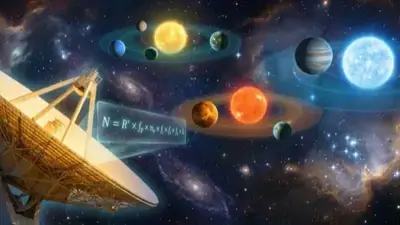
Is there life beyond Earth? This is arguably the most profound question humanity has ever asked. From the microbes that survive in our most extreme environments to the mathematical frameworks predicting billions of habitable worlds, the scientific case for life in the universe has never been stronger — yet we still have no confirmed contact. Here is what we know.
The Scale of the Possibility: Our galaxy alone contains ~200-400 billion stars. ~20-25% have planets in the habitable zone. With 2 trillion galaxies in the observable universe, the conditions for life exist on a staggering scale.
Europa: A Hidden Ocean
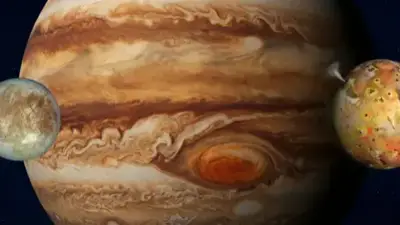
Jupiter's moon Europa is one of the most compelling candidates for extraterrestrial life in our solar system. Beneath its icy surface lies a liquid water ocean estimated to be 100 km deep — containing more liquid water than all of Earth's oceans combined. Tidal heating from Jupiter keeps the interior warm. NASA's Europa Clipper, launched in October 2024, will perform 49 close flybys to assess habitability. If hydrothermal vents exist on Europa's ocean floor, conditions similar to Earth's deep-sea ecosystems may support microbial life.
Enceladus: Active Geysers
Saturn's small moon Enceladus surprised astronomers with its active water vapor plumes, first observed by Cassini in 2005. The plumes contain water, hydrogen (indicating hydrothermal activity), and organics. In 2023, scientists analyzing Cassini data announced the detection of dicarboxylic acids — complex organic molecules that are building blocks of amino acids — in Enceladus's plumes. This is among the most significant astrobiological discoveries yet.
«Enceladus has almost all the ingredients we associate with the potential for life.»
— Jonathan Lunine, Cornell University, 2023Titan: Methane Lakes and Complex Chemistry
Saturn's largest moon Titan has a dense nitrogen atmosphere and lakes of liquid methane. It represents a radically different chemistry for potential life — life that could use methane as a solvent instead of water. NASA's Dragonfly rotorcraft mission, planned for 2028 launch, will explore Titan's surface for prebiotic chemistry, including amino acids and other complex organics.
Extremophiles: Life at the Limits
On Earth, life has been discovered in environments previously thought impossible: pH 0 acid pools, boiling hydrothermal vents, Antarctic ice sheets, nuclear reactor cooling pools. Tardigrades survive vacuum, radiation, desiccation, and temperatures from -272°C to +150°C. The existence of extremophiles dramatically expands our definition of “habitable” environments, suggesting that life could persist in far harsher conditions than any solar system body we've ruled out.
The Fermi Paradox
Despite the immense probability calculations suggesting life should be widespread, we have detected no confirmed signals from alien civilizations. This tension — known as the Fermi Paradox — has dozens of proposed resolutions, from the “Great Filter” hypothesis to the possibility that interstellar communication is simply inefficient at cosmic scales.
- NASA – Europa Clipper Mission
- Postberg et al. – Nature 2023: Organic compounds in Enceladus plumes
- NASA Dragonfly – Titan Mission Overview
- ESA – Search for Life Program
Related Articles
Meeting Alien Civilizations
Kardashev Scale, Arecibo Message, and the silence of the universe.
Jupiter's Moons: 95 Worlds
Europa Clipper and ESA JUICE will search for life in Jupiter's ocean moons.
Neutron Stars: The Universe's Zombies
Gold, platinum and heavy elements come from neutron star collisions.
Betelgeuse: Will We Witness a Supernova?
Will Betelgeuse explode in our lifetime? The science says probably not yet.
The Asteroid Belt: Not What Movies Show
Ceres, Vesta, and OSIRIS-REx amino acids reveal the solar system's history.

Time Slows Down Near Massive Objects
Einstein's prediction is real and GPS proves it every single day.