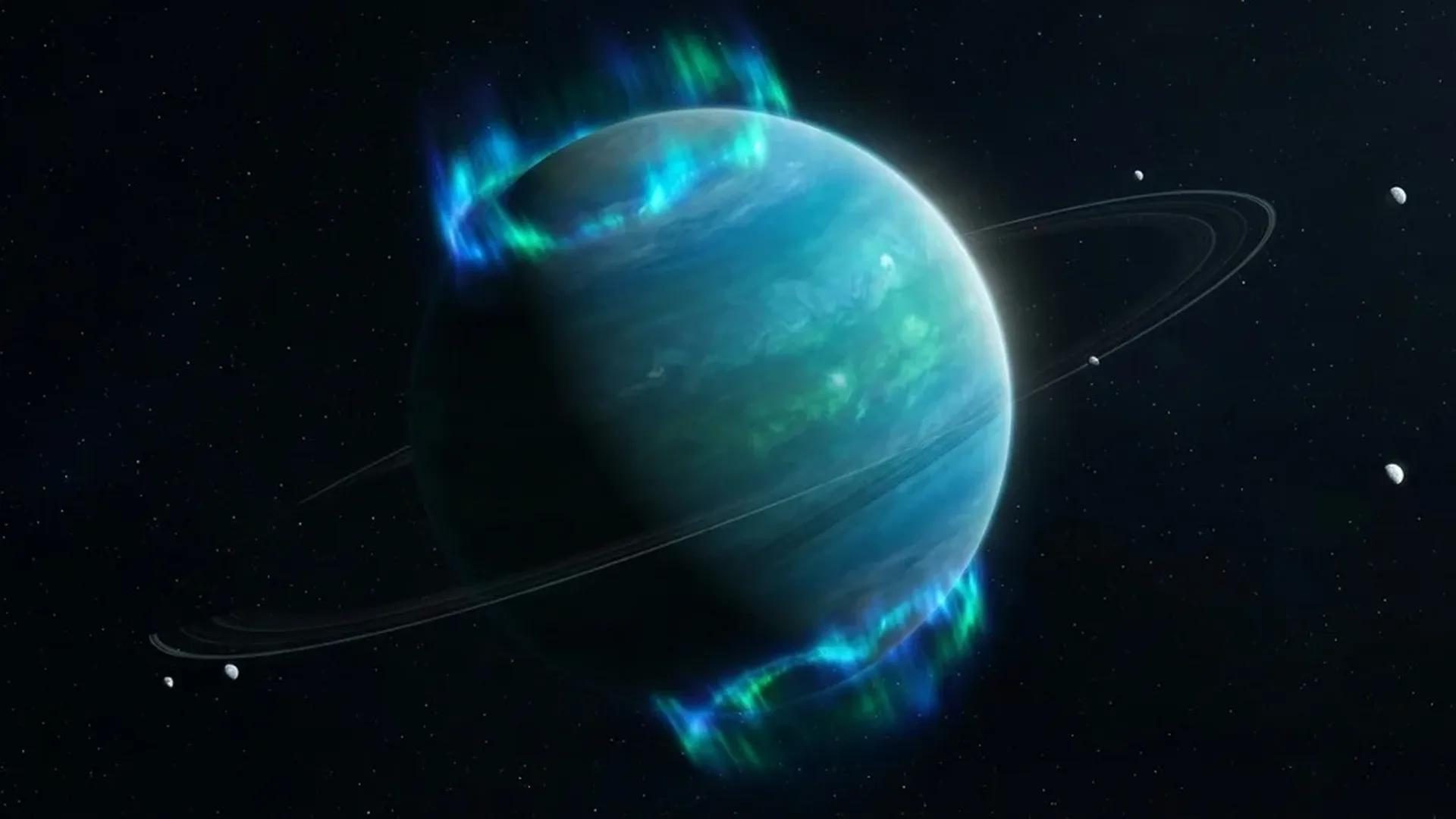
For the first time in the history of astronomy, scientists have mapped the upper atmosphere of Uranus in three dimensions — discovering glowing auroras shaped by one of the strangest magnetic fields in our solar system. NASA's James Webb Space Telescope stared at the planet for 15 unbroken hours, revealing a world of mysteries hiding beneath the calm blue surface.
📖 Read more: Saturn's Rings: Secrets Revealed by the Cassini Mission
🔭 Uranus: The Planet That Sleeps on Its Side
Uranus is unlike any other planet in the solar system. It rotates around its axis at a tilt of nearly 98 degrees — essentially lying on its side. This extreme axial tilt affects everything about the planet: from its astonishingly long seasons (half a Uranian year in sunlight, half in darkness) to its magnetic field, which is so tilted and offset that its auroras trace entirely different paths compared to Earth.
Historically, we knew very little about Uranus's atmosphere. Voyager 2 flew past only once, in 1986, for just a few hours. After that brief encounter, the planet remained largely unexplored — until now.
🔭 The First 3D Map of an Ice Giant's Atmosphere
An international team led by Paola Tiranti of Northumbria University in the UK used NIRSpec — the Near Infrared Spectrograph aboard the James Webb Space Telescope — to monitor Uranus continuously for 15 hours on January 19, 2025, covering nearly one full planetary rotation.
By capturing faint molecular emissions above the visible cloud deck, scientists measured temperatures and ion densities as far as 5,000 kilometers above the clouds, within the ionosphere — the zone where the atmosphere becomes ionized and is strongly governed by the planet's magnetic field.
"This is the first time we've been able to see Uranus's upper atmosphere in three dimensions," said Tiranti. "With Webb's sensitivity, we can trace how energy moves upward through the atmosphere and even see the influence of its lopsided magnetic field."
"Uranus's magnetosphere is one of the strangest in the Solar System — it's tilted and offset from the planet's rotation axis, which means its auroras sweep across the surface in complex ways."
📖 Read more: Voyager 1: The Farthest Human-Made Object in Space
🔭 Auroras, Dark Bands, and Magnetic Surprises
Webb's data revealed two bright auroral bands near Uranus's magnetic poles. Between those bands, the team found a region of reduced emissions and fewer ions — a feature likely linked to transitions in the magnetic field lines. Similar dark regions have been observed at Jupiter, where the magnetic field governs the motion of charged particles through the upper atmosphere.
Because Uranus's tilted magnetosphere generates auroras that don't stay fixed at the poles, they instead roll and shift dynamically as the planet rotates, creating patterns found nowhere else in the solar system.
💡 The Most Lopsided Magnetic Field
While Earth's magnetic pole lies close to the geographic pole, Uranus's magnetic field is tilted 60° from the rotation axis — and its center of magnetism is offset from the planet's center. This eccentricity produces the most asymmetric auroras we know of anywhere in the solar system.
🔭 Is Uranus Slowly Cooling Down?
An additional finding gave researchers pause: Uranus's upper atmosphere appears to be continuing to cool since the 1990s. The average temperature computed from the new data is ~426 kelvins (~150°C), lower than readings previously obtained from ground-based observatories or earlier spacecraft missions. The highest temperatures were found 3,000–4,000 km above the clouds, while maximum ion densities peaked at ~1,000 km.
This ongoing cooling remains a puzzle. Uranus appears to radiate internal heat more efficiently than its neighbor planets, suggesting a complex thermodynamic balance deep in its interior. The new 3D picture of the atmosphere provides, for the first time, enough data to begin addressing this mystery systematically.
📖 Read more: Hubble Space Telescope: 35 Years of Cosmic Discovery
🔭 An Interconnected Revelation: Voyager 2 Arrived at the Worst Moment
Just two weeks earlier, on February 7, 2026, astronomers at the Southwest Research Institute published another Uranus revelation: the reason Voyager 2 recorded such extreme radiation levels in 1986 was that the spacecraft arrived at exactly the wrong moment — during a rare solar wind event (a co-rotating interaction region) that had flooded the planet's radiation belts with enormous energy. This confirmation strengthens the case for a new dedicated mission to Uranus.
🛰️ JWST NIRSpec
Webb's Near Infrared Spectrograph captured H₃⁺ ion emissions from Uranus's ionosphere with unprecedented precision, allowing the team to trace temperature and ion density as a function of altitude for the first time.
🌌 98° Axial Tilt
Uranus rotates nearly horizontal relative to the solar plane. Each pole experiences 42 years of sunlight followed by 42 years of darkness — creating unique seasonal dynamics with no analog elsewhere in the solar system.
🔬 Geophysical Research Letters
The study was published in GRL Vol. 53, 2026. JWST General Observer Program 5073, PI: H. Melin, Northumbria University. DOI: 10.1029/2025GL119304.
🔭 Why We Need a Mission to Uranus
Both ESA and NASA have been considering a dedicated Uranus orbiter and probe for years — it is the top priority in the US Planetary Science Decadal Survey 2023–2032. The new Webb findings, combined with the reinterpretation of Voyager 2 data, make clear that Uranus is far more dynamic and complex than those fleeting six hours of close contact suggested. The Webb data now provide a scientific foundation for designing and targeting the instruments that future explorers will carry into this strange, tilted world.