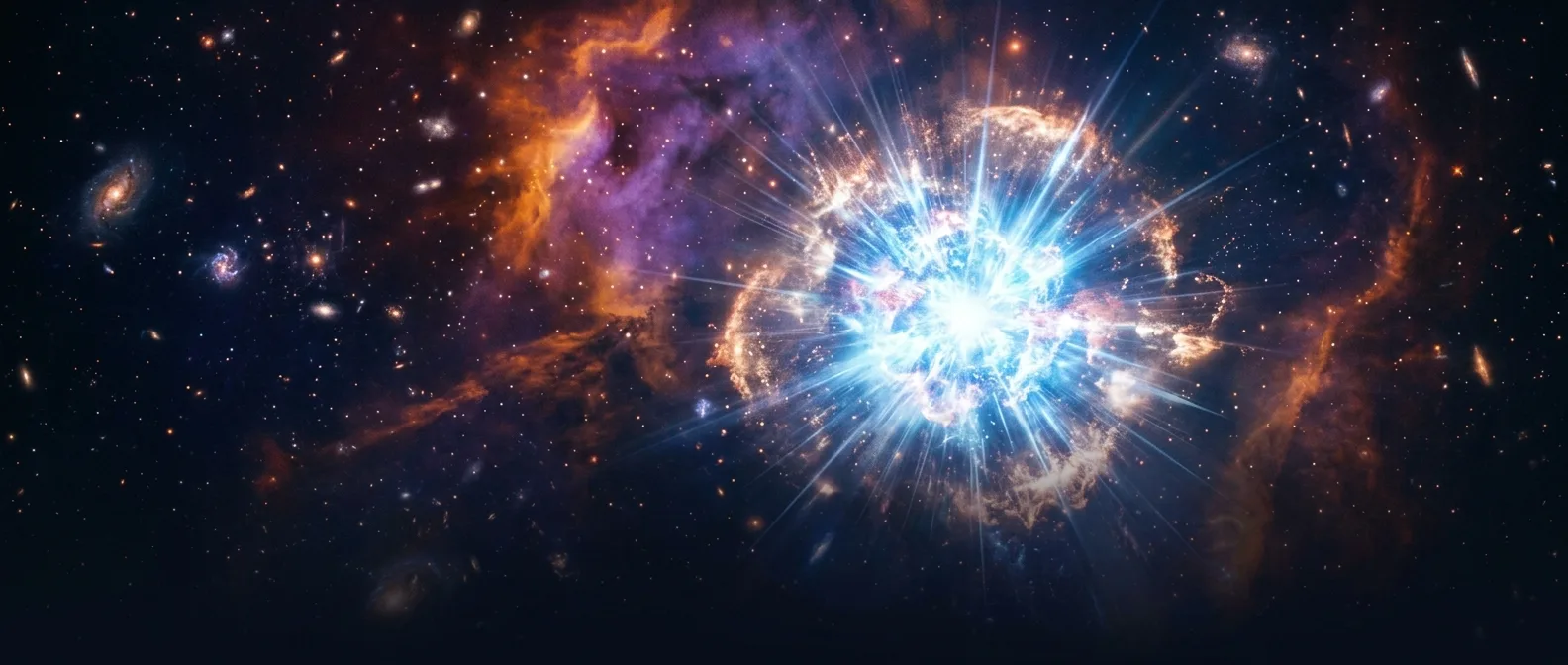
A star exploded like a bomb when the universe was just 730 million years old. What remained from that blast — light that traveled 13 billion years through space — reached the eyes of James Webb last July. That's how we witnessed the most distant supernova ever discovered.
But that's not all. NASA's telescope also managed to spot the host galaxy that harbored this collapsing star. A feat that shatters every previous record — even Webb's own from earlier observations. How did astronomers pull off this stunning discovery?
📖 Read more: Black Hole Growing 13 Times Faster Than Physics Allows
🔬 A Chain of Events That Started in March
On March 14, 2025, an initial alarm pierced the silence of space. SVOM (Space-based multi-band astronomical Variable Objects Monitor), a French-Chinese satellite launched in 2024, detected a gamma-ray burst from distant regions of the universe.
Within an hour and a half, NASA's Swift Observatory pinpointed the X-ray source position in the sky. Eleven hours later, the Nordic Optical Telescope in the Canary Islands spotted a faint glow in the infrared spectrum. Four hours after that, ESO's Very Large Telescope in Chile confirmed something that sounds almost unbelievable: this explosion happened when the universe was just 730 million years old.
Rare phenomenon: According to Andrew Levan from Radboud University, "only a handful of gamma-ray bursts have been detected in the last 50 years from the first billion years of the universe."
This was a coordinated international effort. But the real show was still ahead.
📖 Read more: How James Webb Sees the Universe's First 400 Million Years
⚡ Webb Takes the Baton
Astronomers knew something crucial: supernovas aren't quick events. Unlike gamma-ray bursts that last seconds or minutes, a supernova brightens gradually over weeks and then fades slowly.
But there was a complication. Because this star exploded so early in cosmic history, its light has been stretched as the universe expands. This means time itself appears to move slower from our perspective. So this supernova blazed for months instead of weeks.
That's why Webb took its observations on July 1 — three and a half months after the initial gamma explosion. At that moment, the underlying star was expected to reach peak brightness.
"Only Webb could directly show that this light comes from a supernova — a collapsing massive star," Levan explained. He adds something impressive: "This observation also shows we can use Webb to find individual stars when the universe was only 5% of its current age."
📊 A Surprise: It Looks Familiar
Here comes one of the most stunning elements of the discovery. When researchers compared this ancient supernova with modern supernovas we know well, they found something unexpected: they're nearly identical.
What does this mean? In the universe's first billion years, stars likely contained fewer heavy elements, were more massive, and had shorter lifespans. It was also the Epoch of Reionization, when gas between galaxies was largely opaque to high-energy light.
"We went in with an open mind. We couldn't believe it — Webb showed that this supernova looks exactly like modern supernovas."
Nial Tanvir, University of Leicester
This doesn't mean everything is identical. But the general shape of the event, how it brightened and fades, and the signatures in its light match patterns astronomers already recognize. The next step is finding subtle differences that might reveal what early stars were really like.
The Host Galaxy Challenge
Webb didn't just catch the explosion. It also helped identify the galaxy where the supernova occurred. At such vast distances, galaxies can be so compact and faint they blur into just a few pixels.
"Webb's observations show this distant galaxy is similar to other galaxies that existed at the same epoch," explained Emeric Le Floc'h from CEA Paris-Saclay. A reddish smudge in a few pixels — but the fact that Webb could see it at all is significant.
📖 Read more: JWST Discovers Organic Molecules in Ancient Galaxies
🧬 How Telescope "Networking" Works
This discovery wouldn't have been possible without global telescope coordination. Andrew Levan and his team requested so-called "Director's discretionary time" on Webb — a type of emergency observation time for exceptionally important events.
Their strategy was clever: use gamma-ray bursts as "signposts." Catch the explosion, track the afterglow, and let that glow reveal the galaxy that hosted the event.
SVOM Mission
French-Chinese satellite for detecting rapid astronomical phenomena
Swift Observatory
X-ray source detection within 90 minutes
James Webb
Final confirmation and supernova analysis
This is how modern astronomy works now: react quickly, coordinate globally, and grab transient signals before they vanish.
Redshift 7.3 — What It Means
When we say this supernova has redshift 7.3, we mean its light has been significantly stretched due to cosmic expansion. This number tells us we're seeing an event that happened when the universe was about 5% of its current age. Pretty impressive for a single star.
📖 Read more: James Webb Maps Uranus Auroras in 3D for the First Time
⭐ What This Discovery Changes
Webb's previous record belonged to a supernova that exploded when the universe was 1.8 billion years old. This new finding breaks that record by more than a billion years.
But the value isn't just in the numbers. The ability to study individual stars from so early in cosmic history opens new windows into understanding how the first galaxies formed and how their stars lived and died.
Next steps: The team has already secured more Webb observation time and has a new goal — learning more about distant universe galaxies by capturing the afterglows of gamma-ray bursts themselves.
"This afterglow will help Webb see more and give us a 'fingerprint' of the galaxy," Levan explains. A strategy that sounds promising for 2026 and beyond.
🎯 Frequently Asked Questions
How far is this supernova from Earth?
Light from this supernova traveled approximately 13 billion years to reach us. This means we see it as it was when the universe was just 730 million years old — about 5% of its current age.
Why did it take so many months to detect the supernova?
Supernovas brighten gradually over weeks, but because this one is so distant, cosmic expansion makes everything appear slower. So it took 3.5 months to reach peak brightness.
What makes this supernova so special?
It's the most distant supernova ever directly detected, giving us our first glimpse of how stars died in the universe's early stages. The surprising part is how much it resembles modern supernovas despite the enormous time gap.
At the end of the day, this discovery isn't just a technological achievement. It's a reminder that even at the most distant points in time and space, stars live and die in ways that feel familiar to us. Somehow paradoxically, this makes the universe seem more understandable — and simultaneously more mysterious than ever.