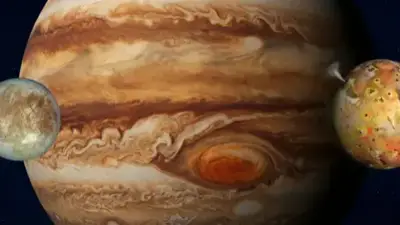
With 95 confirmed moons (as of 2023), Jupiter is the planet with the most known satellites in our solar system. But the sheer number is just the beginning. Jupiter's moon system contains some of the most scientifically significant objects in the known universe — from the most volcanically active body ever observed to a world almost certainly harboring a liquid water ocean beneath its surface.
The Galilean Moons: Io, Europa, Ganymede, and Callisto were discovered by Galileo Galilei in January 1610 — the first objects confirmed to orbit a body other than Earth or the Sun. They range from 3,121 km (Europa) to 5,268 km (Ganymede) in diameter.
Io: The Most Volcanic World
Io is the innermost Galilean moon and the most volcanically active body in the solar system. It has over 400 active volcanoes, some ejecting plumes 500 km high. This hyperactivity is driven by tidal heating: Jupiter's immense gravity, combined with gravitational influences from Europa and Ganymede, squeezes and flexes Io's interior, generating enormous heat. NASA's Juno spacecraft performed close Io flybys in late 2023 and early 2024, revealing unprecedented detail on its volcanic features.
«Io is a window into Earth's past. The volcanism tells us what early Earth may have looked like before plate tectonics took hold.»
— Alfred McEwen, University of Arizona, 2024Europa: The Best Hope for Life
Europa contains a global liquid water ocean beneath a ~15–25 km thick ice shell. The ocean is estimated to be 100 km deep with more water than all of Earth's oceans combined. Surface features like ridges, chaos terrain, and potential water vapor plumes suggest active geological exchange between the ocean and surface. NASA's Europa Clipper, launched in October 2024, will perform 49 close flybys over the next several years to characterize habitability.
Ganymede: Largest Moon in the Solar System
Ganymede is the largest moon in the solar system — larger than Mercury. It is unique among moons in having its own magnetic field (a magnetosphere), which creates auroras near its poles — detected by both the Hubble Space Telescope and ESA's JUICE spacecraft. Ganymede also has a subsurface salt water ocean. ESA's JUICE (Jupiter Icy Moons Explorer), launched in April 2023, will enter orbit around Ganymede in 2034 — the first spacecraft to orbit a moon other than Earth's.
Callisto: Ancient and Cratered
Callisto is the most heavily cratered object in the solar system, preserving a record of ancient impacts going back 4+ billion years. Despite its ancient surface, it may also have a subsurface ocean. Callisto is a candidate for future human outposts as it lies outside Jupiter's intense radiation belts.
- NASA Europa Clipper – Mission Overview
- ESA JUICE – Jupiter Icy Moons Explorer
- NASA Juno – Io Flyby Results 2024
- Spencer et al. – Science 1998: Galileo observations of Europa surface features
Related Articles
Is There Life Elsewhere?
Europa Clipper and the search for life in Jupiter's ocean moon.
Pluto: Why It's Not a Planet
From planet to dwarf planet: the 2006 IAU decision explained.
The Asteroid Belt: Not What Movies Show
Ceres, Vesta, and the real story of the asteroid belt.
Betelgeuse: Will We Witness a Supernova?
The Great Dimming of 2019 and the fate of Orion's shoulder star.
Voyager 1: The Farthest Human Object
Flew past Jupiter in 1979, now 24 billion km away.

Magnetars: The Strongest Magnetic Fields
The most extreme magnetic objects in the universe.