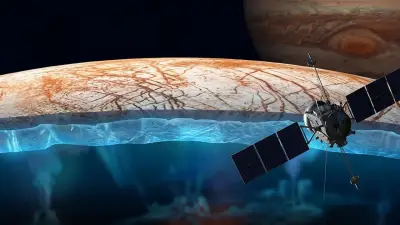
Somewhere beneath a kilometers-thick ice shell, in the most unlikely corner of our solar system, lies an ocean larger than all of Earth's oceans combined. Europa, one of Jupiter's 95 known moons, has become the top candidate in the search for extraterrestrial life — and two spacecraft are already on their way to investigate its secrets.
🌊 The Hidden Ocean
Europa, with a diameter of 3,100 kilometers — slightly smaller than our Moon — conceals a subsurface ocean of salty water beneath its frozen surface. This ocean contains roughly twice as much water as all of Earth's oceans combined — a quantity that surpasses every known reservoir of liquid water in our solar system.
How does an ocean remain liquid 780 million kilometers from the Sun, where surface temperatures plunge to -160°C? The answer lies in tidal heating. Jupiter's enormous gravitational pull, combined with the gravitational interactions of neighboring moons Io and Ganymede, continuously “kneads” Europa's interior. This friction generates enough heat to keep the ocean liquid for billions of years.
The ice shell is estimated to be 15–25 kilometers thick, while the ocean beneath it reaches depths of 60–150 kilometers. The cracks and patterns on the ice surface — resembling blood vessels in an eye — are perhaps the strongest evidence that the ocean below is active and dynamic.
🔬 Two Missions, One Goal
For the first time in the history of space exploration, two major missions are heading simultaneously toward the Jupiter system, targeting its icy moons.
NASA's Europa Clipper launched in October 2024 and is expected to reach Jupiter by 2030. It is the largest planetary spacecraft NASA has ever built, with solar panels spanning 30.5 meters. The craft will perform 49 close flybys of Europa, scanning nearly its entire surface with nine scientific instruments. An ice-penetrating radar will “look” through the ice to map the ocean, while a magnetometer will measure the water's salinity.
ESA's JUICE (Jupiter Icy Moons Explorer) launched in April 2023 and will arrive at Jupiter in 2031. While its primary target is Ganymede — the solar system's largest moon, which also has a subsurface ocean — it will also make two flybys of Europa. JUICE will eventually orbit Ganymede, an unprecedented feat for a moon of another planet.
💡 Chemosynthesis — Life Without Light: On Earth's ocean floors, at depths where not a single ray of light reaches, entire ecosystems thrive around hydrothermal vents. These organisms don't use photosynthesis but chemosynthesis — they draw energy from chemical reactions between water and rocks. If something similar occurs at the bottom of Europa's ocean, then life could exist there without any sunlight at all.
🧬 The Ingredients of Life
For life to exist — at least as we know it — three things are needed: water, chemical ingredients, and energy. Europa appears to have all three.
Water: The subsurface ocean provides vast quantities of liquid water under stable conditions for billions of years. Chemistry: The salts and minerals detected on the surface suggest rich chemistry in the ocean, including sodium chloride (table salt) and possibly organic compounds. Energy: Tidal heating may create hydrothermal vents on the ocean floor, providing both heat and chemical energy.
The possibility of hydrothermal vents is particularly thrilling. On Earth, such vents host life in extremely harsh conditions — tube worms, eyeless shrimp, and microbes thriving at temperatures above 100°C. If the floor of Europa's ocean resembles these environments even slightly, then all the basic ingredients for life are there.
🔭 What We'll Learn
Europa Clipper won't search directly for life — its mission is to determine whether Europa is habitable. It will measure the ice thickness, analyze the surface composition, search for water plumes erupting through cracks, and map the ocean floor.
The most exciting scenario: if Europa Clipper detects water plumes — similar to those observed on Saturn's moon Enceladus — it could literally “taste” Europa's ocean without ever landing. Its instruments would analyze particles in the plumes, searching for organic molecules, amino acids, or even traces of biological activity.
⏰ Timeline
The coming decades will be critical for studying the icy moons:
- 2024: Europa Clipper launch (October 2024)
- 2030: Europa Clipper arrives at the Jupiter system — begins 49 flybys of Europa
- 2031: JUICE arrives at Jupiter — studies Europa, Callisto, and Ganymede
- 2034: JUICE enters orbit around Ganymede
If data from these missions shows that Europa is truly habitable, the next generation of missions could include a lander — a spacecraft that would touch down on the ice, drill downward, and search for life directly in the ocean. Until then, Europa Clipper and JUICE will give us the most detailed map of an alien ocean ever created.