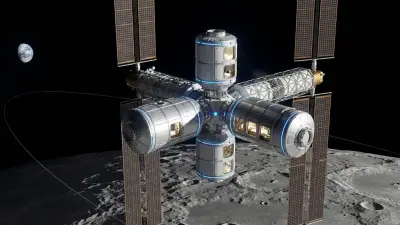
Humanity is preparing to establish a permanent presence around the Moon. The Lunar Gateway is a small space station that will orbit the Moon, serving as a staging point for Artemis missions and as a gateway to deeper space exploration. It's a truly international endeavor combining technology, ambition, and cooperation among the world's leading space agencies.
📖 Read more: Artemis III: When Will Humans Walk on the Moon Again?
🌙 What Is the Gateway?
The Gateway won't sit on the Moon's surface — it will orbit around it in a special trajectory known as a Near-Rectilinear Halo Orbit (NRHO). This unique orbit allows easy access to both the lunar surface and deep space, while requiring minimal fuel for station-keeping.
Unlike the ISS, the Gateway won't be permanently crewed. Astronaut teams will visit for periods of 30–90 days, conducting experiments, preparing lunar missions, and testing technologies for future Mars journeys.
🔧 The Modules
The station will consist of multiple modules, the first two of which will launch together:
- PPE (Power and Propulsion Element): Built by Maxar Technologies for NASA. Provides electrical power via large solar arrays and propulsion through ion thrusters.
- HALO (Habitation and Logistics Outpost): Built by Northrop Grumman. Serves as the primary living and laboratory space, with docking capabilities for visiting spacecraft.
- ESPRIT: An ESA module providing fuel storage, additional telecommunications, and an observation window.
- I-HAB: A joint ESA-JAXA module that will provide additional habitation space and life support systems.
The PPE + HALO launch is planned aboard a SpaceX Falcon Heavy, around 2027.
🌍 International Cooperation
The Gateway is a truly international program. NASA leads the overall design, ESA contributes the ESPRIT and I-HAB modules along with European astronauts, JAXA (Japan) participates in I-HAB and will provide logistics support, while CSA (Canada) is building Canadarm3 — the station's robotic arm.
🛰️ What is NRHO? The Near-Rectilinear Halo Orbit is a special trajectory around the Moon, near the Earth-Moon gravitational balance point (Lagrange point L2). The station will pass close to the Moon's poles, ranging from 3,000 km to 70,000 km in distance. A complete orbit takes approximately 6.5 days.
🚀 How It Will Be Used
The Gateway's primary role is as a transfer station for Artemis missions. Astronauts will arrive at Gateway aboard Orion, transfer to the lunar lander (e.g., Starship HLS), descend to the surface, then return via Gateway. Additionally, the station will function as a fuel depot, a platform for scientific experiments, and a telecommunications hub for lunar activities.
🔭 From the Moon to Mars
The Gateway isn't just about the Moon — it's a stepping stone to Mars. The experience of building and operating a station in deep space will provide invaluable lessons for deep space missions. Life support technologies, radiation protection, and autonomous operations will be tested here first, before being applied to a journey lasting months.
The Gateway marks a new era in space exploration: from low orbit to deep space, from visits to permanent presence, and from the Moon to Mars. The gateway to the future is already under construction.