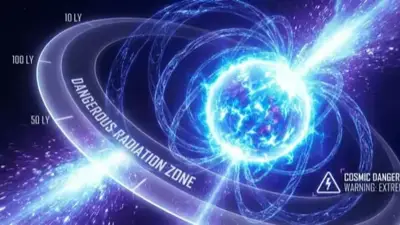
Of all the objects in the known universe, magnetars are perhaps the most extreme. They are a rare class of neutron star — themselves already the densest objects short of black holes — but with magnetic fields trillions of times stronger than Earth's. Currently, only about 30 magnetars are confirmed in our galaxy, yet they have already demonstrated their capacity for catastrophic explosions visible across the universe.
Magnetic Power: A magnetar's magnetic field reaches 1015 Gauss (1011 Tesla). For comparison, a typical fridge magnet is ~100 Gauss. At half the Earth-Moon distance, a magnetar's field would erase every credit card and strip oxygen from the atmosphere.
What Is a Magnetar?
Magnetars are born when a massive star collapses and the resulting neutron star somehow acquires an extraordinarily strong magnetic field during formation. The leading theory involves a convective dynamo process in the first seconds of the neutron star's life. They are 20 km in diameter, typically spinning every few seconds, and radiating primarily in X-rays and gamma rays.
The December 27, 2004 Event
On December 27, 2004, magnetar SGR 1806-20, located ~50,000 light-years away, unleashed a “giant flare.” In 0.2 seconds, it released more energy than our Sun emits in 250,000 years. The gamma-ray pulse was so intense that it partially ionized Earth's upper atmosphere. This event — the brightest observed extragalactic event in recorded history until gamma-ray bursts — was detected by multiple satellites including INTEGRAL and Swift.
«Had this event occurred within 10 light-years of Earth, it would have triggered a mass extinction.»
— Astronomers' assessment of SGR 1806-20 Dec 27 2004Fast Radio Bursts (FRBs) from Magnetars
In April 2020, SGR 1935+2154 in our own galaxy produced a radio burst — simultaneously observed by CHIME and STARE2 telescopes — with properties matching the mysterious Fast Radio Bursts (FRBs) detected from other galaxies. This provided the first direct evidence that at least some FRBs are caused by magnetar activity, solving one of astronomy's biggest mysteries of the 2010s.
What Happens If You Approach One?
The effects begin far before you could reach any meaningful distance. At 1,000 km: atomic bonds in your body would be disrupted by the magnetic field. At 100 km: the field becomes so intense it rearranges electron orbitals in matter. Within 1 km of the surface: the gradient of gravity would spaghettify you. You would cease to exist as any recognizable structure long before reaching the surface. The magnetar would also periodically emit lethal X-ray bursts capable of killing at thousands of light-years.
- NASA – SGR 1806-20 Giant Flare, 2004
- CHIME/FRB – Detection of SGR 1935+2154, 2020
- Thompson & Duncan – ApJ 1993: Formation of highly magnetized neutron stars
- Mereghetti et al. – ApJ Letters 2020: Discovery of the galactic FRB
Related Articles
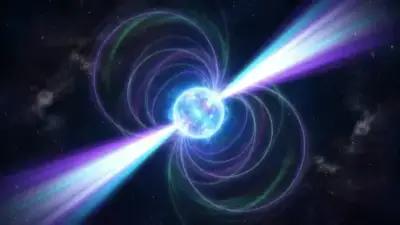
Neutron Stars: The Universe's Zombies
The cosmic remnants that forge gold in kilonova explosions.
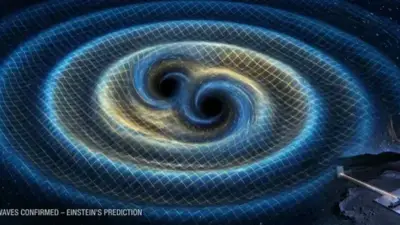
Gravitational Waves: LIGO's New Astronomy
From binary black holes to neutron star mergers, LIGO changed everything.
Betelgeuse: Will We Witness a Supernova?
In the constellation of Orion, a red giant is counting down.
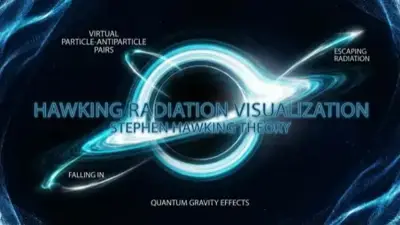
Hawking Radiation: Black Holes That Evaporate
Are black holes truly eternal? Hawking said no.

Time Slows Down Near Massive Objects
GPS works because relativity is real. Time near a massive object flows slower.
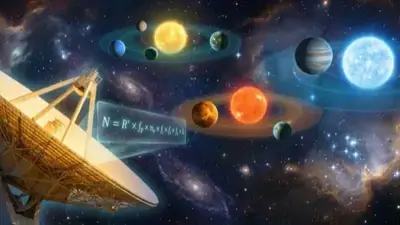
Is There Life Elsewhere in the Universe?
From Europa's ocean to Enceladus's geysers — we are not alone?