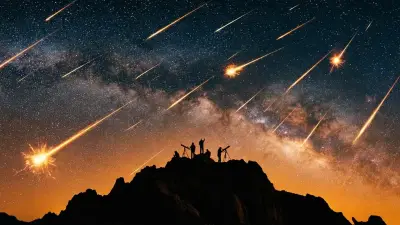
The night sky offers spectacular meteor showers every year — “shooting stars” that streak across the heavens in brilliant lines of light. 2026 features eight major meteor showers, from the Quadrantids in January to the Geminids in December. Here is your complete guide to when, where, and how to see them all.
📖 Read more: Total Lunar Eclipse March 2026: When and Where to See It
☄️ The Major Showers of 2026
Every year, Earth passes through the debris trails left behind by comets and asteroids, producing meteor showers. The eight major showers of 2026 are: Quadrantids (Jan 3-4, ~120/hr ZHR), Lyrids (Apr 22-23, ~20/hr), Eta Aquariids (May 6, ~50/hr), Perseids (Aug 12-13, ~100/hr), Orionids (Oct 21-22, ~20/hr), Leonids (Nov 17-18, ~15/hr), Geminids (Dec 14-15, ~150/hr), and Ursids (Dec 22-23, ~10/hr).
📖 Read more: Ring of Fire: Upcoming Solar Eclipses in 2026
🌟 Perseids — The Most Popular
The Perseids are the most popular meteor shower of the year. They peak on August 12-13, producing approximately 100 meteors per hour under ideal conditions. They originate from debris left by Comet 109P/Swift-Tuttle, which returns every 133 years. Their popularity comes from the fact that they fall in summer, when the nights are warm and pleasant for stargazing. Perseids are known for producing bright, fast meteors and occasional spectacular fireballs.
💎 Geminids — The Brightest
The Geminids are the brightest and most impressive meteor shower of the year. They peak on December 14-15 with up to 150 meteors per hour. This is the only major meteor shower that originates from an asteroid (3200 Phaethon) rather than a comet. Geminid meteors are bright, slow-moving, and often multicolored, making them a favorite among photographers and astronomy enthusiasts alike.
📖 Read more: Cosmic Mystery: Giant Iron Bar Discovered in the Ring Nebula
🔭 How to Watch
Watching meteor showers requires no equipment — just your eyes. Find a dark sky away from city light pollution. Let your eyes adapt to the darkness for at least 20 minutes. Look away from the radiant point to see longer meteor trails. Lie down and enjoy the show. The Moon phase matters: a full moon “washes out” faint meteors, while a new moon provides the best conditions for viewing.
📚 Terminology: Meteoroids = small space rocks in space. Meteors = the bright streak in the atmosphere (the “shooting star”). Meteorites = whatever reaches the ground. Fireballs = exceptionally bright meteors.
📖 Read more: Galaxies: How Far Away Are They and How Do We Know?
📸 Photographing Meteors
To photograph meteors, you need a camera with a wide-angle lens, a tripod, and patience. Set the exposure to 15-30 seconds, ISO 1600-3200, and aperture f/2.8 or wider. Point the lens at a section of sky and take many exposures — luck plays a role. With persistence, you will capture some extraordinary moments streaking across the night sky.