📖 Read more: Galaxy: New Magnetic Field Map Reveals Hidden Structure
📡 What Are Fast Radio Bursts?
Fast Radio Bursts (FRBs) are brief, intense flashes of radio waves lasting just milliseconds. They were discovered accidentally in 2007 by astronomer Duncan Lorimer, while analyzing older data from the Parkes radio telescope in Australia.
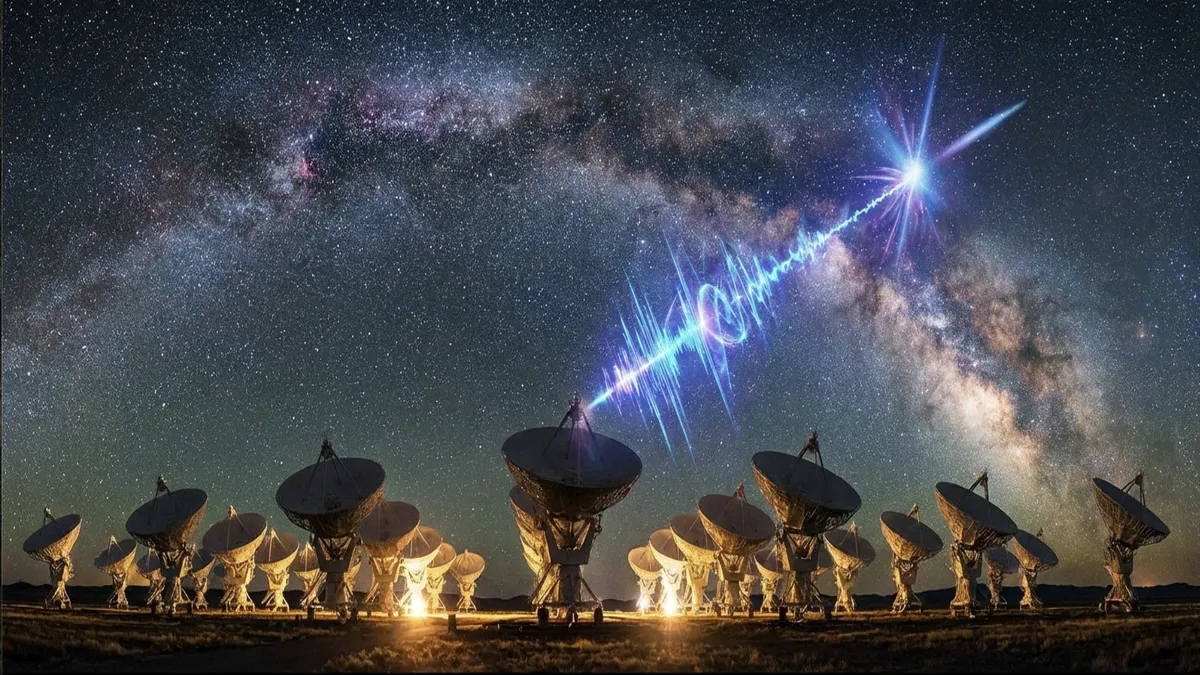
Radio telescopes detect mysterious signals from the depths of the universe
What makes FRBs so fascinating is their incredible energy. In just milliseconds, a single FRB releases as much energy as our Sun does in days or even months. And yet, they originate from galaxies billions of light-years away.
🌌 The 13 Billion-Year-Old Signal
In 2023, astronomers announced the detection of FRB 20220610A — a signal that began its journey when the universe was just 800 million years old. To put that in perspective: the universe is 13.8 billion years old. This signal had been traveling for nearly the entire history of the cosmos.
"It's like receiving a message from the beginning of time. The universe was an infant when this signal set off."
📖 Read more: JWST Discovers Organic Molecules in Ancient Galaxies
❓ Where Do They Come From?
The origin of FRBs remains one of the greatest mysteries of modern astrophysics. There are several theories:
🔄 Repeating FRBs: The Major Discovery
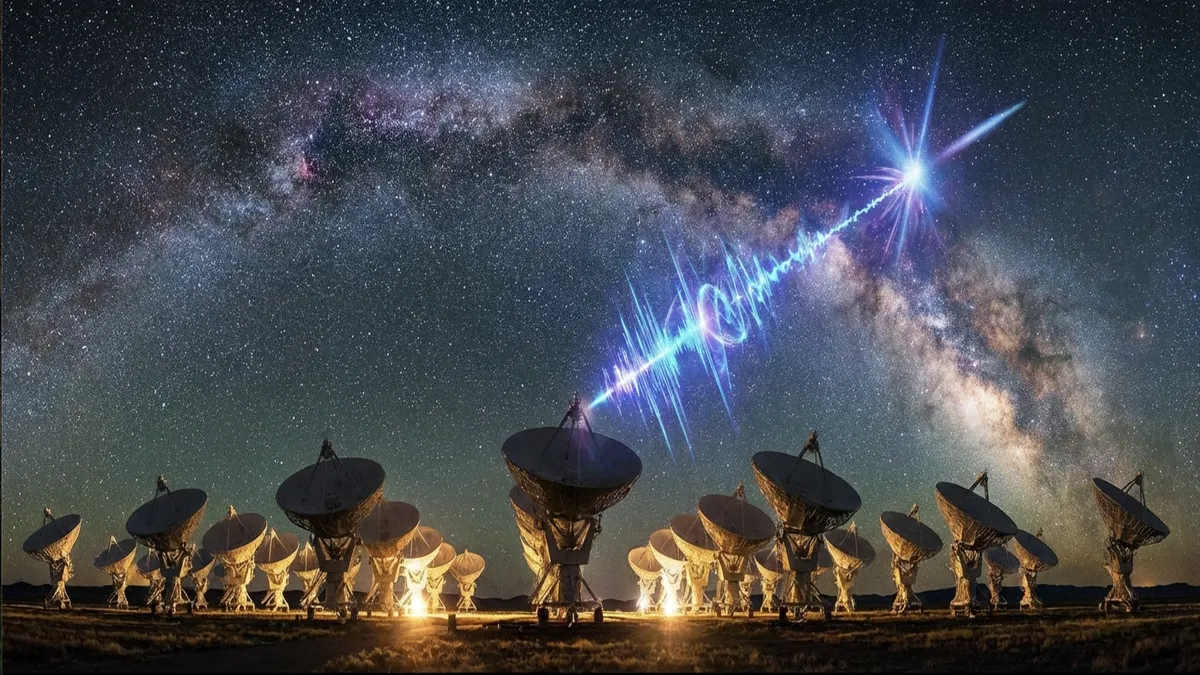
Some FRBs repeat in patterns — this helps scientists pinpoint their source
Initially, FRBs were thought to be one-off events. But in 2016, FRB 121102 was discovered — the first one to repeat. This changed everything. If something is destroyed (e.g., a stellar collision), it can't repeat. So the source must survive.
📖 Read more: Total Solar Eclipse August 2026: Spain Gets First Since 1999
In 2020, a crucial discovery was made: an FRB was detected from within our own galaxy, originating from a magnetar. This confirmed (for at least some FRBs) the magnetar theory.
🔬 Why Do We Study FRBs?
Beyond their origins, FRBs are tools. As they travel billions of light-years, they interact with “missing matter” — the invisible gas between galaxies. By studying how FRBs are affected, we can map the universe.
🔭 What Does This Mean for the Future?
With new telescopes like CHIME in Canada and the SKA currently under construction, we are expected to detect thousands of FRBs every year. This will give us:
- Maps of the universe: The “missing matter” will become visible
- Understanding of extreme phenomena: Magnetars, black holes, mergers
- Perhaps... contact? If there is an artificial origin, the patterns will reveal it
Fast Radio Bursts are a reminder that the universe is full of mysteries. Every signal that reaches Earth is a message from the past — and an invitation to discover more.