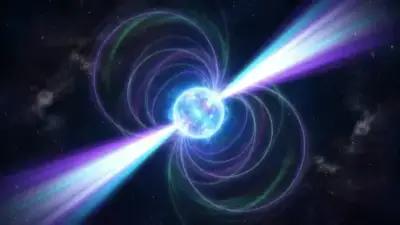
When a massive star — at least 8–20 times the mass of our Sun — exhausts its nuclear fuel, it collapses catastrophically and explodes as a supernova. But unlike lighter stars that produce white dwarfs, these stellar giants leave behind an extraordinary remnant: a neutron star. Despite being “dead” in the sense that they no longer fuse elements, they are anything but quiet. They spin at extraordinary speeds, emit powerful radiation, and sometimes collide to forge gold and platinum. This is why astronomers call them zombie stars.
Quick Facts: A neutron star has a diameter of only ~20 km but contains 1–2 solar masses. One teaspoon of its material weighs approximately 1 billion tons. Its surface gravity is 200 billion times stronger than Earth's.
The Discovery of Pulsars
In 1967, Jocelyn Bell Burnell, a graduate student at Cambridge University, detected a remarkably regular radio pulse arriving every 1.33 seconds. Initially nicknamed “LGM-1” (for “Little Green Men”), this turned out to be a rapidly rotating neutron star — a pulsar. Her supervisor Antony Hewish received the 1974 Nobel Prize for the discovery, in a decision widely considered controversial for omitting Bell Burnell.
«I am not myself upset about it — after all, I am in good company, am I not? As far as I am aware, no woman has ever won the Nobel Prize in Physics.»
— Jocelyn Bell Burnell, on being excluded from the 1974 Nobel PrizeThe Crab Nebula Pulsar
The most famous pulsar is at the center of the Crab Nebula — the remnant of a supernova observed by Chinese astronomers on July 4, 1054 AD. It was bright enough to be visible in daylight for 23 days. The Crab Pulsar spins 30 times per second (30 Hz) and is a major source of high-energy radiation across the electromagnetic spectrum, from radio waves to gamma rays.
GW170817: Neutron Stars Create Gold
On August 17, 2017, LIGO and Virgo detected gravitational waves from the merger of two neutron stars — GW170817. Optical telescopes simultaneously observed the resulting kilonova explosion, a cataclysm that synthesized enormous amounts of heavy elements including gold, platinum, and uranium through rapid neutron capture (r-process nucleosynthesis). This event confirmed that most heavy elements in the universe — including the gold in jewelry — originated in neutron star mergers.
The NICER Mission
NICER (Neutron star Interior Composition Explorer), installed on the International Space Station in 2017, studies neutron stars through X-ray observations with unprecedented precision. In 2024, NICER provided the most accurate measurements yet of neutron star radii (~12 km) and densities, helping constrain the equation of state of ultra-dense matter.
- LIGO Scientific Collaboration – GW170817 Detection
- NASA NICER – Neutron Star Interior Composition Explorer
- Hewish et al. – Nature, 1968: Discovery of a rapidly pulsating radio source
- Abbott et al. – Physical Review Letters, 2017: GW170817
Related Articles
Betelgeuse: Will We Witness a Supernova?
The Great Dimming of 2019 was not a sign of imminent explosion.
Magnetars: The Strongest Magnetic Fields
What happens when you approach a magnetar? Spoiler: not much of you survives.
Gravitational Waves: How LIGO Hears the Universe
GW150914 and GW170817 changed how we study the cosmos.
Hawking Radiation: Black Holes That Evaporate
Hawking's 1974 prediction remains one of physics' greatest unsolved puzzles.
Time Slows Down Near Massive Objects
GPS satellites correct for relativistic time dilation every day.
Is There Life Elsewhere in the Universe?
Europa, Enceladus, Titan — the search for cosmic neighbors.