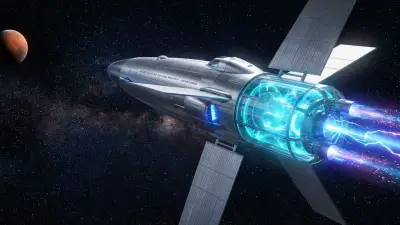
For over sixty years, chemical rockets have been the sole means of space travel. But their limitations are clear: a trip to Mars takes 7–9 months, astronauts are exposed to radiation and microgravity, and the amount of fuel required is enormous. Nuclear energy could change everything — from propulsion to power generation on other planets.
⚛️ Why Nuclear Energy?
Chemical rockets work by burning fuel — hydrogen and oxygen. They are effective for launch, but for long-distance travel they have serious limitations. Their specific impulse (Isp) is limited, meaning they require enormous amounts of propellant for every maneuver.
Nuclear energy offers dramatically better performance. A nuclear thermal engine (NTP) can achieve an Isp 2–3 times greater than chemical rockets. This translates to less fuel, lower mass, and much faster transit times.
🚀 Nuclear Thermal Propulsion
Nuclear Thermal Propulsion (NTP) uses a nuclear fission reactor to heat hydrogen propellant to extremely high temperatures. The superheated hydrogen is expelled through a nozzle at tremendous velocities, producing thrust far more efficiently than chemical combustion.
The DRACO program (Demonstration Rocket for Agile Cislunar Operations), a collaboration between NASA and DARPA, aims for the first in-space test of a nuclear thermal engine around 2027. If successful, it will pave the way for crewed Mars missions with travel times of just 3–4 months instead of 7–9.
Reducing travel time is not merely a matter of convenience — it is a matter of survival. Less time in space means less exposure to cosmic radiation, less muscle and bone loss, and reduced psychological strain on the crew.
🔋 RTG — Plutonium in Space
Radioisotope Thermoelectric Generators (RTGs) are the backbone of deep space exploration. They convert heat from the radioactive decay of Plutonium-238 into electrical energy — with no moving parts, no fuel, and no sunlight required.
Voyager 1 and 2, launched in 1977, continue to transmit data from interstellar space thanks to their RTGs — over 45 years of uninterrupted operation. Curiosity and Perseverance on Mars are also powered by RTGs (MMRTG), allowing them to operate day and night, through dust storms and winter.
New Horizons, which gave us the first close-up images of Pluto, is also powered by Plutonium-238. At such distances from the Sun, solar panels are useless — only nuclear energy works.
⚡ Fission Reactors
For the Moon and Mars, we need more than RTGs. NASA's Kilopower program developed KRUSTY (Kilopower Reactor Using Stirling Technology) — a small fission reactor capable of producing 10 kW of electrical power for over 10 years.
Four Kilopower units could power a lunar habitat — lighting, life support systems, communications, and research laboratories. This is critical for the lunar south pole, where the lunar night lasts 14 days and solar panels are inadequate.
Nuclear Electric Propulsion (NEP) is another approach: the reactor generates electricity that powers ion thrusters. The thrust is small but continuous, ideal for deep space missions to the outer planets and beyond.
💡 Notable: The Voyager spacecraft RTGs continue to operate after 45+ years in space — transmitting data from over 24 billion kilometers away. No other power source could achieve this.
📜 History
The idea of nuclear propulsion is not new. The NERVA program (Nuclear Engine for Rocket Vehicle Application) in the 1960s–70s proved that nuclear thermal engines work. Multiple reactors were tested on the ground, but the program was canceled in 1973 due to budget cuts.
Even more audacious was Project Orion in the 1950s — the concept of propulsion using nuclear pulses (essentially small nuclear explosions behind the spacecraft). Theoretically it could reach Mars in weeks, but the Partial Nuclear Test Ban Treaty of 1963 ended it.
⚠️ Challenges
Nuclear energy in space faces serious challenges. Launch safety is critical: a launch failure with radioactive material onboard would be catastrophic. Political opposition to the word “nuclear” remains strong in many countries.
Furthermore, production of Plutonium-238 is limited globally. The United States only resumed production in 2015 after decades of dependence on Russian stockpiles. Despite the challenges, the future of space exploration inevitably passes through nuclear energy — whether for propulsion or for power generation on other worlds.