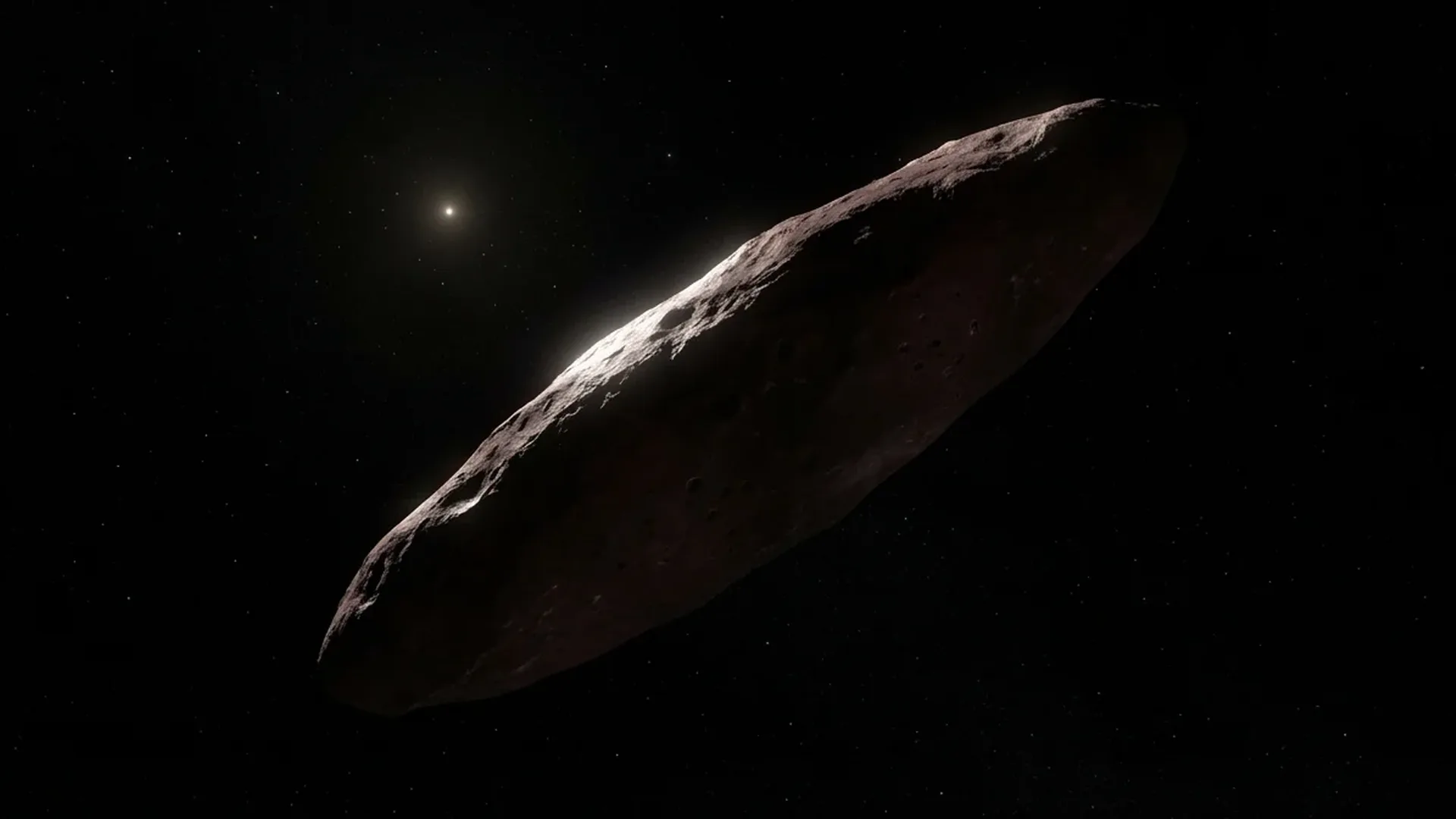
In October 2017, a mysterious object passed through our solar system at a speed no Sun-bound body could ever achieve. It was 1I/'Oumuamua — the first confirmed interstellar visitor in the history of astronomy. Its name comes from Hawaiian and means “a messenger from afar arriving first.” What followed was one of the greatest mysteries of modern science.
📖 Read more: The Solar System: A Complete Guide to Our Planets
🌟 The Discovery
'Oumuamua was detected on October 19, 2017, by the Pan-STARRS telescope in Hawaii, a system designed to spot moving objects in the sky. Initially classified as a comet, then as an asteroid, it ultimately received the unprecedented designation “1I” — the first interstellar object. Its trajectory was hyperbolic, meaning it wasn't bound by the Sun's gravity. 'Oumuamua came from the depths of interstellar space, swung past the Sun, and continued its journey into the void.
❓ The Mysteries
From the earliest observations, 'Oumuamua displayed characteristics that didn't match any known type of celestial body. Its brightness varied dramatically every 7–8 hours, suggesting an extremely elongated shape — roughly 230 meters long but only 35 meters wide, like a giant cigar or a thin pancake.
📖 Read more: James Webb Maps Uranus Auroras in 3D for the First Time
Most troubling was the non-gravitational acceleration. As it moved away from the Sun, 'Oumuamua slightly sped up — something comets do through outgassing, but no gas, dust, or tail was ever observed. No coma, no tail, nothing. This spawned a cascade of theories ranging from the plausible to the extraordinary.
🧊 Natural Explanations
Many scientists proposed natural mechanisms for the strange behavior. Seligman and Laughlin hypothesized it could be a “hydrogen iceberg” — a body made of frozen molecular hydrogen. The sublimation of hydrogen would be invisible to telescopes but would produce thrust. Others, like Jackson and Desch, proposed nitrogen ice, similar to what's found on Pluto's surface.
A third hypothesis suggested the outgassing was so diffuse that we simply couldn't see it — particularly if it came from water molecules released from the object's crystalline lattice through solar radiation.
📖 Read more: Saturn's Rings: Secrets Revealed by the Cassini Mission
🛸 The Loeb Theory
Avi Loeb, a professor of astronomy at Harvard, proposed a far bolder explanation: 'Oumuamua could have been an artificial construct. Specifically, he suggested it might be a “light sail” — an extremely thin, flat object propelled by solar radiation pressure. Loeb published a book titled “Extraterrestrial” defending this theory.
The scientific community reacted mostly negatively. Most astronomers stressed that exotic natural explanations are more likely than an alien artifact, and that Occam's razor demands we exhaust natural explanations first.
⚖️ Scientific Consensus: The majority of researchers believe 'Oumuamua was a natural object — most likely a piece of nitrogen ice or an unusual cometary fragment — but acknowledge that a full explanation remains elusive, since the object can no longer be studied.
📖 Read more: Voyager 1: The Farthest Human-Made Object in Space
☄️ 2I/Borisov — A Normal Visitor
In August 2019, amateur astronomer Gennady Borisov discovered the second confirmed interstellar visitor: 2I/Borisov. In stark contrast to 'Oumuamua, Borisov was a typical comet — with a bright coma, a dust tail, and clear outgassing. Its existence proved that interstellar objects aren't rare; they were just invisible until we had the right telescopes. Borisov's normal behavior made 'Oumuamua's strangeness even more striking.
🔭 Searching for More
With the Vera C. Rubin Observatory (formerly LSST) coming online, astronomers expect to detect many more interstellar objects. The telescope will scan the entire visible sky every few nights, spotting even faint, fast-moving bodies. Estimates suggest several interstellar objects may cross through the inner solar system every year.
'Oumuamua, however, is already gone. It's traveling away from us at roughly 26 km/s and can no longer be reached by any existing spacecraft. Its mystery will remain open — unless someday we find another visitor equally strange.