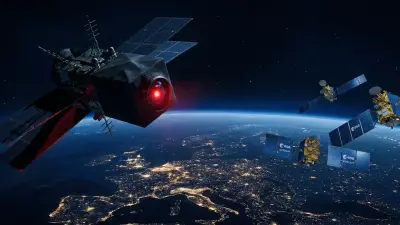
In the dark, silent world of orbit, a new kind of espionage is unfolding without a sound. Russian spy satellites have approached and intercepted European communications satellites, gaining access to unencrypted data belonging to the European Union. The revelation, published by the Financial Times in February 2026, opens a disturbing chapter in the geopolitics of space.
📖 Read more: China's Lunar Program: From Chang'e to Crewed Moon Landings
🛰️ The Revelation
According to the Financial Times investigation, Russian satellites conducted Rendezvous and Proximity Operations (RPO) against European communications satellites. The Russian “inspectors” (as they are officially called) approached at unusually close range to Western satellites, enabling the interception of signals.
What's alarming is that many of these communications were unencrypted. This means Moscow could likely read the content of communications carried by European satellites — from government communications to commercial data and diplomatic exchanges.
The story was picked up by Ars Technica and sparked intense debate about space security, European vulnerability, and the future of space defense.
🕵️ How Space Espionage Works
Space espionage doesn't look like a James Bond movie. There are no spies in tuxedos — there are satellites maneuvering silently through the void. Russia operates specialized "inspector satellites" that can change orbit and approach other satellites.
The process is relatively simple in theory: the Russian satellite performs maneuvers to position itself in a close orbit with its target. From there, it can monitor the target satellite, photograph its equipment, analyze the signals it emits, and — in the case of unencrypted communications — read their content.
What makes the situation particularly concerning is that there is no way to physically prevent one satellite from approaching another in space. There are no borders, no fences, no "space police." Anyone can position their satellite wherever they want.
📖 Read more: China vs NASA: The New Moon Race of the 2020s
⚠️ 2021 ASAT Test: In November 2021, Russia tested an anti-satellite weapon (ASAT), destroying its own decommissioned satellite Cosmos 1408. The destruction created over 1,500 pieces of orbital debris that threatened even the International Space Station (ISS). Many of these fragments continue to orbit, posing a danger to every space object. The test demonstrated both Russia's willingness to weaponize space and the devastating consequences such actions can have for all spacefaring nations.
🇪🇺 European Vulnerability
Europe finds itself in a particularly vulnerable position for two reasons. First, many European satellite communications remain unencrypted. What was once considered insignificant — after all, who would “listen in” on a satellite at 36,000 kilometers altitude? — has now become a critical security gap. With Russian inspectors approaching, the lack of encryption means an open door.
Second, Europe lacks launch sovereignty. The Ariane 6 rocket, while a step in the right direction, has not yet reached full operational capability. The EU depends heavily on third parties for satellite launches, limiting its ability to quickly replace compromised satellites or deploy security countermeasures.
The lack of autonomous space capability means Europe is essentially a passive observer in its own space environment. It can see Russian satellites approaching but doesn't have the means to respond effectively.
🛡️ What Can Be Done
The first and most obvious step is encrypting all satellite communications. This sounds self-evident, but the reality is that many commercial satellites operate on protocols designed decades ago, with no provisions for threats of this kind. Upgrading requires time and money.
📖 Read more: Corona Effect: Why Trees Spark During Thunderstorms
Second, Europe needs Space Domain Awareness (SDA) — the capability to track every object in orbit and identify suspicious movements. Today, this capability is primarily American, with the US Space Command tracking over 47,000 objects in orbit. Europe needs its own independent capability.
Third, NATO has recognized space as an operational domain since 2019. But the gap from recognition to action is large. The alliance needs specific response protocols for when a hostile satellite approaches allied assets in orbit.
⚔️ Space as a Battlefield
The Russian spy satellite case is a symptom of a broader trend: space is becoming an increasingly contested domain. Beyond Russia, China has also tested anti-satellite weapons, while the United States created its Space Force in 2019 as a separate branch of the armed forces.
The militarization of space isn't new — satellites have always been critical for navigation, communications, and intelligence. What's changing is the active threat: satellites that can approach, monitor, jam, or even destroy other satellites.
In a world that depends more and more on satellites for everything — from GPS to banking transactions, from weather forecasting to military communications — security in orbit is no longer the stuff of science fiction. It's a matter of national security.
The Financial Times revelation is a reminder: the war of the future won't be fought only on land and sea. It will be fought in orbit too — silently, invisibly, and without anyone on Earth noticing. And that, perhaps, is the most unsettling part of all.