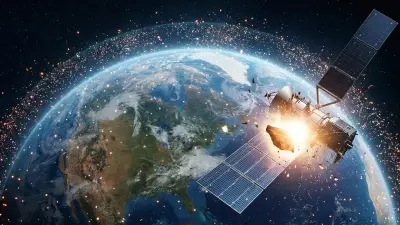
Above our heads, traveling at speeds exceeding 28,000 km/h, millions of pieces of space debris orbit the Earth. From microscopic flecks of paint to entire abandoned satellites, the space around our planet is becoming increasingly dangerous. This invisible threat endangers everything — from our GPS and telecommunications to astronauts aboard the ISS and humanity's future in space.
📖 Read more: Nuclear Energy in Space: The Key to Mars and Beyond
🗑️ How Much Junk Is Up There?
The numbers are staggering. According to ESA, over 36,500 objects larger than 10 centimeters are actively tracked in orbit around Earth. But these represent only the tip of the iceberg. Approximately 1 million fragments between 1–10 centimeters circulate without reliable detection, while pieces smaller than 1 centimeter are estimated to number over 130 million.
This debris comes from decades of launches: abandoned rocket stages, defunct satellites, fragments from explosions and collisions, even tools that astronauts dropped during spacewalks. Every new launch adds to the problem, and every collision multiplies the number of fragments exponentially.
💥 Collisions at 10 km/s
In low Earth orbit (LEO), the average collision speed between two objects reaches 10 kilometers per second — approximately 36,000 km/h. At this velocity, even a 1-centimeter piece can cause catastrophic damage to an operational satellite. The kinetic energy of such a collision is equivalent to a hand grenade explosion.
📖 Read more: Elon Musk's Pivot: From Mars Dreams to Moon Reality
The worst-case scenario is known as the Kessler Syndrome — a cascading collision effect. When two large objects collide, they create thousands of new fragments, which in turn can strike other objects, generating even more debris. This chain reaction could theoretically render certain orbits completely unusable for decades or even centuries.
💡 Kessler Syndrome: First proposed in 1978 by NASA scientist Donald Kessler. It describes a scenario where the density of objects in orbit is so high that collisions become inevitable, triggering chain reactions that make entire orbital zones inaccessible.
⚠️ Dangerous Incidents
Two events marked turning points in the space debris problem. In January 2007, China deliberately destroyed its Fengyun-1C weather satellite in an anti-satellite weapon (ASAT) test. The destruction created over 3,500 trackable fragments, many of which remain in orbit today.
In November 2021, Russia conducted a similar test, destroying the Cosmos 1408 satellite. This generated over 1,500 new fragments, even forcing ISS astronauts to take shelter in their rescue vehicles as a precaution. The international community condemned the test, as debris scattered into orbits that endanger hundreds of satellites.
📖 Read more: iPhones on the Moon: NASA Allows Astronauts Smartphones
🛡️ How We Protect Ourselves
The International Space Station (ISS) regularly performs avoidance maneuvers — dozens each year — to dodge known debris. Each maneuver costs precious fuel and interrupts scientific experiments. Meanwhile, the Space Fence — a U.S. military radar system — monitors objects in orbit with remarkable precision, detecting objects as small as 10 centimeters in low orbit.
ESA and NASA maintain offices dedicated to space debris, issuing collision warnings to satellite operators. However, current monitoring capabilities can only detect a fraction of the actual number of objects — the millions of smaller fragments remain detectable only after a collision occurs.
📖 Read more: Jupiter's Europa: An Ocean World That May Harbor Life
🧹 Cleaning Up Space
ESA is developing the ClearSpace-1 mission, planned as the first Active Debris Removal (ADR) mission. The goal is to capture and deorbit an abandoned VESPA payload adapter. ADR technology includes robotic arms, nets, harpoons, and even lasers that can push debris toward the atmosphere.
Laser deorbiting technology is in early stages but shows great promise: a powerful laser from Earth or the ISS could vaporize part of a fragment's surface, creating thrust that would gradually lower its orbit, leading to atmospheric burn-up.
🔮 The Challenge Ahead
With satellite megaconstellations — such as SpaceX's Starlink, which already numbers over 6,000 satellites — the count of active and inactive objects in orbit is growing rapidly. While modern satellites are designed to deorbit at end-of-life, the statistical probability of failure means a percentage will remain in orbit as debris.
Sustainable use of space is now a vital issue. Without international regulations, debris removal technologies, and responsible launch practices, we risk losing access to orbits essential for telecommunications, Earth observation, GPS navigation, and crewed missions. The battle for clean space has begun — and the clock is ticking.