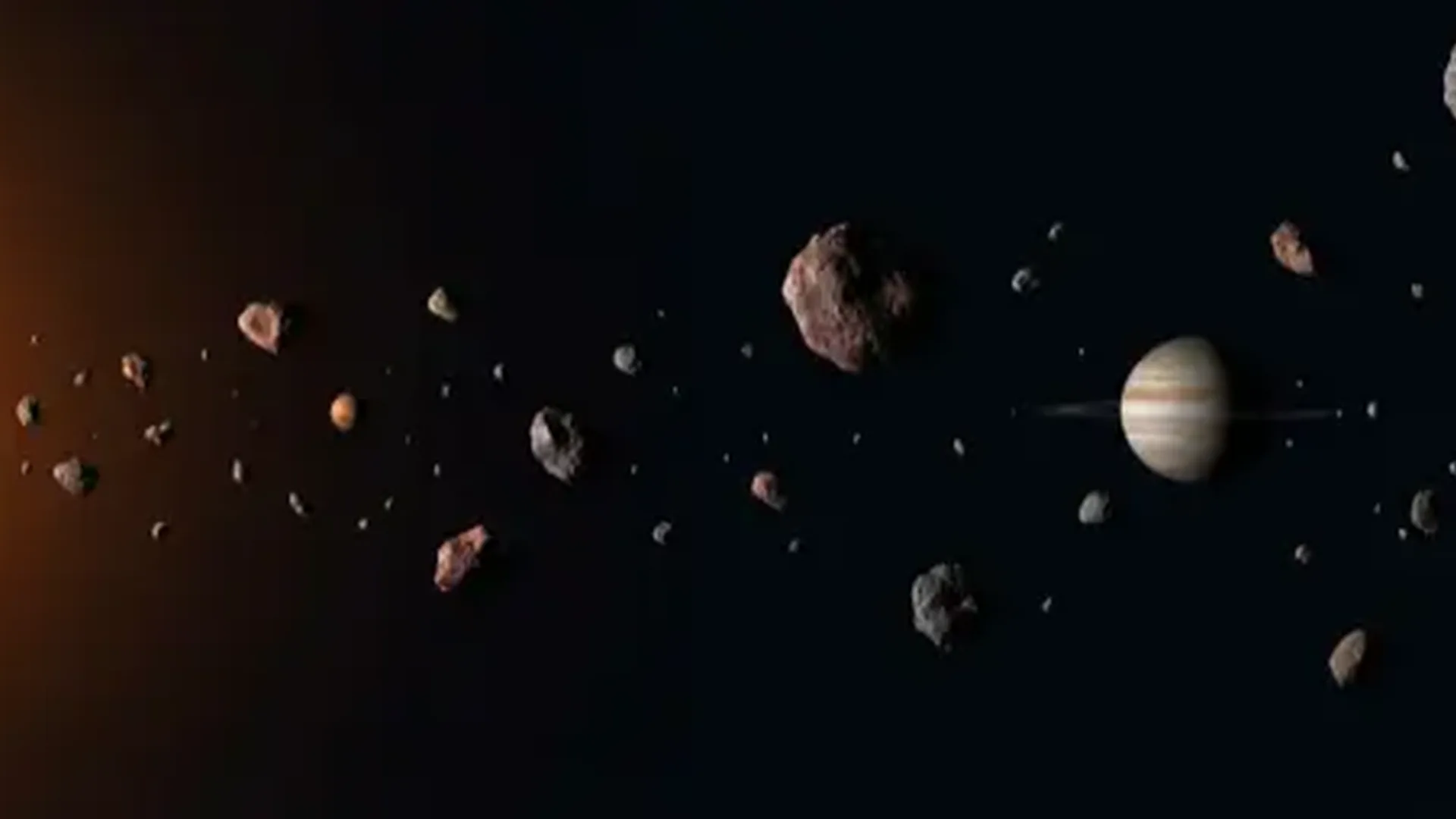
Science fiction films routinely portray the Asteroid Belt as a treacherous field of densely packed rocks that spaceships must navigate carefully. The reality is dramatically different. The asteroid belt — a region of space between the orbits of Mars and Jupiter at 2.2-3.2 AU from the Sun — is so vast and its contents so sparse that the average distance between objects is hundreds of thousands of kilometers. Every spacecraft sent through it has passed without incident. But what it does contain is fascinating.
Scale Check: If all asteroid belt material were combined, it would form an object smaller than Earth's Moon. The total mass of the belt is about 4% of the Moon's mass. The belt is not the leftover of a destroyed planet — it's material that never formed one due to Jupiter's gravitational influence.
Ceres: The Dwarf Planet in the Belt
Ceres, discovered by Giuseppe Piazzi on January 1, 1801, is the largest body in the asteroid belt with a diameter of 945 km. It was classified as a dwarf planet in 2006 alongside Pluto. NASA's Dawn spacecraft (2015) revealed bright spots in Occator Crater — salt deposits formed from ancient brine. Ceres may have had (or still have) subsurface liquid water, making it an astrobiological candidate.
Vesta: A Differentiated World
Vesta, the second largest body (~525 km), has a distinct character from other asteroids. It has undergone planetary differentiation — it has an iron core, mantle, and crust, like a terrestrial planet. A massive impact in its southern hemisphere created the Rheasilvia Crater and sent billions of fragments into space. Some of these fragments eventually arrive on Earth as HED meteorites.
«OSIRIS-REx has delivered to us one of the most valuable scientific samples in history.»
— NASA, September 2023, on Bennu sample returnKirkwood Gaps: Jupiter's Influence
The asteroid belt is not uniform. Kirkwood Gaps are regions with noticeably fewer asteroids, occurring at specific distances where orbital periods are simple fractions of Jupiter's period (resonances like 1:3, 2:5, 3:7). Jupiter's gravity periodically pulls asteroids out of these zones, injecting them into Earth-crossing orbits over millions of years — making Jupiter both a shield against some impactors and a source of others.
DART Mission: Planetary Defense Test
In September 2022, NASA's DART spacecraft (Double Asteroid Redirection Test) deliberately impacted the 160-meter asteroid Dimorphos — a moonlet of asteroid Didymos. The collision successfully shortened Dimorphos's orbital period by 33 minutes, proving that kinetic impactor technology can deflect threatening asteroids. This was the first successful demonstration of planetary defense.
OSIRIS-REx: Amino Acids on Bennu
NASA's OSIRIS-REx sample return mission collected 60+ grams of material from asteroid Bennu and returned it to Earth in September 2023. Analysis revealed organic compounds including amino acids and hydrated silicates, providing direct evidence that asteroid material contains the chemical building blocks of life, consistent with the hypothesis that asteroids delivered these molecules to early Earth.
- NASA DART – Double Asteroid Redirection Test
- NASA OSIRIS-REx – Bennu Sample Analysis, 2023
- NASA Dawn – Ceres Observations, 2015-2018
- Bottke et al. – Annual Review of Earth and Planetary Sciences 2006: The Yarkovsky Effect and Asteroid Delivery
Related Articles
Pluto: Why It's Not a Planet
The IAU's 2006 decision and what it means for solar system classification.
Jupiter's Moons: 95 Worlds
From Io's volcanoes to Europa's hidden ocean.
Is There Life Elsewhere?
OSIRIS-REx proves asteroids carry life's building blocks.
Betelgeuse: Will We Witness a Supernova?
The Great Dimming mystery and what comes next.
Voyager 1: The Farthest Human Object
Now in interstellar space, still transmitting 47 years later.
Interstellar Space: Empty but Not Void
What exists in the vast space between the stars?